
Fun Introduction
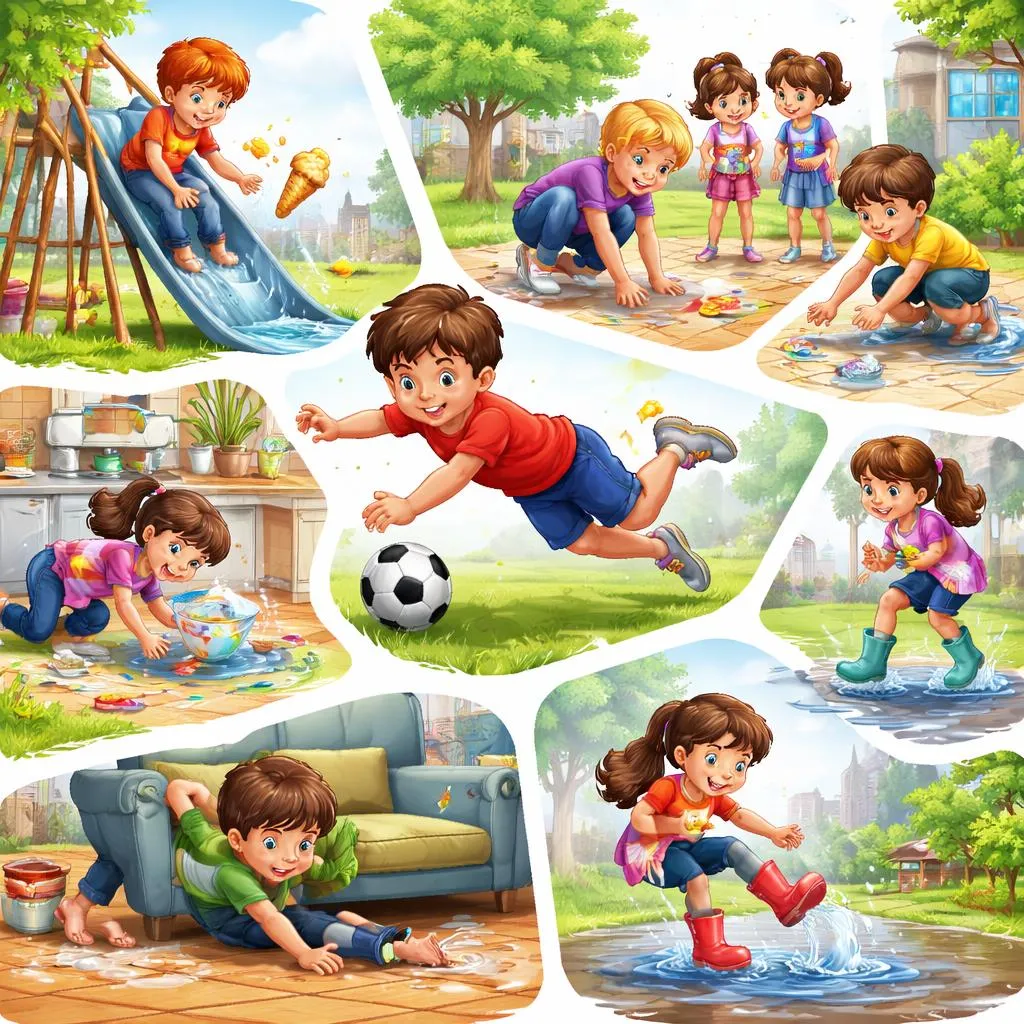
Last Saturday, Mia played at the park. She held an ice cream cone. Her hand slipped. The cone dropped to the ground. Splat! Ice cream smeared the grass. Mia felt sad. Later, Mia rode her scooter fast. She hit a bump. She fell to the pavement. Ouch! Her knee scraped. Both actions involved going down. But dropping was letting go. Falling was losing balance. Mia wondered about the difference. She asked her dad. Dad smiled and explained. Dropping is controlled. Falling is unexpected. Let’s learn together.
Word Breakdown
Core Principle
We reject boring dictionary definitions. We use pictures in your mind. We add functions and memory hooks. This helps you remember forever.
Fall To Do
Image: Imagine a leaf tumbling from a tree. It spins wildly downward. That is fall to do. It means descending without control.
Function: It is for accidental descents. Like fall off a bike. Or fall into a puddle.
Sensory Description: You hear a sudden crash. You feel surprise and pain. Your body jerks unexpectedly.
Memory Anchor: A leaf twisting in the wind. See the uncontrolled spin? That is fall to do.
Drop To Do
Image: Think of letting go of a ball. It plops straight down. That is drop to do. It means releasing something intentionally.
Function: It is for deliberate descents. Like drop a pencil. Or drop a cookie.
Sensory Description: You hear a soft thud. You feel calm and purposeful. Your hand opens gently.
Memory Anchor: A ball slipping from your palm. See the straight drop? That is drop to do.
Advanced Comparison
Fall is accidental and wild. Drop is intentional and straight. Fall happens to you. Drop is something you do. Use fall for surprises. Use drop for choices.
Scene Comparison
Scene One happens at school. Leo drops his pencil during math. It clatters on the floor. He bends to pick it up. This is drop to do—controlled release.
Scene Two takes place at recess. Emma falls from the swing. She lands in the sand. Her friends rush over. This is fall to do—unexpected tumble.
Scene Three occurs at home. Ben drops his cookie on the rug. He sighs and gets a new one. Mia falls asleep on the couch. She slumps sideways. Notice the shift. Dropping is small and calm. Falling is big and startling.
Pitfalls Deep Reminder
Mistake One is saying “I fell my backpack on the floor.” Why wrong? Backpacks are dropped intentionally. Falling is accidental. Funny result? Backpack thinks it tripped over itself. Correct phrase is I dropped my backpack on the floor. Memory trick: Drop is for letting go.
Mistake Two is saying “I dropped off my bike.” Why wrong? Bikes involve falling accidentally. Dropping is controlled. Funny result? Bike thinks you placed it gently. Correct phrase is I fell off my bike. Memory trick: Fall is for losing balance.
Mistake Three is saying “I fell the ball during dodgeball.” Why wrong? Balls are dropped on purpose. Falling is not a choice. Funny result? Ball thinks it grew legs and tripped. Correct phrase is I dropped the ball during dodgeball. Memory trick: Drop is for releasing.
Mistake Four is saying “I dropped into the pool.” Why wrong? Falling into water is accidental. Dropping is intentional. Funny result? Pool thinks you climbed in carefully. Correct phrase is I fell into the pool. Memory trick: Fall is for surprises.
Interactive Exercises
Read each sentence. Pick fall or drop.
I will ___ my spoon into the sink. (fall/drop)
She ___ off the monkey bars yesterday. (fall/drop)
We ___ our bags by the door. (fall/drop)
He ___ into the mud puddle. (fall/drop)
They ___ the remote on the carpet. (fall/drop)
Act with a friend. Use the phrases.
Scene A: Intentional Release
A: I will drop this paper airplane.
B: Aim for the target.
Scene B: Accidental Descent
A: I almost fell off the ladder.
B: Hold on tight next time.
Spot the Mistake
Which sentence sounds odd? Explain why.
Sentence: I dropped from the tree branch.
Reason: Branches involve falling. Use fall instead.
Sentence: I fell my phone on the bed.
Reason: Phones are dropped. Use drop instead.
Sentence: I dropped down the stairs.
Reason: Stairs involve falling. Use fall instead.
Create Sentences
Use both phrases.
Fall to do: I fall when I slip on ice.
Drop to do: I drop crumbs when I eat.
Bonus Challenge
You let go of a balloon. Did it fall or drop? Answer: Drop. You released it on purpose.
Rhyme Time
Fall it down, drop it down.
One trips, one lets go.
Accident? Choose fall.
On purpose? Drop to recall.
Homework Task
Pick one activity. Complete it this week. Share with family.
Option One: Observation Journal. Get a small notebook. Draw three pictures. Write a sentence under each.
Picture One: You drop something. Sentence: I dropped my crayon under the table.
Picture Two: You fall somewhere. Sentence: I fell into a pile of leaves.
Picture Three: You drop something else. Sentence: I dropped my sandwich wrapper.
Show your journal to a parent. Explain the differences.
Option Two: Role Play. With a parent, act out moments. Use phrases correctly.
You: Mom, I will drop my dirty clothes in the hamper.
Parent: Good, aim straight.
You: Dad, I almost fell on the icy step.
Parent: Walk slowly next time.
Practice until it feels natural.
Option Three: Sharing Time. Tomorrow at school, tell a friend. Describe one drop and one fall. Say: Yesterday I dropped my pencil. I fell off the curb. Ask your friend about theirs.
Life Practice
Week Challenge: Try one task. Complete within seven days. Share your success.
Task One: Observation Log. For three days, note fall and drop moments. Draw icons.
Day One: Drop a small item. Draw a hand icon.
Day Two: Fall accidentally. Draw a warning sign.
Day Three: Drop another item. Draw a crumb icon.
Show your log to your teacher. Place it on the classroom wall.
Task Two: Action Demo. Use both phrases in real actions.
Step One: Drop an object. Say: I drop this toy gently.
Step Two: Pretend to fall. Say: I fall when I lose balance.
Demonstrate to a sibling. Explain the difference.
Task Three: Social Mission. Use phrases with others.
Drop a hint to a friend. Say: I drop clues for you to guess.
Fall into laughter with a classmate. Say: We fall into giggles together.
Record a short voice message. Send it to your teacher.
Task Four: Creative Story. Write a short tale. Include both phrases.
Title: The Slippery Floor.
Story: I dropped my juice cup. Then I fell on the wet floor. What a messy day!
Share your story in class.
Remember, practice makes perfect. Use these phrases often. Soon they will feel easy.