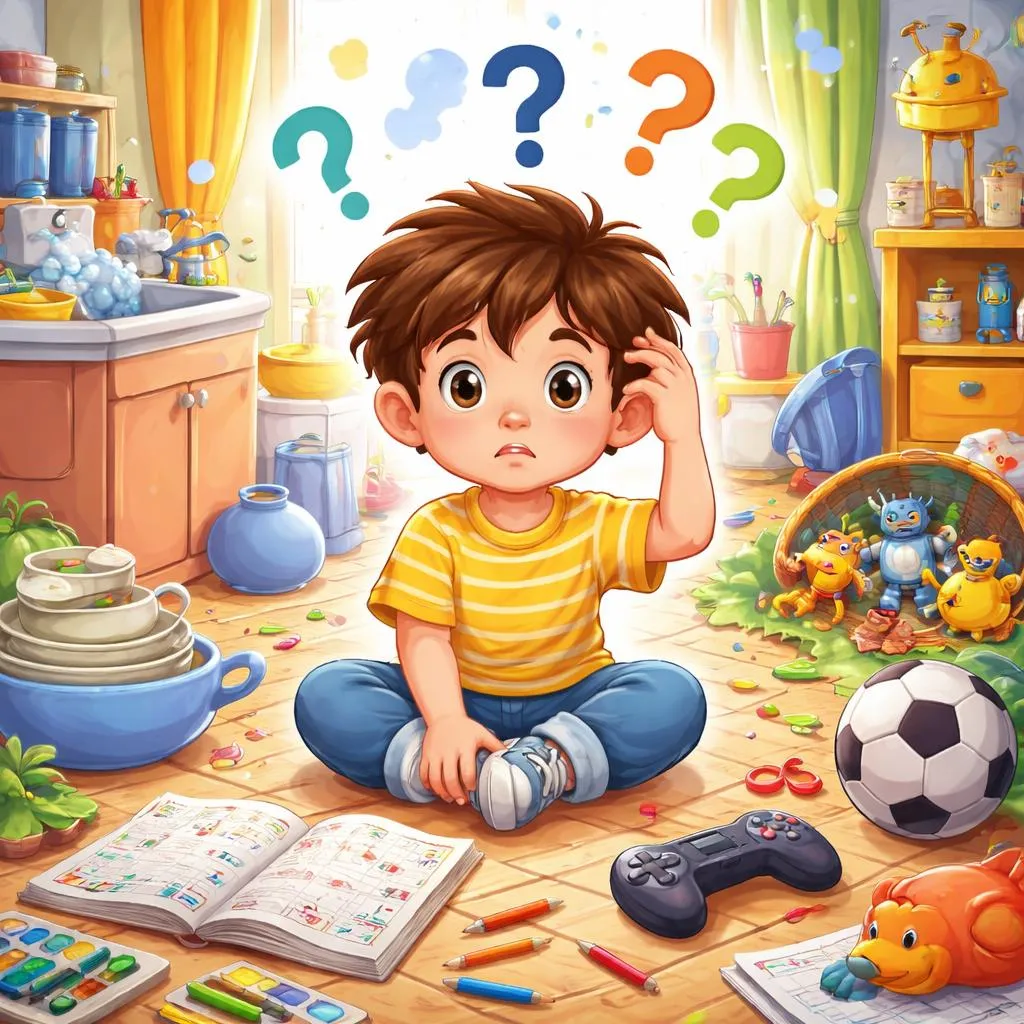

Fun Introduction
Last Wednesday, Mia tried a new puzzle. The pieces did not fit. She felt confused to put them together. Her brow wrinkled. Later, Mia saw a tricky riddle. She felt puzzled to guess the answer. Her eyes narrowed. Both felt unsure. But confused made her shrug. Puzzled made her think hard. Mia asked her dad. Dad smiled and explained. Confused is like a foggy window. Puzzled is like a locked box. Let’s learn together.
Mia turned the puzzle piece. It would not click. Then she read the riddle again. Her dad watched. He said confused feels lost. Puzzled feels curious. Mia understood now. She tried a new piece.
Word Breakdown
Core Principle
We reject boring dictionary definitions. We use pictures in your mind. We add functions and memory hooks. This helps you remember forever.
Confused To Do
Image: Imagine being confused to follow directions. You look at the map upside down. That is confused to do. It means not understanding clearly.
Function: It is for unclear instructions. Like confused to do a math problem. Or confused to find a classroom.
Sensory Description: You hear a sigh. You feel your head tilt. Your fingers fumble.
Memory Anchor: A kid holding a map sideways. See the furrowed brow? That is confused to do.
Puzzled To Do
Image: Think of being puzzled to solve a mystery. You stroke your chin. That is puzzled to do. It means wondering deeply.
Function: It is for brain teasers. Like puzzled to guess a riddle. Or puzzled to figure out a magic trick.
Sensory Description: You hear a hum. You feel your eyes squint. Your hand taps your chin.
Memory Anchor: A child pondering a riddle. See the thoughtful gaze? That is puzzled to do.
Advanced Comparison
Confused is messy and unclear. Puzzled is focused and wondering. Confused uses shrugs. Puzzled uses thinking. Use confused for not getting it. Use puzzled for trying to figure it out.
Scene Comparison
Scene One happens in class. Mia is confused to do the worksheet. She raises her hand. The teacher explains again. This is confused to do—not understanding.
Scene Two takes place at home. Mia is puzzled to solve the riddle. She writes clues on paper. She thinks hard. This is puzzled to do—deep wondering.
Scene Three occurs at the park. Ben is confused to play the new game. He watches others. Mia is puzzled to find the hidden toy. She searches the sandbox. Notice the shift. Confused needs help. Puzzled keeps trying.
Pitfalls Deep Reminder
Mistake One is saying “I was puzzled to follow the recipe.” Why wrong? Recipes need clear steps. Puzzled is for mysteries. Funny result? You add salt instead of sugar. Correct phrase is I was confused to follow it. Memory trick: Steps equal confused.
Mistake Two is saying “I was confused to guess the riddle.” Why wrong? Riddles are brain teasers. Confused is too vague. Funny result? You shrug and walk away. Correct phrase is I was puzzled to guess it. Memory trick: Brain teasers equal puzzled.
Mistake Three is saying “I was puzzled to find my classroom.” Why wrong? Finding rooms is simple. Puzzled is too intense. Funny result? You examine the door like a detective. Correct phrase is I was confused to find it. Memory trick: Simple things equal confused.
Mistake Four is saying “I was confused to solve the math mystery.” Why wrong? Math mysteries need thought. Confused is too passive. Funny result? You stare blankly. Correct phrase is I was puzzled to solve it. Memory trick: Mysteries equal puzzled.
Interactive Exercises
Read each sentence. Think of the right phrase.
I was ___ to understand the directions. (confused/puzzled)
She was ___ to guess the secret code. (confused/puzzled)
We were ___ to play the complicated game. (confused/puzzled)
He was ___ to figure out the magic trick. (confused/puzzled)
They were ___ to read the messy handwriting. (confused/puzzled)
Act with a friend. Use the phrases.
Scene A: Feeling Confused
A: I am confused to do this step.
B: Let me show you how.
Scene B: Feeling Puzzled
A: I am puzzled to solve this clue.
B: Think about what it means.
Spot the Mistake
Which sentence sounds odd? Explain why.
Sentence: I was puzzled to tie my shoes.
Reason: Shoes are simple. Use confused instead.
Sentence: I was confused to solve the crossword.
Reason: Crosswords are puzzles. Use puzzled instead.
Sentence: I was puzzled to follow the bus route.
Reason: Routes are clear. Use confused instead.
Create Sentences
Use both phrases.
Confused to do: I am confused to do my homework.
Puzzled to do: I am puzzled to guess the answer.
Bonus Challenge
You see a strange machine with buttons. Do you feel confused or puzzled? Answer: Puzzled. You want to figure it out.
Rhyme Time
Confused shrugs, puzzled thinks.
One blinks, one winks.
Not get it? Choose confused.
Wonder why? Puzzled, amused.
Homework Task
Pick one activity. Complete it this week. Share with family.
Option One: Observation Journal. Get a small notebook. Draw three pictures. Write a sentence under each.
Picture One: You feel confused. Sentence: I was confused to do the science project.
Picture Two: You feel puzzled. Sentence: I was puzzled to guess the riddle.
Picture Three: You feel confused. Sentence: I was confused to follow the map.
Show your journal to a parent. Explain the differences.
Option Two: Role Play. With a parent, act out moments. Use phrases correctly.
You: Mom, I am confused to set the table.
Parent: Put the fork on the left.
You: Dad, I am puzzled to solve this puzzle.
Parent: Look for the edge pieces first.
Practice until it feels natural.
Option Three: Sharing Time. Tomorrow at school, tell a friend. Describe one confused and one puzzled. Say: Yesterday I was confused to play soccer. I was puzzled to find my lost toy. Ask your friend about theirs.
Life Practice
Week Challenge: Try one task. Complete within seven days. Share your success.
Task One: Observation Log. For three days, note confused and puzzled moments. Draw icons.
Day One: Confused moment. Draw a question mark.
Day Two: Puzzled moment. Draw a thinking face.
Day Three: Confused moment. Draw a shrugging stick figure.
Show your log to your teacher. Place it on the classroom wall.
Task Two: Action Demo. Use both phrases in real actions.
Step One: Show confused softly. Say: I am confused to do this.
Step Two: Show puzzled deeply. Say: I am puzzled to understand this.
Demonstrate to a sibling. Explain the difference.
Task Three: Social Mission. Use phrases with others.
Feel confused to help a friend. Say: I am confused to explain this.
Feel puzzled to help a friend. Say: I am puzzled to solve this problem.
Record a short voice message. Send it to your teacher.
Task Four: Creative Story. Write a short tale. Include both phrases.
Title: The Mixed-Up Day.
Story: I was confused to find my way. Then I was puzzled to see a clue. I solved it with dad.
Share your story in class.
Remember, practice makes perfect. Use these phrases often. Soon they will feel easy.