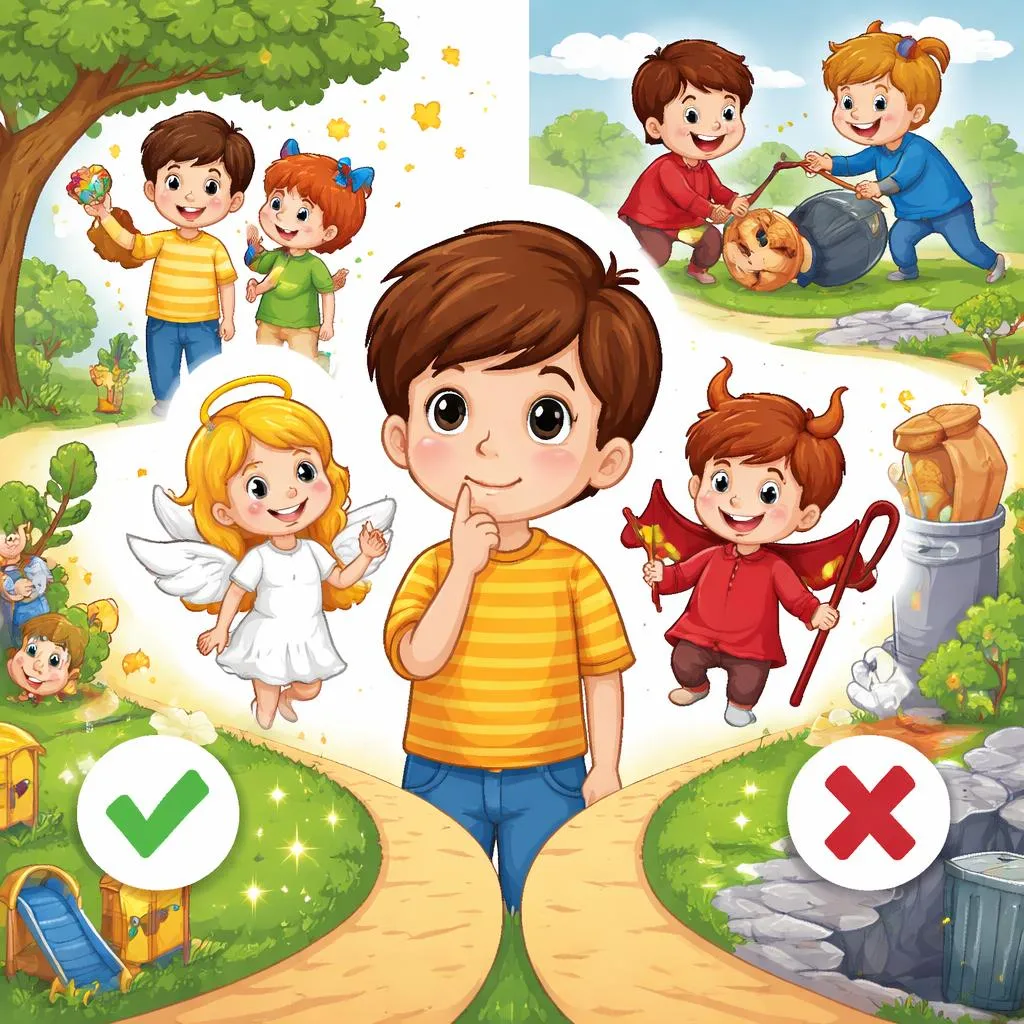

Fun Introduction
Last Thursday, Leo faced a big choice. He found a wallet on the playground. He felt right to return it. His heart felt light. Later, Leo saw a candy bar. He felt wrong to take it without paying. His tummy twisted. Both feelings guided him. But right made him stand tall. Wrong made him slump. Leo asked his dad. Dad smiled and explained. Right is like a green light. Wrong is like a red light. Let’s learn together.
Leo ran to the office. He handed the wallet over. The secretary smiled. Then he put the candy back. His dad watched. He said right builds trust. Wrong breaks trust. Leo understood now. He skipped home.
Word Breakdown
Core Principle
We reject boring dictionary definitions. We use pictures in your mind. We add functions and memory hooks. This helps you remember forever.
Right To Do
Image: Imagine being right to tell the truth. You look straight ahead. That is right to do. It means making a good choice.
Function: It is for honest actions. Like right to share fairly. Or right to help others.
Sensory Description: You hear praise. You feel your chest expand. Your head lifts up.
Memory Anchor: A child returning a lost item. See the bright smile? That is right to do.
Wrong To Do
Image: Think of being wrong to cheat on a test. You glance sideways. That is wrong to do. It means making a bad choice.
Function: It is for dishonest actions. Like wrong to steal candy. Or wrong to lie.
Sensory Description: You hear silence. You feel a heavy weight. Your eyes look down.
Memory Anchor: A child hiding a stolen toy. See the guilty frown? That is wrong to do.
Advanced Comparison
Right is bright and honest. Wrong is dark and sneaky. Right builds character. Wrong damages it. Use right for moral choices. Use wrong for immoral choices.
Scene Comparison
Scene One happens at school. Leo is right to admit his mistake. He tells the teacher. She nods. This is right to do—honest action.
Scene Two takes place at the store. Leo is wrong to pocket a gum. He looks around nervously. This is wrong to do—dishonest action.
Scene Three occurs at home. Mia is right to clean her room. She puts toys away. Her mom hugs her. Mia is wrong to blame her brother. She sees his sad face. Notice the shift. Right feels proud. Wrong feels heavy.
Pitfalls Deep Reminder
Mistake One is saying “I was wrong to help my grandma.” Why wrong? Helping is right. Wrong is for bad actions. Funny result? You get scolded for being kind. Correct phrase is I was right to help her. Memory trick: Helpful equals right.
Mistake Two is saying “I was right to break the window.” Why wrong? Breaking is wrong. Right is for good actions. Funny result? You get rewarded for causing damage. Correct phrase is I was wrong to break it. Memory trick: Damaging equals wrong.
Mistake Three is saying “I was wrong to say please.” Why wrong? Please is polite. Wrong is for rude actions. Funny result? People think you are rude. Correct phrase is I was right to say it. Memory trick: Polite equals right.
Mistake Four is saying “I was right to take the toy without asking.” Why wrong? Taking without permission is wrong. Right is for respectful actions. Funny result? You get praised for stealing. Correct phrase is I was wrong to take it. Memory trick: Disrespectful equals wrong.
Interactive Exercises
Read each sentence. Think of the right phrase.
I was ___ to share my lunch. (right/wrong)
She was ___ to copy her friend’s answers. (right/wrong)
We were ___ to wait for our turn. (right/wrong)
He was ___ to push the little kid. (right/wrong)
They were ___ to tell the truth. (right/wrong)
Act with a friend. Use the phrases.
Scene A: Feeling Right
A: I am right to help you carry that.
B: Thank you for doing the right thing.
Scene B: Feeling Wrong
A: I was wrong to eat your cookie.
B: Please ask next time.
Spot the Mistake
Which sentence sounds odd? Explain why.
Sentence: I was wrong to hold the door open.
Reason: Holding door is right. Use right instead.
Sentence: I was right to steal the pencil.
Reason: Stealing is wrong. Use wrong instead.
Sentence: I was wrong to say sorry.
Reason: Saying sorry is right. Use right instead.
Create Sentences
Use both phrases.
Right to do: I am right to listen to my teacher.
Wrong to do: I was wrong to ignore my friend.
Bonus Challenge
You find money on the ground. Do you feel right or wrong? Answer: Right. You return it.
Rhyme Time
Right shines bright, wrong brings night.
One feels right, one feels tight.
Good choice? Choose right.
Bad choice? Wrong, lose the light.
Homework Task
Pick one activity. Complete it this week. Share with family.
Option One: Observation Journal. Get a small notebook. Draw three pictures. Write a sentence under each.
Picture One: You feel right. Sentence: I was right to help dad wash the car.
Picture Two: You feel wrong. Sentence: I was wrong to forget my homework.
Picture Three: You feel right. Sentence: I was right to share my crayons.
Show your journal to a parent. Explain the differences.
Option Two: Role Play. With a parent, act out moments. Use phrases correctly.
You: Mom, I was right to tell the truth.
Parent: That makes me proud.
You: Dad, I was wrong to track mud inside.
Parent: Next time wipe your shoes.
Practice until it feels natural.
Option Three: Sharing Time. Tomorrow at school, tell a friend. Describe one right and one wrong. Say: Yesterday I was right to help Leo. I was wrong to yell. Ask your friend about theirs.
Life Practice
Week Challenge: Try one task. Complete within seven days. Share your success.
Task One: Observation Log. For three days, note right and wrong moments. Draw icons.
Day One: Right moment. Draw a green light.
Day Two: Wrong moment. Draw a red light.
Day Three: Right moment. Draw a thumbs up.
Show your log to your teacher. Place it on the classroom wall.
Task Two: Action Demo. Use both phrases in real actions.
Step One: Show right proudly. Say: I am right to do this.
Step Two: Show wrong regretfully. Say: I was wrong to do that.
Demonstrate to a sibling. Explain the difference.
Task Three: Social Mission. Use phrases with others.
Feel right to help a friend. Say: I am right to stand by you.
Feel wrong to help a friend. Say: I was wrong to leave you out.
Record a short voice message. Send it to your teacher.
Task Four: Creative Story. Write a short tale. Include both phrases.
Title: The Lost Wallet.
Story: I was right to return the wallet. Then I was wrong to take a coin. Dad taught me.
Share your story in class.
Remember, practice makes perfect. Use these phrases often. Soon they will feel easy.