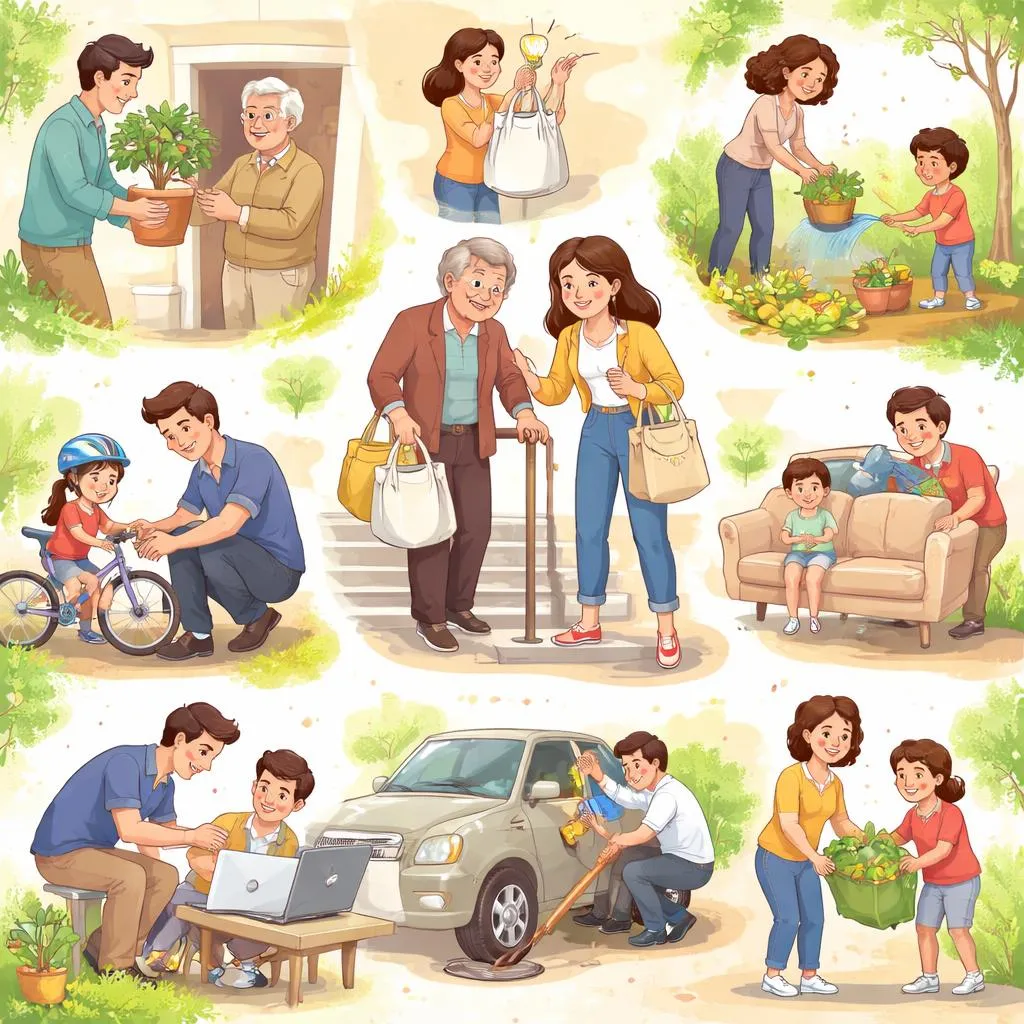

Fun Introduction
Last Saturday, Mia helped her mom bake cookies. She measured flour and cracked eggs. Her mom smiled at her work. Later, Mia assisted her dad in the garden. She held the watering can carefully. Dad planted flowers nearby. Both actions supported others. But helping felt like joining in. Assisting felt like lending a hand. Let’s explore the difference.
Word Breakdown
Core Principle
We reject boring dictionary definitions. We use pictures in your mind. We add functions and memory hooks. This helps you remember forever.
Help To Do
Image: Imagine carrying grocery bags with your grandma. You share the weight. That is help to do. It means giving support freely and actively.
Function: It is for direct participation. Like help wash the car. Or help clean your room.
Sensory Description: You feel busy and useful. You hear teamwork sounds. Your hands move with purpose.
Memory Anchor: Two people carrying a heavy box together. See the shared effort? That is help to do.
Assist To Do
Image: Think of holding a ladder for a painter. You stand steady and watch. That is assist to do. It means providing aid without taking over.
Function: It is for supportive roles. Like assist a teacher with papers. Or assist a coach during practice.
Sensory Description: You feel alert and ready. You see others succeed. Your presence enables their work.
Memory Anchor: A person steadying a ladder for someone climbing. See the careful support? That is assist to do.
Advanced Comparison
Help is active and involved. Assist is supportive and enabling. Help joins the main action. Assist supports from the side. Use help for shared tasks. Use assist for backup roles.
Scene Comparison
Scene One happens at home. Leo helps his sister build a LEGO castle. He snaps blocks together. They laugh at wobbly towers. This is help to do—active participation.
Scene Two takes place in the classroom. Emma assists the teacher with attendance. She passes out papers quietly. The teacher nods thanks. This is assist to do—supportive aid.
Scene Three occurs at the park. Ben helps his friend fly a kite. He runs to launch it. Later, he assists a younger child to reach the swing. He pushes gently. Notice the shift. Helping shares the fun. Assisting enables others.
Pitfalls Deep Reminder
Mistake One is saying “I assisted my dad paint the fence.” Why wrong? Painting is active help. Assisting is holding tools or steadying. Funny result? Dad expects you to just watch. Correct phrase is help my dad paint the fence. Memory trick: Help is for doing together.
Mistake Two is saying “I helped the coach during tryouts.” Why wrong? Tryouts need assisting with organization. Helping implies playing. Funny result? Coach thinks you want to join the team. Correct phrase is assist the coach during tryouts. Memory trick: Assist is for supporting roles.
Mistake Three is saying “I assisted my little brother with his homework.” Why wrong? Homework needs helping with answers. Assisting is too passive. Funny result? Brother stays stuck on every question. Correct phrase is help my little brother with his homework. Memory trick: Help is for active guidance.
Mistake Four is saying “I helped the librarian shelve books.” Why wrong? Shelving books is assisting the librarian. Helping would mean organizing the whole library. Funny result? Librarian thinks you want to rearrange everything. Correct phrase is assist the librarian shelve books. Memory trick: Assist is for specific support.
Interactive Exercises
Read each sentence. Pick help or assist.
I ___ my grandma carry groceries. (help/assist)
She ___ the nurse with patient files. (help/assist)
We ___ the team win the championship. (help/assist)
He ___ his neighbor fix a flat tire. (help/assist)
They ___ the director with stage props. (help/assist)
Act with a friend. Use the phrases.
Scene A: Active Participation
A: I will ___ you build this model rocket.
B: Great, let’s glue the fins first.
Scene B: Supportive Aid
A: I will ___ you while you climb the rope.
B: Thanks, just keep the rope steady.
Spot the Mistake
Which sentence sounds odd? Explain why.
Sentence: I assisted my mom cook dinner.
Reason: Cooking is active help. Use help instead.
Sentence: I helped the receptionist answer phones.
Reason: Answering phones is assisting. Use assist instead.
Sentence: We assisted the team score goals.
Reason: Scoring goals is active help. Use help instead.
Create Sentences
Use both phrases.
Help to do: I help my dad wash the car.
Assist to do: I assist my teacher collect homework.
Bonus Challenge
Your friend is struggling with a heavy box. Do you help or assist? Answer: Help. You join in carrying it.
Rhyme Time
Help it do, assist it be.
One works with, one lets you see.
Shared task? Choose help.
Support role? Assist to keep.
Homework Task
Pick one activity. Complete it this week. Share with family.
Option One: Observation Journal. Get a small notebook. Draw three pictures. Write a sentence under each.
Picture One: You help someone. Sentence: I helped my sister set the table.
Picture Two: You assist someone. Sentence: I assisted my coach with equipment.
Picture Three: You help someone else. Sentence: I helped my neighbor rake leaves.
Show your journal to a parent. Explain the differences.
Option Two: Role Play. With a parent, act out moments. Use phrases correctly.
You: Mom, I will help you fold laundry.
Parent: Good, match the socks together.
You: Dad, I will assist you with the grill.
Parent: Just hand me the tongs when I need them.
Practice until it feels natural.
Option Three: Sharing Time. Tomorrow at school, tell a friend. Describe one help and one assist. Say: Yesterday I helped my friend with math. I assisted the librarian. Ask your friend about theirs.
Life Practice
Week Challenge: Try one task. Complete within seven days. Share your success.
Task One: Observation Log. For three days, note help and assist moments. Draw icons.
Day One: Help with dishes. Draw a sponge icon.
Day Two: Assist with recycling. Draw a bin icon.
Day Three: Help with pet care. Draw a bone icon.
Show your log to your teacher. Place it on the classroom wall.
Task Two: Action Demo. Use both phrases in real actions.
Step One: Join in a shared task. Say: I help you with this.
Step Two: Provide supportive aid. Say: I assist you by holding this.
Demonstrate to a sibling. Explain the difference.
Task Three: Social Mission. Use phrases with others.
Help a friend carry books. Say: I helped you with your heavy load!
Assist a classmate during a project. Say: I assisted you by finding supplies.
Record a short voice message. Send it to your teacher.
Task Four: Creative Story. Write a short tale. Include both phrases.
Title: The Helpful Day.
Story: I helped my mom bake a cake. Then I assisted my dad with yard work. What a great day!
Share your story in class.
Remember, practice makes perfect. Use these phrases often. Soon they will feel easy.