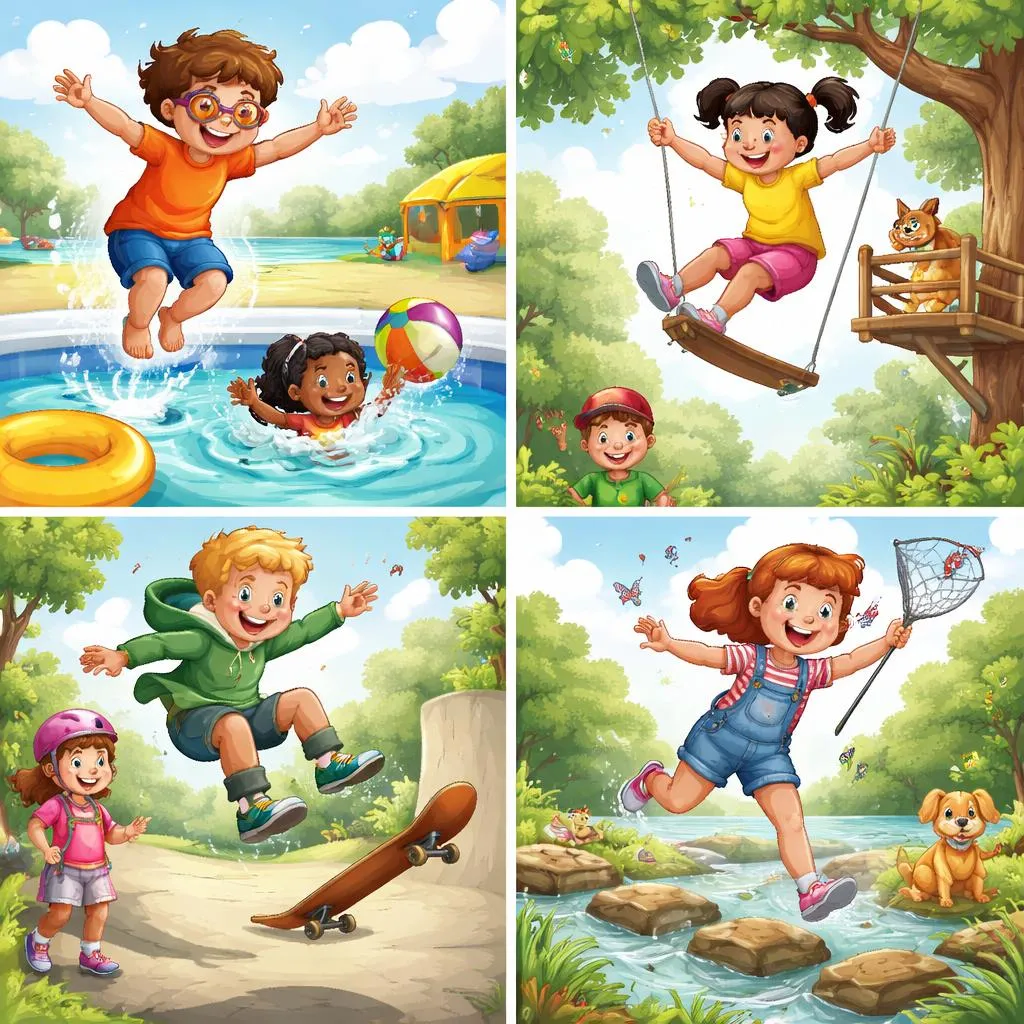

Fun Introduction
Last Saturday, Mia played at the park. She saw a small puddle. She jumped to avoid getting wet. Her feet barely left the ground. Later, Mia saw a big trampoline. She leaped high into the air. Her arms waved wildly. Both actions made her go up. But jumping was quick and small. Leaping was big and powerful. Mia laughed with joy. She asked her dad about the difference. Dad smiled and explained. Jumping is for short hops. Leaping is for big bounds. Let’s learn together.
Word Breakdown
Core Principle
We reject boring dictionary definitions. We use pictures in your mind. We add functions and memory hooks. This helps you remember forever.
Jump To Do
Image: Imagine a frog hopping quickly. It bounces off lily pads. That is jump to do. It means a small, quick upward move.
Function: It is for short, light actions. Like jump to grab a low toy. Or jump to skip a crack.
Sensory Description: You feel light and fast. You hear a soft tap. Your feet touch down quickly.
Memory Anchor: A frog hopping on one leg. See the tiny bounce? That is jump to do.
Leap To Do
Image: Think of a kangaroo bounding high. It soars over fences. That is leap to do. It means a big, powerful upward move.
Function: It is for large, energetic actions. Like leap to catch a frisbee. Or leap to reach a high shelf.
Sensory Description: You feel strong and soaring. You hear a loud thump. Your body stretches fully.
Memory Anchor: A kangaroo jumping with both feet. See the huge bound? That is leap to do.
Advanced Comparison
Jump is small and quick. Leap is big and powerful. Jump uses little energy. Leap uses lots of strength. Use jump for tiny hops. Use leap for giant bounds.
Scene Comparison
Scene One happens at school. Leo jumps to reach a book. It sits on a low shelf. He taps it with his fingertips. This is jump to do—small effort.
Scene Two takes place at recess. Emma leaps to catch a ball. It flies high overhead. She stretches her arms fully. This is leap to do—big effort.
Scene Three occurs at home. Ben jumps over a crack. It runs along the sidewalk. His feet barely clear it. Mia leaps onto her bed. She bounces on the soft mattress. Notice the shift. Jumping is casual. Leaping is exciting.
Pitfalls Deep Reminder
Mistake One is saying “I leaped over the tiny puddle.” Why wrong? Puddles need small jumps. Leaping is too dramatic. Funny result? Puddle thinks it is a lake. Correct phrase is I jumped over the tiny puddle. Memory trick: Jump is for small obstacles.
Mistake Two is saying “I jumped across the wide stream.” Why wrong? Streams need big leaps. Jumping is too small. Funny result? Stream thinks you tiptoed. Correct phrase is I leaped across the wide stream. Memory trick: Leap is for big gaps.
Mistake Three is saying “I leaped to pick up my pencil.” Why wrong? Pencils need small jumps. Leaping is too much. Funny result? Pencil thinks it is a trophy. Correct phrase is I jumped to pick up my pencil. Memory trick: Jump is for quick motions.
Mistake Four is saying “I jumped to reach the top shelf.” Why wrong? Top shelves need big leaps. Jumping is too low. Funny result? Shelf stays out of reach. Correct phrase is I leaped to reach the top shelf. Memory trick: Leap is for high goals.
Interactive Exercises
Read each sentence. Pick jump or leap.
I will ___ to grab my fallen eraser. (jump/leap)
She ___ to catch the flying balloon. (jump/leap)
We ___ over the small garden hose. (jump/leap)
He ___ onto the high diving board. (jump/leap)
They ___ to avoid the sprinkler spray. (jump/leap)
Act with a friend. Use the phrases.
Scene A: Small Jump
A: I will jump to touch the wall.
B: Bend your knees slightly.
Scene B: Big Leap
A: I need to leap to reach the branch.
B: Swing your arms up high.
Spot the Mistake
Which sentence sounds odd? Explain why.
Sentence: I leaped to step over the tiny ant.
Reason: Ants need small jumps. Use jump instead.
Sentence: I jumped to cross the huge ditch.
Reason: Ditches need big leaps. Use leap instead.
Sentence: I leaped to get my sock from the floor.
Reason: Socks need small jumps. Use jump instead.
Create Sentences
Use both phrases.
Jump to do: I jump to skip the cracks.
Leap to do: I leap to catch the ball.
Bonus Challenge
You see a small rock. Do you jump or leap over it? Answer: Jump. It is tiny.
Rhyme Time
Jump it small, leap it tall.
One bounces quick, one gives a call.
Short hop? Choose jump.
High bound? Leap to enthrall.
Homework Task
Pick one activity. Complete it this week. Share with family.
Option One: Observation Journal. Get a small notebook. Draw three pictures. Write a sentence under each.
Picture One: You jump to do something. Sentence: I jumped over a puddle.
Picture Two: You leap to do something. Sentence: I leaped for the ball.
Picture Three: You jump to do something else. Sentence: I jumped to reach the shelf.
Show your journal to a parent. Explain the differences.
Option Two: Role Play. With a parent, act out moments. Use phrases correctly.
You: Mom, I will jump to get my toy.
Parent: Land softly on your toes.
You: Dad, I will leap to touch the ceiling.
Parent: Use all your strength.
Practice until it feels natural.
Option Three: Sharing Time. Tomorrow at school, tell a friend. Describe one jump and one leap. Say: Yesterday I jumped over a crack. I leaped for the frisbee. Ask your friend about theirs.
Life Practice
Week Challenge: Try one task. Complete within seven days. Share your success.
Task One: Observation Log. For three days, note jump and leap moments. Draw icons.
Day One: Jump to avoid. Draw a puddle icon.
Day Two: Leap to catch. Draw a ball icon.
Day Three: Jump to reach. Draw a shelf icon.
Show your log to your teacher. Place it on the classroom wall.
Task Two: Action Demo. Use both phrases in real actions.
Step One: Jump lightly. Say: I jump to clear this gap.
Step Two: Leap powerfully. Say: I leap to grab that bar.
Demonstrate to a sibling. Explain the difference.
Task Three: Social Mission. Use phrases with others.
Jump to help a friend. Say: I jump to pass you the marker.
Leap to encourage a classmate. Say: I leap to cheer for your goal.
Record a short voice message. Send it to your teacher.
Task Four: Creative Story. Write a short tale. Include both phrases.
Title: The Great Hopper.
Story: I jumped over logs in the forest. Then I leaped across the stream. What fun!
Share your story in class.
Remember, practice makes perfect. Use these phrases often. Soon they will feel easy.