
Fun Introduction
Last Saturday, Mia built a tall tower with blocks. She lifted a big red block carefully. Her arms worked hard to pick it up. Later, Mia raised a small flag on her castle. She moved it higher and higher. Both actions moved things up. But lifting was about picking up. Raising was about making higher. Mia wondered about the difference. She asked her dad. Dad smiled and explained. Lifting uses your strength. Raising changes the height. Let’s learn together.
Word Breakdown
Core Principle
We reject boring dictionary definitions. We use pictures in your mind. We add functions and memory hooks. This helps you remember forever.
Lift To Do
Image: Imagine picking up a heavy backpack. Your hands grip the straps tight. That is lift to do. It means using strength to pick something up.
Function: It is for moving things upward. Like lift a box off the floor. Or lift a friend over a puddle.
Sensory Description: You feel your muscles strain. You hear a grunt. Your feet plant firmly.
Memory Anchor: A weightlifter holding a barbell. See the strong arms? That is lift to do.
Raise To Do
Image: Think of raising a window shade. Your hand pulls the cord smoothly. That is raise to do. It means moving something to a higher position.
Function: It is for elevating things gently. Like raise a flag on a pole. Or raise your hand in class.
Sensory Description: You feel a smooth motion. You hear a soft slide. Your arm moves steadily.
Memory Anchor: A hand raising a flag. See the steady climb? That is raise to do.
Advanced Comparison
Lift uses strength to pick up. Raise uses motion to elevate. Lift is about the effort. Raise is about the height. Use lift for heavy things. Use raise for positioning things.
Scene Comparison
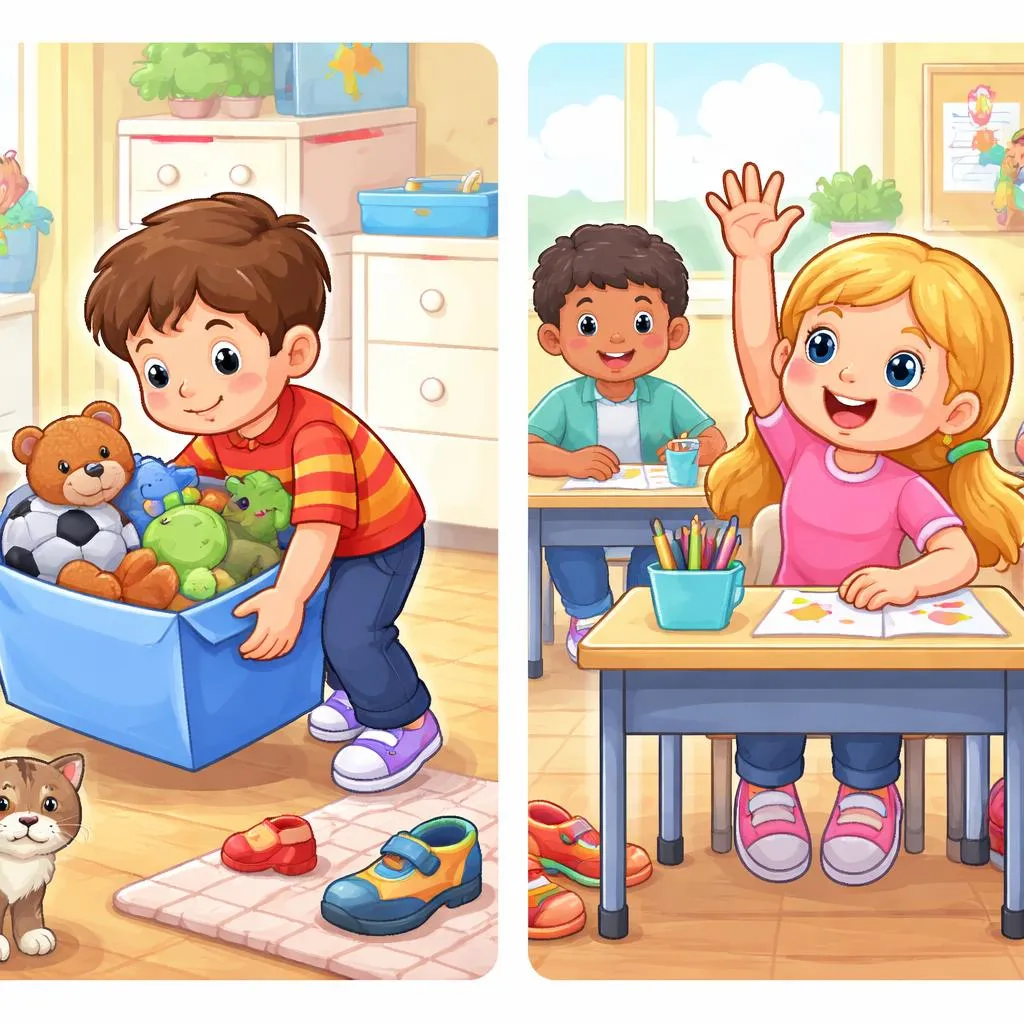
Scene One happens in the bedroom. Leo lifts his heavy backpack onto his shoulders. He grunts with effort. This is lift to do—using strength.
Scene Two takes place in the classroom. Emma raises her hand to answer a question. She holds it up high. This is raise to do—moving higher.
Scene Three occurs at the park. Ben lifts his little sister over a puddle. He bends and lifts. Mia raises a kite into the wind. She lets it climb. Notice the shift. Lifting is effortful. Raising is elevating.
Pitfalls Deep Reminder
Mistake One is saying “I raised the heavy box onto the shelf.” Why wrong? Heavy boxes need lifting. Raising is too gentle. Funny result? Box crashes down. Correct phrase is I lifted the heavy box onto the shelf. Memory trick: Lift heavy things.
Mistake Two is saying “I lifted the flag to the top of the pole.” Why wrong? Flags need raising smoothly. Lifting is too jerky. Funny result? Flag gets tangled. Correct phrase is I raised the flag to the top. Memory trick: Raise flags and shades.
Mistake Three is saying “I raised my little brother into my arms.” Why wrong? Brothers need lifting with strength. Raising is too soft. Funny result? Brother slips. Correct phrase is I lifted my little brother into my arms. Memory trick: Lift people and pets.
Mistake Four is saying “I lifted my voice to speak louder.” Why wrong? Voice needs raising to be heard. Lifting is physical. Funny result? Voice sounds like a grunt. Correct phrase is I raised my voice to speak louder. Memory trick: Raise volume and levels.
Interactive Exercises
Read each sentence. Pick lift or raise.
I will ___ the bucket of water carefully. (lift/raise)
She ___ her hand to ask a question. (lift/raise)
We ___ the fallen branches off the path. (lift/raise)
He ___ the curtain to let in sunlight. (lift/raise)
They ___ the trophy above their heads. (lift/raise)
Act with a friend. Use the phrases.
Scene A: Strong Lifting
A: I need to lift this box now.
B: Use your legs, not your back.
Scene B: Smooth Raising
A: I will raise the window shade.
B: Let the light shine in.
Spot the Mistake
Which sentence sounds odd? Explain why.
Sentence: I raised the heavy suitcase onto the bed.
Reason: Suitcases need lifting. Use lift instead.
Sentence: I lifted the flag during the ceremony.
Reason: Flags need raising. Use raise instead.
Sentence: I raised my little sister onto my shoulders.
Reason: Sisters need lifting. Use lift instead.
Create Sentences
Use both phrases.
Lift to do: I lift my backpack every morning.
Raise to do: I raise my hand in class.
Bonus Challenge
You need to get a cat off the floor. Do you lift or raise it? Answer: Lift. Cats need picking up.
Rhyme Time
Lift it up with all your might.
Raise it high to reach the light.
Heavy load? Choose lift.
Higher place? Raise as a gift.
Homework Task
Pick one activity. Complete it this week. Share with family.
Option One: Observation Journal. Get a small notebook. Draw three pictures. Write a sentence under each.
Picture One: You lift something. Sentence: I lifted the heavy box for mom.
Picture Two: You raise something. Sentence: I raised the flag at school.
Picture Three: You lift something else. Sentence: I lifted my little brother.
Show your journal to a parent. Explain the differences.
Option Two: Role Play. With a parent, act out moments. Use phrases correctly.
You: Mom, I will lift the groceries now.
Parent: Good, be careful with the eggs.
You: Dad, I will raise the garage door.
Parent: Press the button gently.
Practice until it feels natural.
Option Three: Sharing Time. Tomorrow at school, tell a friend. Describe one lift and one raise. Say: Yesterday I lifted my backpack. I raised my hand to answer. Ask your friend about theirs.
Life Practice
Week Challenge: Try one task. Complete within seven days. Share your success.
Task One: Observation Log. For three days, note lift and raise moments. Draw icons.
Day One: Lift a chair. Draw a chair icon.
Day Two: Raise a blind. Draw a window icon.
Day Three: Lift a pet. Draw a paw icon.
Show your log to your teacher. Place it on the classroom wall.
Task Two: Action Demo. Use both phrases in real actions.
Step One: Lift strongly. Say: I lift to move heavy things.
Step Two: Raise smoothly. Say: I raise to adjust positions.
Demonstrate to a sibling. Explain the difference.
Task Three: Social Mission. Use phrases with others.
Lift to help a friend. Say: I lift your bag for you.
Raise to help a friend. Say: I raise the blind so you see.
Record a short voice message. Send it to your teacher.
Task Four: Creative Story. Write a short tale. Include both phrases.
Title: The Strong Helper.
Story: I lifted the heavy box for grandma. Then I raised the flag at the park. What a helper!
Share your story in class.
Remember, practice makes perfect. Use these phrases often. Soon they will feel easy.