
Fun Introduction
Last Sunday, Mia helped her mom bake cookies. She measured flour with a cup. The cup had marks. Later, Mia weighed the dough on a scale. The scale showed numbers. Both actions used tools. But measuring checked size. Weighing checked heaviness. Mia wondered about the difference. She asked her dad. Dad smiled and explained. Measuring finds length or volume. Weighing finds how heavy. Let’s learn together.
Mia felt excited in the kitchen. She wore a small apron. Flour dusted her nose. She measured milk carefully. Then she weighed the butter. The scale clicked. Her dad nodded. He said measuring is for amounts. Weighing is for weight. Mia understood now.
Word Breakdown
Core Principle
We reject boring dictionary definitions. We use pictures in your mind. We add functions and memory hooks. This helps you remember forever.
Measure To Do
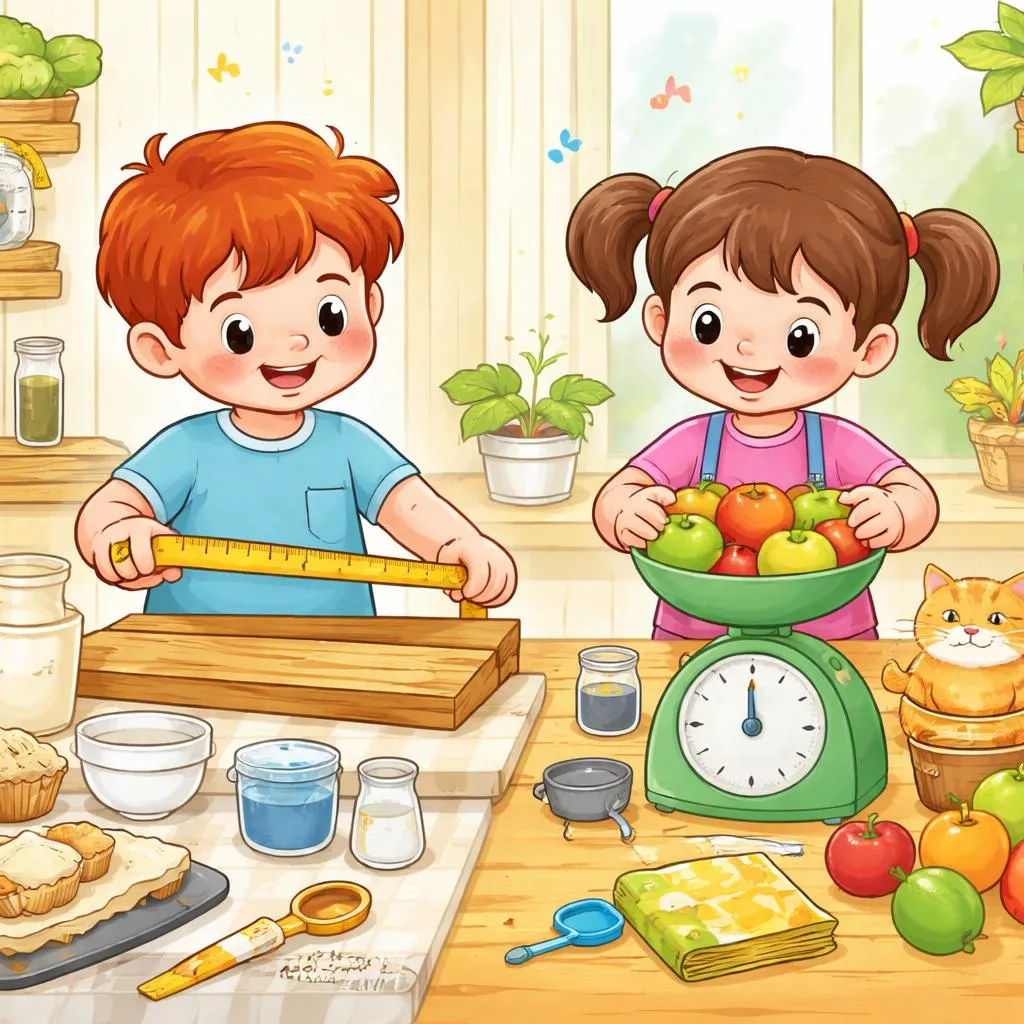
Image: Imagine measuring a ribbon with a ruler. You see numbers along the edge. That is measure to do. It means finding size or length.
Function: It is for checking dimensions. Like measure a table. Or measure water.
Sensory Description: You see clear markings. You hear a soft click. Your fingers touch the tool.
Memory Anchor: A ruler with inch marks. See the numbers? That is measure to do.
Weigh To Do
Image: Think of weighing apples on a scale. The needle moves down. That is weigh to do. It means finding heaviness.
Function: It is for checking mass. Like weigh a backpack. Or weigh ingredients.
Sensory Description: You feel pressure on the pan. You hear a beep. Your hands sense the weight.
Memory Anchor: A scale with a digital display. See the digits? That is weigh to do.
Advanced Comparison
Measure checks size or volume. Weigh checks heaviness. Measure uses rulers or cups. Weigh uses scales. Use measure for length. Use weigh for weight.
Scene Comparison
Scene One happens in the kitchen. Leo measures flour for pancakes. He uses a measuring cup. The cup fills to the line. This is measure to do—checking volume.
Scene Two takes place on the playground. Emma weighs her backpack before a hike. She puts it on a scale. The scale shows five pounds. This is weigh to do—checking weight.
Scene Three occurs at school. Ben measures his desk with a ruler. He finds it sixty centimeters. Mia weighs her stack of books. She uses a small scale. Notice the shift. Measuring is about size. Weighing is about mass.
Pitfalls Deep Reminder
Mistake One is saying “I weighed the ribbon for my gift.” Why wrong? Ribbon needs measuring. Weighing is for heavy things. Funny result? Ribbon gets crushed. Correct phrase is I measured the ribbon. Memory trick: Weigh heavy objects.
Mistake Two is saying “I measured my dog’s weight.” Why wrong? Weight needs weighing. Measuring is for size. Funny result? Dog thinks it is a ruler. Correct phrase is I weighed my dog. Memory trick: Measure length or volume.
Mistake Three is saying “I weighed the paper for my art project.” Why wrong? Paper needs measuring. Weighing might tear it. Funny result? Paper rips. Correct phrase is I measured the paper. Memory trick: Weigh solid items.
Mistake Four is saying “I measured the potatoes for the stew.” Why wrong? Potatoes need weighing. Measuring is not accurate. Funny result? Stew lacks flavor. Correct phrase is I weighed the potatoes. Memory trick: Weigh food ingredients.
Interactive Exercises
Read each sentence. Pick measure or weigh.
I will ___ the sugar for the cake. (measure/weigh)
She ___ the length of her jump. (measure/weigh)
We ___ the apples at the market. (measure/weigh)
He ___ the water in the jug. (measure/weigh)
They ___ the suitcase before flying. (measure/weigh)
Act with a friend. Use the phrases.
Scene A: Measuring Carefully
A: I need to measure this now.
B: Line up the zero mark.
Scene B: Weighing Accurately
A: I will weigh this gently.
B: Place it in the center.
Spot the Mistake
Which sentence sounds odd? Explain why.
Sentence: I weighed the ribbon to wrap the gift.
Reason: Ribbon is measured. Use measure instead.
Sentence: I measured the dog to see if he gained weight.
Reason: Weight is weighed. Use weigh instead.
Sentence: I weighed the paper for my drawing.
Reason: Paper is measured. Use measure instead.
Create Sentences
Use both phrases.
Measure to do: I measure my room to buy a rug.
Weigh to do: I weigh my lunchbox to pack snacks.
Bonus Challenge
You have a bag of rice. You want to know how heavy. Do you measure or weigh? Answer: Weigh. You check heaviness.
Rhyme Time
Measure the length, weigh the load.
One checks size, one checks the road.
How long? Choose measure.
How heavy? Weigh, that is the code.
Homework Task
Pick one activity. Complete it this week. Share with family.
Option One: Observation Journal. Get a small notebook. Draw three pictures. Write a sentence under each.
Picture One: You measure something. Sentence: I measured the table for a new cloth.
Picture Two: You weigh something. Sentence: I weighed my backpack for school.
Picture Three: You measure something else. Sentence: I measured the water for my plant.
Show your journal to a parent. Explain the differences.
Option Two: Role Play. With a parent, act out moments. Use phrases correctly.
You: Mom, I will measure the flour for muffins.
Parent: Use the cup marked one cup.
You: Dad, I will weigh the fish we caught.
Parent: Place it gently on the scale.
Practice until it feels natural.
Option Three: Sharing Time. Tomorrow at school, tell a friend. Describe one measure and one weigh. Say: Yesterday I measured my jump. I weighed my bookbag. Ask your friend about theirs.
Life Practice
Week Challenge: Try one task. Complete within seven days. Share your success.
Task One: Observation Log. For three days, note measure and weigh moments. Draw icons.
Day One: Measure a shelf. Draw a ruler icon.
Day Two: Weigh a fruit. Draw a scale icon.
Day Three: Measure a cord. Draw a measuring tape icon.
Show your log to your teacher. Place it on the classroom wall.
Task Two: Action Demo. Use both phrases in real actions.
Step One: Measure precisely. Say: I measure to know exact size.
Step Two: Weigh carefully. Say: I weigh to know exact heaviness.
Demonstrate to a sibling. Explain the difference.
Task Three: Social Mission. Use phrases with others.
Measure to help a friend. Say: I measure your desk for a new cover.
Weigh to help a friend. Say: I weigh your suitcase for the trip.
Record a short voice message. Send it to your teacher.
Task Four: Creative Story. Write a short tale. Include both phrases.
Title: The Baking Contest.
Story: I measured the flour carefully. Then I weighed the chocolate chips. My cookies won first prize!
Share your story in class.
Remember, practice makes perfect. Use these phrases often. Soon they will feel easy.