
Fun Introduction
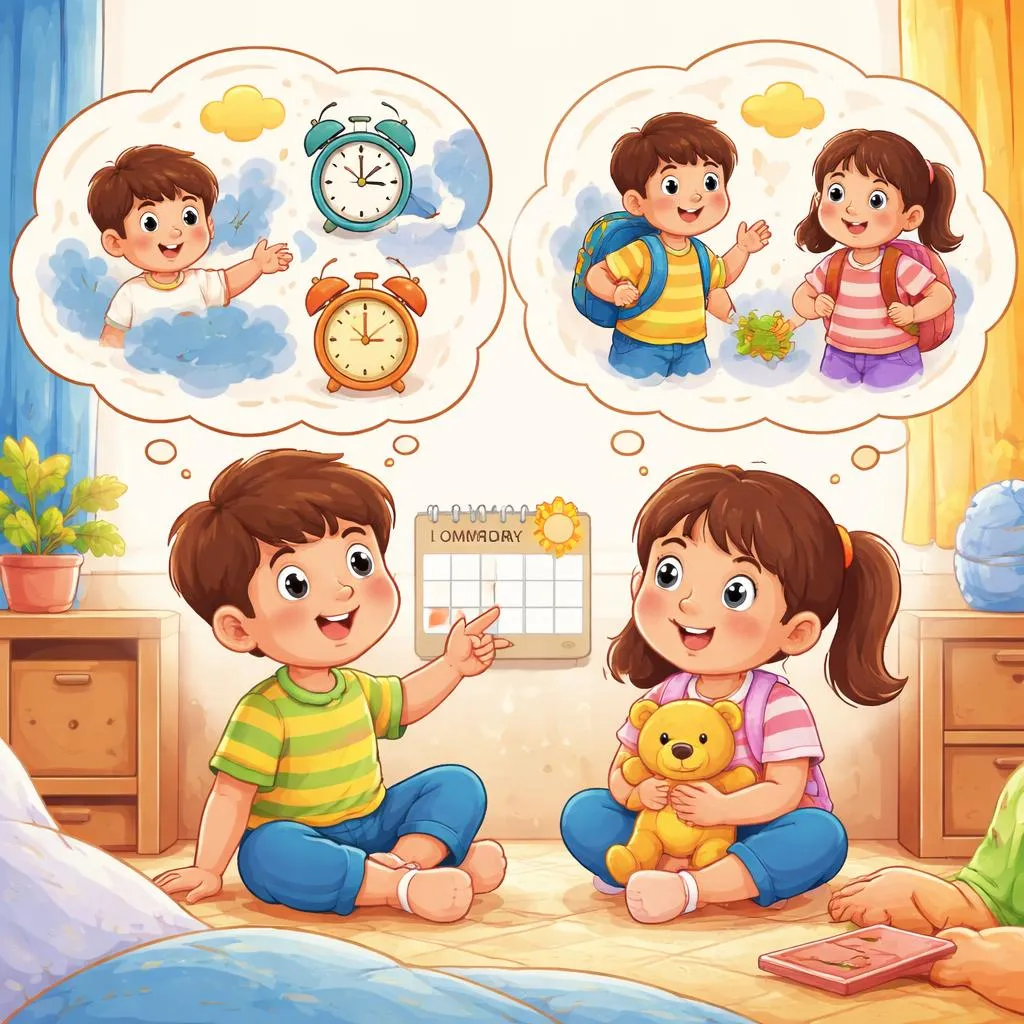
Last Sunday, Mia and Leo planned their week. Mia said she would clean her room tomorrow to surprise Mom. Leo said he would visit the zoo next day to celebrate his birthday. Both felt excited. Mia saw dust bunnies under her bed. Leo imagined lions roaring. Dad watched them. He smiled and explained the difference. Tomorrow means the day after today. Next day means the day after an event. Mia understood now. She skipped to the kitchen happily.
Mia loved finishing chores early. The vacuum waited in the closet. Leo liked special trips. Dad nodded slowly. He said tomorrow is like a sunrise alarm. Next day is like a party invitation. Mia felt clever. She started marking her calendar.
Word Breakdown
Core Principle
We reject boring dictionary definitions. We use pictures in your mind. We add functions and memory hooks. This helps you remember forever.
Tomorrow To Do
Image: Imagine being tomorrow to eat pancakes. You wake up to syrup smells. That is tomorrow to do. It means doing something the day after today.
Function: It is for regular upcoming tasks. Like tomorrow to pack your backpack. Or tomorrow to water plants.
Sensory Description: You hear a morning alarm. You feel fresh pajamas. Your eyes see the sunrise.
Memory Anchor: A child setting an alarm clock. See the glowing numbers? That is tomorrow to do.
Next Day To Do
Image: Think of being next day to open gifts. You wait after a party. That is next day to do. It means doing something the day after an event.
Function: It is for actions tied to occasions. Like next day to return a book. Or next day to go hiking.
Sensory Description: You hear wrapping paper crinkle. You feel anticipation bubble. Your nose smells cake.
Memory Anchor: A child circling a date on a calendar. See the star sticker? That is next day to do.
Advanced Comparison
Tomorrow is fixed to today. Next day is linked to an event. Tomorrow always follows now. Next day follows something else. Use tomorrow for daily plans. Use next day for event-based plans.
Scene Comparison
Scene One happens at school. Mia is tomorrow to hand in her essay. She writes final sentences. Teacher collects papers. This is tomorrow to do—routine deadline.
Scene Two takes place at home. Leo is next day to visit Grandma. He finishes his birthday party. Mom packs cookies. This is next day to do—after celebration.
Scene Three occurs at the park. Ben is tomorrow to practice his swing. He hits balls against a fence. Mia is next day to go camping. She packs after sleepover. Notice the shift. Tomorrow is standard progression. Next day is event-dependent.
Pitfalls Deep Reminder
Mistake One: Saying "I next day to brush my teeth." Why wrong? Brushing is daily. Next day is too vague. Funny result? You skip brushing today. Correct phrase: I tomorrow to brush my teeth. Memory trick: Tomorrow is for habits.
Mistake Two: Saying "I tomorrow to celebrate my party." Why wrong? Party is an event. Tomorrow ignores the party. Funny result? You celebrate alone. Correct phrase: I next day to celebrate my party. Memory trick: Next day needs an event.
Mistake Three: Saying "I next day to do my homework." Why wrong? Homework is due tomorrow. Next day is too late. Funny result? You get a zero. Correct phrase: I tomorrow to do my homework. Memory trick: Tomorrow is for deadlines.
Mistake Four: Saying "I tomorrow to go on vacation." Why wrong? Vacation starts after packing. Tomorrow is too early. Funny result? You forget suitcase. Correct phrase: I next day to go on vacation. Memory trick: Next day follows preparation.
Interactive Exercises
Mini Dialogue
A: I am tomorrow to feed my fish. B: Pour the flakes gently. A: I am next day to visit my cousin. B: Bring your favorite toy.
Mini Theater
A: (Whispering) The test is tomorrow to me. B: Review your notes now. A: (Nodding) The picnic is next day to me. B: Pack extra sandwiches.
Spot The Mistake
Which sentence sounds odd? Explain why.
I was next day to eat breakfast. Breakfast is daily. Use tomorrow instead.
I was tomorrow to open my presents. Presents follow a party. Use next day instead.
I was next day to walk the dog. Dog walking is routine. Use tomorrow instead.
Create Sentences
Use both phrases.
Tomorrow to do: I am tomorrow to clean my desk. Next day to do: I am next day to return my library book.
Bonus Challenge
Your friend sleeps over Friday. When do you go to the movies? Answer: Next day. After sleepover.
Rhyme Time
Tomorrow comes, next day waits. One follows sun, one celebrates. Alarm rings? Tomorrow, rise. Party ends? Next day, surprise.
Homework Task
Pick one activity. Complete it this week. Share with family.
Option One: Observation Journal. Get a small notebook. Draw three pictures. Write a sentence under each.
Picture One: You feel tomorrow. Sentence: I was tomorrow to finish my drawing. Picture Two: You feel next day. Sentence: I was next day to see my aunt. Picture Three: You feel tomorrow. Sentence: I was tomorrow to set the table.
Show your journal to a parent. Explain the differences.
Option Two: Role Play. With a parent, act out moments. Use phrases correctly.
You: Mom, I am tomorrow to take out trash. Parent: Do it before dinner. You: Dad, I am next day to go fishing. Parent: Pack your rod tonight.
Practice until it feels natural.
Option Three: Sharing Time. Tomorrow at school, tell a friend. Describe one tomorrow and one next day. Say: Yesterday I was tomorrow to read a book. I was next day to play soccer. Ask your friend about theirs.
Life Practice
Week Challenge: Try one task. Complete within seven days. Share your success.
Task One: Observation Log. For three days, note tomorrow and next day moments. Draw icons.
Day One: Tomorrow moment. Draw a sun. Day Two: Next day moment. Draw a gift. Day Three: Tomorrow moment. Draw a clock.
Show your log to your teacher. Place it on the classroom wall.
Task Two: Action Demo. Use both phrases in real actions.
Step One: Show tomorrow by pointing at calendar. Say: I am tomorrow to do this. Step Two: Show next day by placing a star. Say: I am next day to do that.
Demonstrate to a sibling. Explain the difference.
Task Three: Social Mission. Use phrases with others.
Feel tomorrow to help a friend. Say: I am tomorrow to lend my markers. Feel next day to help a friend. Say: I am next day to congratulate you.
Record a short voice message. Send it to your teacher.
Task Four: Creative Story. Write a short tale. Include both phrases.
Title: The Double Plan.
Story: I was tomorrow to clean my room. Then I was next day to go to the beach. Both made me happy.
Share your story in class.
Remember, practice makes perfect. Use these phrases often. Soon they will feel easy.