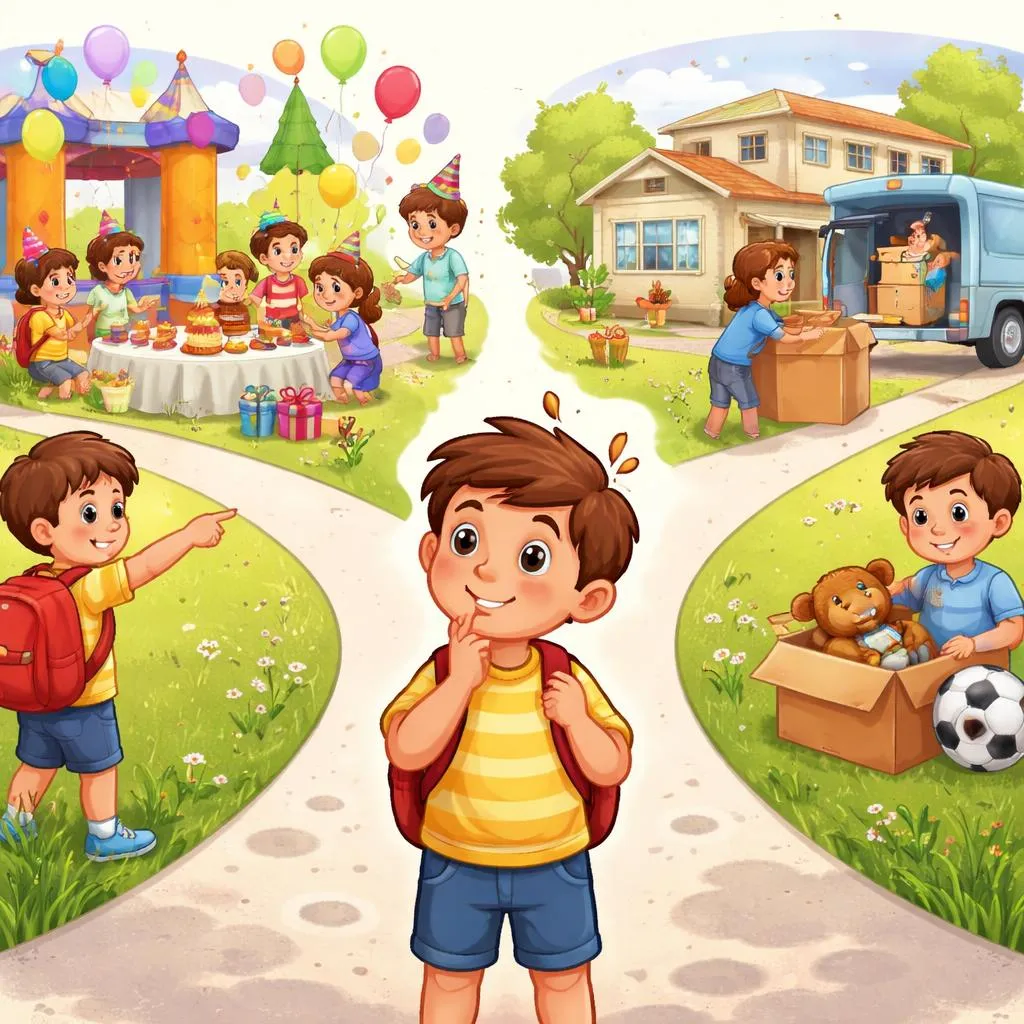

Fun Introduction
Last weekend, Mia and Leo played in the backyard. Mia ran to the swing set. She shouted I am going to swing high. Leo packed a small bag. He said I am moving to the treehouse. Both involved changing places. Mia went with quick steps. Leo moved with careful packing. Dad watched them play. He explained the big difference. Going is fast and simple. Moving is slow and planned. Mia understood now. She skipped to the slide.
Mia felt excited and free. Her hair flew in the wind. Leo felt serious and busy. Dad nodded slowly. He said going is like a quick hop. Moving is like a big journey. Mia felt clever. She started planning her own travel chart. She drew a hop for going. She drew a suitcase for moving.
Later, they went to the kitchen. Mia went to get a snack. Leo moved the chairs for dinner. Both were helpful. Mia liked quick trips. Leo liked organizing things. Dad smiled and said both are useful. Going gets you there fast. Moving prepares you well.
Word Breakdown
Core Principle
We reject boring dictionary definitions. We use pictures in your mind. We add functions and memory hooks. This helps you remember forever.
Going To Do
Image: Imagine being going to ride your bike. You jump on and pedal. That is going to do. It means doing something with quick action.
Function: It is for actions with immediate purpose. Like going to eat lunch. Or going to play outside.
Sensory Description: You feel wind rush past you. You hear your feet hit the ground. Your body leans forward eagerly.
Memory Anchor: A child running toward a playground. See the big smile? That is going to do.
Moving To Do
Image: Think of being moving to a new desk. You carry books and pencils. That is moving to do. It means doing something with careful planning.
Function: It is for actions with organized change. Like moving to a new house. Or moving to a different seat.
Sensory Description: You feel boxes in your arms. You hear items shifting. Your steps are measured and slow.
Memory Anchor: A child carrying a box with both hands. See the focused look? That is moving to do.
Advanced Comparison
Going is quick and light. Moving is slow and heavy. Going needs little thought. Moving needs preparation. Use going for short trips. Use moving for big changes. Going is like a bird flying. Moving is like a turtle carrying its shell.
Scene Comparison
Scene One happens at home. Mia is going to the kitchen. She opens the fridge door. She says I am going to get milk. This is going to do—quick errand. She pours a glass quickly. Milk spills a little.
Scene Two takes place in the classroom. Leo is moving to a new desk. He carries his books carefully. He says I am moving to sit near friends. This is moving to do—planned relocation. He arranges pencils neatly. Teacher nods approval.
Scene Three occurs at the park. Ben is going to the swings. He runs across the grass. Mia is moving to the picnic area. She carries a basket slowly. Notice the shift. Going is spontaneous. Moving is deliberate. Ben swings high. Mia sets out sandwiches.
Guide Summary
Going is like a quick dash. Moving is like a careful walk. Choose going for fast trips. Choose moving for big shifts. Both help you change places.
Pitfalls Deep Reminder
Mistake One
Saying I moving to get my pencil. Why wrong? Pencil is right there. Moving is too much work. Funny result? You pack a whole bag. Correct phrase: I going to get my pencil. Memory trick: Quick grabs need going.
Mistake Two
Saying I going to change schools. Why wrong? Changing schools needs moving. Going is too casual. Funny result? You forget all your stuff. Correct phrase: I moving to change schools. Memory trick: Big changes need moving.
Mistake Three
Saying I moving to join the game. Why wrong? Game needs quick going. Moving is too slow. Funny result? Game ends before you arrive. Correct phrase: I going to join the game. Memory trick: Joining needs going.
Mistake Four
Saying I going to rearrange my room. Why wrong? Rearranging needs moving furniture. Going is too light. Funny result? You barely move anything. Correct phrase: I moving to rearrange my room. Memory trick: Furniture needs moving.
Mistake Five
Saying I moving to answer the door. Why wrong? Door answering is quick going. Moving is unnecessary. Funny result? You wear a backpack. Correct phrase: I going to answer the door. Memory trick: Quick answers need going.
Mistake Six
Saying I going to pack for vacation. Why wrong? Packing needs moving items. Going is too fast. Funny result? You forget swimsuit. Correct phrase: I moving to pack for vacation. Memory trick: Packing needs moving.
Interactive Exercises
Mini Dialogue
A: I am going to the store for candy. B: Buy me a chocolate bar. A: I am moving to a new house next week. B: Pack your favorite toys first.
Mini Dialogue Two
A: I am going to play soccer now. B: Kick the ball to me. A: I am moving my desk closer to the window. B: Let me help you carry it.
Mini Theater
A: (Running fast) I am going to catch the ice cream truck. B: Run faster, it is turning. A: (Carrying a box) I am moving to a new classroom. B: Be careful with those books.
Mini Theater Two
A: (Jumping up) I am going to the trampoline. B: Bounce high and safe. A: (Pushing a cart) I am moving to the library section. B: Organize the books by color.
Spot The Mistake
Which sentence sounds odd? Explain why.
I was moving to get a drink of water. Drink needs going. Use going instead.
I was going to relocate my entire bedroom. Relocating needs moving. Use moving instead.
I was moving to say hello to grandma. Hello needs going. Use going instead.
I was going to transfer to a new school. Transfer needs moving. Use moving instead.
Create Sentences
Use both phrases.
Going to do: I am going to ride my bike to the park. Moving to do: I am moving to a bigger desk tomorrow.
Going to do: I am going to get my backpack. Moving to do: I am moving my toys to the shelf.
Bonus Challenge
You want to play outside. Going or moving? Answer: Going. It is quick.
Summary Rhyme
Going hops, moving walks. One talks, one stalks. Quick trip? Going, fast. Big shift? Moving, last. Both help you change your space. Pick the right one for the place.
Homework Task
Option One
Observation Journal. Get a small notebook. Draw three pictures. Write a sentence under each.
Picture One: You feel going. Sentence: I was going to the mailbox. Picture Two: You feel moving. Sentence: I was moving my books to the shelf. Picture Three: You feel going. Sentence: I was going to the playground.
Show your journal to a parent. Explain the differences. Talk about how going felt fast. Talk about how moving felt organized.
Option Two
Role Play. With a parent, act out moments. Use phrases correctly.
You: Mom, I am going to get my shoes. Parent: Tie them tight. You: Dad, I am moving my LEGO to the box. Parent: Sort them by size.
Practice until it feels natural. Switch roles sometimes. Let parent go to you.
Option Three
Sharing Time. Tomorrow at school, tell a friend. Describe one going and one moving. Say: Yesterday I was going to the library. I was moving my desk in class. Ask your friend about theirs. Listen carefully to their examples.
Life Practice
Week Challenge
Try one task. Complete within seven days. Share your success.
Task One
Observation Log. For three days, note going and moving moments. Draw icons.
Day One: Going moment. Draw a child running. Day Two: Moving moment. Draw a child carrying a box. Day Three: Going moment. Draw a child skipping.
Show your log to your teacher. Place it on the classroom wall. Explain why each moment mattered.
Task Two
Action Demo. Use both phrases in real actions.
Step One: Show going by running to a sibling. Say: I am going to do this. Step Two: Show moving by carrying a pillow. Say: I am moving to do that.
Demonstrate to a sibling. Explain the difference. Ask them which felt easier.
Task Three
Social Mission. Use phrases with others.
Feel going to help a friend. Say: I am going to play with you. Feel moving to help a friend. Say: I am moving to help you organize.
Record a short voice message. Send it to your teacher. Describe how it felt.
Task Four
Creative Story. Write a short tale. Include both phrases.
Title: The Backyard Adventure.
Story: I was going to climb the tree. Then I was moving my toys to the fort. Both made the day fun.
Share your story in class. Read it aloud with expression.
Remember, practice makes perfect. Use these phrases often. Soon they will feel easy. You will know exactly when to go and when to move.