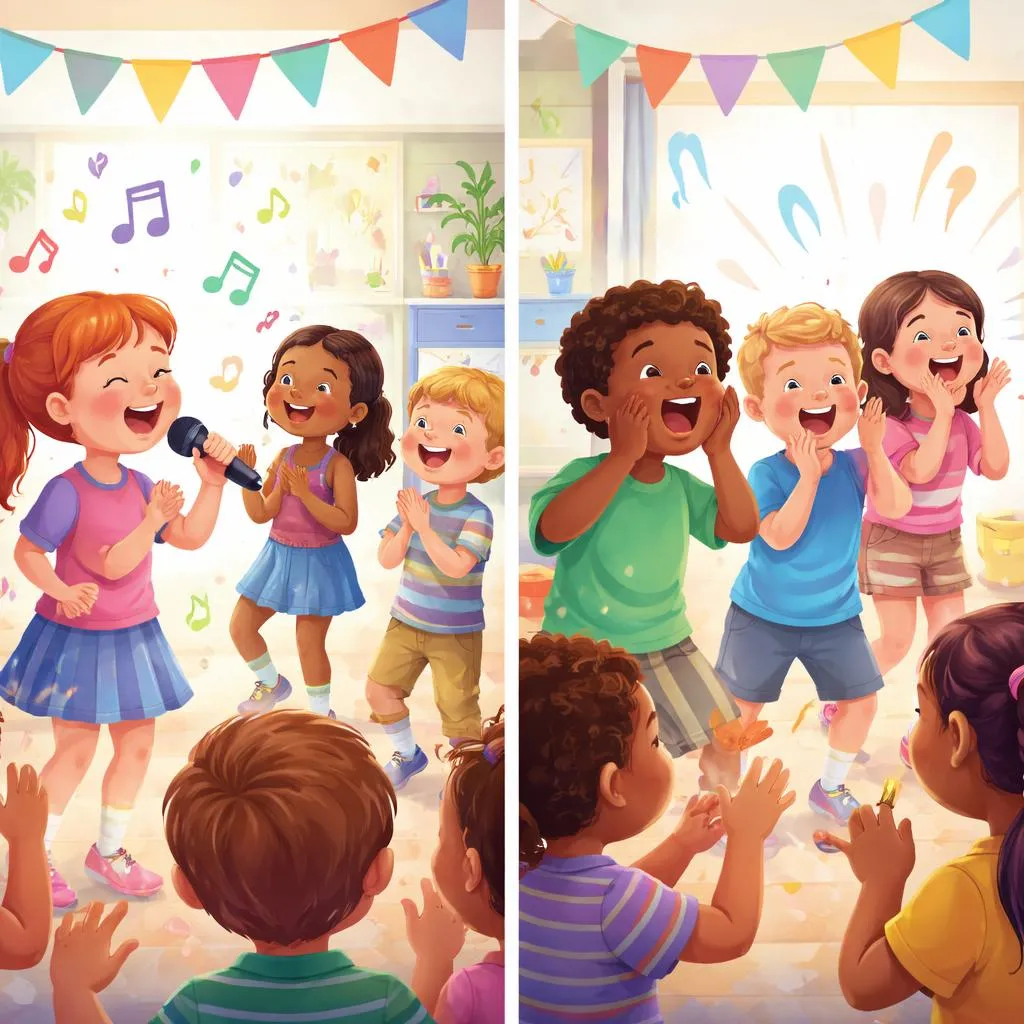

Fun Introduction
Last music class, Mia and Leo practiced for the show. Mia sang a soft song. She told her friend she was singing to share joy. Leo led the group loudly. He shouted he was chanting to pump up the team. Both made beautiful sounds. Mia used smooth flowing notes. Leo used strong repeating words. Teacher Ms. Chen smiled warmly. She explained the big difference. Singing means using melodies and tunes. Chanting means using rhythms and repetition. Mia understood quickly. She clapped her hands happily.
Mia loved the gentle melody. Her voice rose and fell like waves. Leo liked the powerful beat. Ms. Chen nodded slowly. She said singing is like a bird warbling. Chanting is like a drum beating. Mia felt very clever. She started planning her own performance chart.
Word Breakdown
Core Principle
We reject boring dictionary definitions. We use pictures in your mind. We add functions and memory hooks. This helps you remember forever.
Singing To Do
Image: Imagine being singing to perform a solo. You shape each note carefully. That is singing to do. It means doing something with melody and tune.
Function: It is for actions with musical expression. Like singing to entertain others. Or singing to express feelings.
Sensory Description: You hear changing pitches. You feel breath control. Your ears catch harmonies.
Memory Anchor: A child holding a microphone. See the focused expression? That is singing to do.
Chanting To Do
Image: Think of being chanting to cheer at a game. You repeat words with force. That is chanting to do. It means doing something with rhythm and repetition.
Function: It is for actions with energy and unity. Like chanting to support your team. Or chanting to remember facts.
Sensory Description: You hear steady beats. You feel chest vibrate. Your body sways naturally.
Memory Anchor: A child raising fists with a crowd. See the shouting mouths? That is chanting to do.
Advanced Comparison
Singing is melodic and varied. Chanting is rhythmic and repetitive. Singing shows individual art. Chanting shows group power. Use singing for performances. Use chanting for encouragement.
Scene Comparison
Scene One happens in music class. Mia is singing to perform her solo. She stands on the small stage. Her voice floats like a butterfly. This is singing to do—artistic expression.
Scene Two takes place at the basketball game. Leo is chanting to cheer his team. He leads the whole crowd. Everyone claps on the same beat. This is chanting to do—united support.
Scene Three occurs at the birthday party. Ben is singing to wish his friend well. His voice is soft and sweet. Mia is chanting to start the pinata game. She repeats the words loudly. Notice the shift. Singing is personal. Chanting is collective.
Pitfalls Deep Reminder
Mistake One: Saying "I chanting to sing a lullaby." Why wrong? Lullabies need gentle singing. Chanting is too forceful. Funny result? Baby starts crying louder. Correct phrase: I singing to sing a lullaby. Memory trick: Sleep needs soft singing.
Mistake Two: Saying "I singing to lead the school chant." Why wrong? Chants need rhythmic chanting. Singing is too complex. Funny result? Crowd loses the beat. Correct phrase: I chanting to lead the school chant. Memory trick: Groups need chanting.
Mistake Three: Saying "I chanting to audition for the choir." Why wrong? Choir needs skilled singing. Chanting is too simple. Funny result? Teacher thinks you are joking. Correct phrase: I singing to audition for the choir. Memory trick: Auditions need singing.
Mistake Four: Saying "I singing to remember multiplication tables." Why wrong? Tables need repetitive chanting. Singing distracts from memory. Funny result? You mix up numbers. Correct phrase: I chanting to remember multiplication tables. Memory trick: Memory needs chanting.
Interactive Exercises
Mini Dialogue
A: I am singing to share my new song. B: Your melody is very pretty. A: I am chanting to help us clean up. B: Repeat after me, clean up, clean up.
Mini Theater
A: (Holding pretend microphone) I am singing to tell a story. B: What happens in the story? A: (Leading a group) I am chanting to march forward. B: Left, right, left, right, keep the beat.
Spot The Mistake
Which sentence sounds odd? Explain why.
I was chanting to perform the national anthem. Anthem needs singing. Use singing instead.
I was singing to do the stadium wave. Wave needs chanting. Use chanting instead.
I was chanting to record my album. Album needs singing. Use singing instead.
Create Sentences
Use both phrases.
Singing to do: I am singing to entertain my grandparents. Chanting to do: I am chanting to motivate my soccer team.
Bonus Challenge
You want to teach your friend a new song. Singing or chanting? Answer: Singing. Melody matters.
Rhyme Time
Singing flows, chanting pounds. One wears crowns, one resounds. Notes change? Singing, free. Words repeat? Chanting, key.
Homework Task
Pick one activity. Complete it this week. Share with family.
Option One: Observation Journal. Get a small notebook. Draw three pictures. Write a sentence under each.
Picture One: You feel singing. Sentence: I was singing to practice my solo. Picture Two: You feel chanting. Sentence: I was chanting to lead the warm-up. Picture Three: You feel singing. Sentence: I was singing to say goodnight.
Show your journal to a parent. Explain the differences.
Option Two: Role Play. With a parent, act out moments. Use phrases correctly.
You: Mom, I am singing to show you my new song. Parent: That is a lovely tune. You: Dad, I am chanting to get ready for the game. Parent: Let us hear that strong rhythm.
Practice until it feels natural.
Option Three: Sharing Time. Tomorrow at school, tell a friend. Describe one singing and one chanting. Say: Yesterday I was singing to perform in class. I was chanting to cheer for my team. Ask your friend about theirs.
Life Practice
Week Challenge: Try one task. Complete within seven days. Share your success.
Task One: Observation Log. For three days, note singing and chanting moments. Draw icons.
Day One: Singing moment. Draw a musical note. Day Two: Chanting moment. Draw a drum. Day Three: Singing moment. Draw a singer on stage.
Show your log to your teacher. Place it on the classroom wall.
Task Two: Action Demo. Use both phrases in real actions.
Step One: Show singing by shaping notes with your hands. Say: I am singing to do this. Step Two: Show chanting by stomping and repeating. Say: I am chanting to do that.
Demonstrate to a sibling. Explain the difference.
Task Three: Social Mission. Use phrases with others.
Feel singing to help a friend. Say: I am singing to cheer you up. Feel chanting to help a friend. Say: I am chanting to encourage you.
Record a short voice message. Send it to your teacher.
Task Four: Creative Story. Write a short tale. Include both phrases.
Title: The Talent Show.
Story: I was singing to win the contest. Then I was chanting to celebrate with friends. Both made the day special.
Share your story in class.
Remember, practice makes perfect. Use these phrases often. Soon they will feel easy.