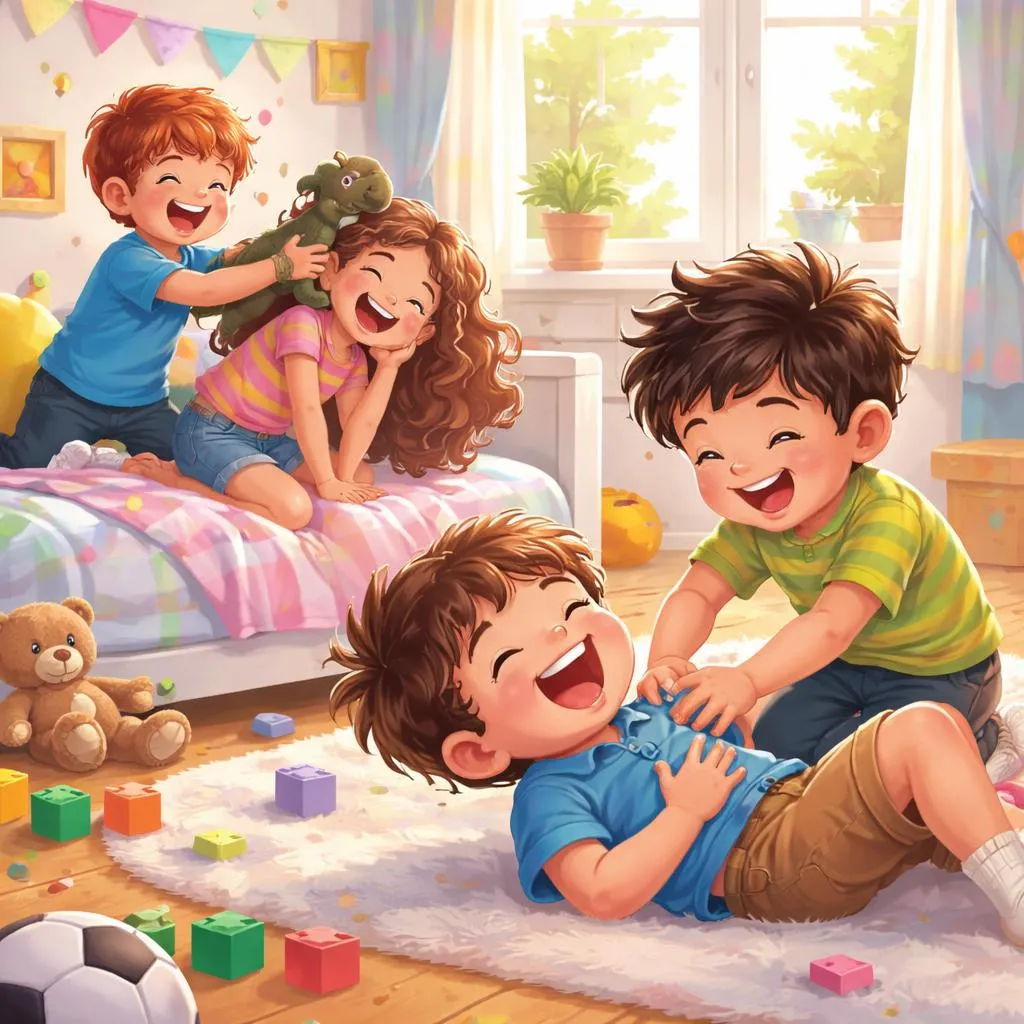

Fun Introduction
Last Saturday, Mia and Leo played at home. Mia wiggled her fingers. She poked Leo's ribs. Leo laughed and squirmed. He said she was tickling to make him laugh. Then Leo stuck out his tongue. He said he was teasing to make Mia chase him. Both used words and touch. Mia's touch was light and silly. Leo's words were playful and tricky. Mom watched them. She smiled and explained the difference. Tickling means using fingers to make someone laugh. Teasing means using words to provoke fun. Mia understood now. She skipped to get a snack.
Mia loved the giggly feeling. Her fingers danced like butterflies. Leo liked the chase game. Mom nodded slowly. She said tickling is like feathers dancing. Teasing is like a riddle game. Mia felt clever. She started planning her own fun chart.
Word Breakdown
Core Principle
We reject boring dictionary definitions. We use pictures in your mind. We add functions and memory hooks. This helps you remember forever.
Tickling To Do
Image: Imagine being tickling to make your baby sister giggle. You wiggle fingers on her tummy. That is tickling to do. It means doing something with light touch to cause laughter.
Function: It is for actions with gentle fun. Like tickling to make someone smile. Or tickling to play silly games.
Sensory Description: You hear high-pitched giggles. You feel soft skin under fingertips. Your eyes see big smiles.
Memory Anchor: A child with wiggling fingers on a belly. See the big grin? That is tickling to do.
Teasing To Do
Image: Think of being teasing to challenge your friend. You say "I bet you can't catch me!" That is teasing to do. It means doing something with playful words to provoke reaction.
Function: It is for actions with verbal fun. Like teasing to start a chase. Or teasing to make a joke.
Sensory Description: You hear loud laughs. You feel excitement build. Your eyes sparkle with mischief.
Memory Anchor: A child sticking out tongue and running. See the mischievous grin? That is teasing to do.
Advanced Comparison
Tickling uses touch only. Teasing uses words only. Tickling creates giggles. Teasing creates reactions. Use tickling for gentle fun. Use teasing for playful challenges.
Scene Comparison
Scene One happens at home. Mia is tickling baby sister. She wiggles fingers gently. Baby kicks legs and giggles. Mia says "I am tickling to make you laugh." This is tickling to do—soft touch.
Scene Two takes place at school. Leo is teasing his friend. He says "Your shoes are untied!" Friend looks down. Leo laughs and says "Gotcha!" This is teasing to do—playful words.
Scene Three occurs at the park. Ben is tickling his cousin. He sneaks up and pokes ribs. Cousin runs away laughing. Mia is teasing her brother. She hides his toy and says "Where is it?" Brother searches frantically. Notice the shift. Tickling is physical fun. Teasing is verbal fun.
Guide Summary
Tickling is like feathers dancing. Teasing is like a riddle game. Choose tickling to share giggles. Choose teasing to spark fun.
Pitfalls Deep Reminder
Mistake One
Saying "I teasing to make my baby laugh." Why wrong? Babies need tickling. Teasing confuses them. Funny result? Baby cries loudly. Correct phrase: I tickling to make my baby laugh. Memory trick: Babies love tickles.
Mistake Two
Saying "I tickling to challenge my friend." Why wrong? Challenges need teasing. Tickling is not enough. Funny result? Friend ignores you. Correct phrase: I teasing to challenge my friend. Memory trick: Challenges need words.
Mistake Three
Saying "I teasing to comfort someone sad." Why wrong? Sadness needs hugs. Teasing hurts feelings. Funny result? Friend gets more sad. Correct phrase: I hugging to comfort someone sad. Memory trick: Sadness needs kindness.
Mistake Four
Saying "I tickling to win a race." Why wrong? Races need speed. Tickling slows you down. Funny result? You lose the race. Correct phrase: I running to win the race. Memory trick: Races need running.
Interactive Exercises
Mini Dialogue
A: I am tickling to make you smile. B: Stop, that tickles too much! A: I am teasing to make you chase me. B: Catch me if you can!
Mini Theater
A: (Wiggling fingers) I am tickling to see you laugh. B: Giggles burst out loud. A: (Sticking tongue) I am teasing to start a game. B: I will get you back!
Spot The Mistake
Which sentence sounds odd? Explain why.
I was teasing to make the baby stop crying. Teasing hurts babies. Use tickling instead.
I was tickling to challenge my friend to a race. Tickling is not challenging. Use teasing instead.
I was teasing to comfort my sad friend. Teasing is mean when sad. Use kind words instead.
Create Sentences
Use both phrases.
Tickling to do: I am tickling to make my little sister laugh. Teasing to do: I am teasing to make my friend run faster.
Bonus Challenge
Your friend is happy and you want to play. Tickling or teasing? Answer: Either works, but teasing is more common.
Summary Rhyme
Tickling light, teasing sly. One makes giggle, one makes try. Fingers wiggle? Tickling, fun. Words provoke? Teasing, begun.
Homework Task
Option One
Observation Journal. Get a small notebook. Draw three pictures. Write a sentence under each.
Picture One: You feel tickling. Sentence: I was tickling to make my cousin laugh. Picture Two: You feel teasing. Sentence: I was teasing to challenge my friend. Picture Three: You feel tickling. Sentence: I was tickling to play with my sister.
Show your journal to a parent. Explain the differences.
Option Two
Role Play. With a parent, act out moments. Use phrases correctly.
You: Mom, I am tickling to make you smile. Parent: That feels so tickly! You: Dad, I am teasing to start a game. Parent: I will chase you around.
Practice until it feels natural.
Option Three
Sharing Time. Tomorrow at school, tell a friend. Describe one tickling and one teasing. Say: Yesterday I was tickling my baby brother. I was teasing my best friend. Ask your friend about theirs.
Life Practice
Week Challenge
Try one task. Complete within seven days. Share your success.
Task One
Observation Log. For three days, note tickling and teasing moments. Draw icons.
Day One: Tickling moment. Draw wiggling fingers. Day Two: Teasing moment. Draw a mischievous face. Day Three: Tickling moment. Draw a child laughing.
Show your log to your teacher. Place it on the classroom wall.
Task Two
Action Demo. Use both phrases in real actions.
Step One: Show tickling by wiggling fingers on your arm. Say: I am tickling to do this. Step Two: Show teasing by sticking out tongue and running. Say: I am teasing to do that.
Demonstrate to a sibling. Explain the difference.
Task Three
Social Mission. Use phrases with others.
Feel tickling to help a friend. Say: I am tickling to make you laugh. Feel teasing to help a friend. Say: I am teasing to start a game.
Record a short voice message. Send it to your teacher.
Task Four
Creative Story. Write a short tale. Include both phrases.
Title: The Silly Afternoon.
Story: I was tickling my dog to make him roll over. Then I was teasing my brother to chase me. Both made us laugh.
Share your story in class.
Remember, practice makes perfect. Use these phrases often. Soon they will feel easy.