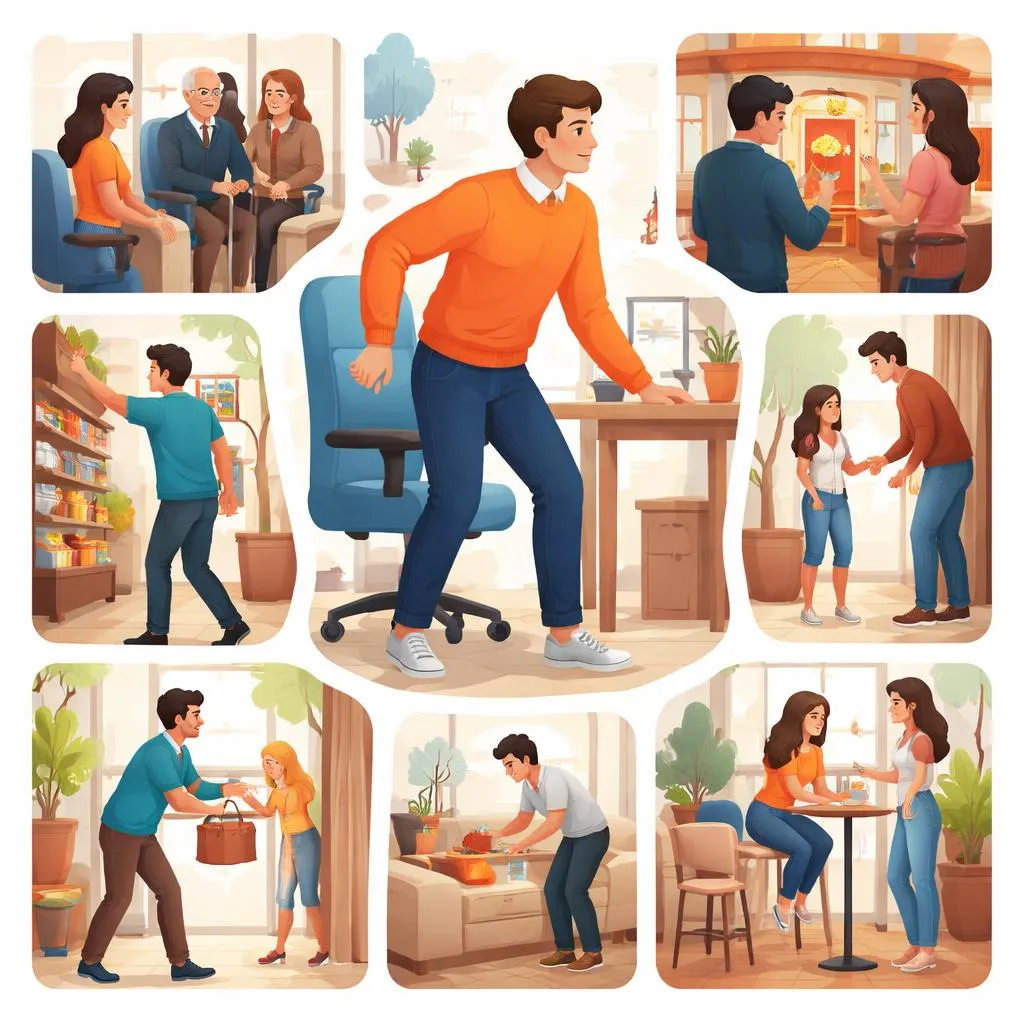

Fun Introduction
Last Saturday, Mia played a game with friends. They pretended to be statues. Mia stood to guard the castle gate. She stayed stiff and tall. Her legs felt strong. Later, Mia rose to answer a tricky riddle. She jumped up with excitement. Her hands waved in the air. Both actions involved getting up. But standing felt steady and firm. Rising felt quick and eager. Mia wondered about the difference. She asked her dad. Dad smiled and explained. Standing shows stability. Rising shows enthusiasm. Let’s learn together.
Word Breakdown
Core Principle
We reject boring dictionary definitions. We use pictures in your mind. We add functions and memory hooks. This helps you remember forever.
Stand To Do
Image: Imagine a soldier standing guard. He stays perfectly still. That is stand to do. It means maintaining a stable position.
Function: It is for steady, unmoving actions. Like stand to wait in line. Or stand to hold a door.
Sensory Description: You feel grounded and solid. You hear silence around you. Your muscles stay tense.
Memory Anchor: A statue standing in a park. See the firm posture? That is stand to do.
Rise To Do
Image: Think of a rocket launching into space. It shoots upward fast. That is rise to do. It means moving up with energy and purpose.
Function: It is for quick, upward movements. Like rise to greet a friend. Or rise to meet a challenge.
Sensory Description: You feel a surge of energy. You hear a whoosh of air. Your body lifts off the ground.
Memory Anchor: A rocket blasting off. See the powerful ascent? That is rise to do.
Advanced Comparison
Stand is steady and grounded. Rise is dynamic and upward. Stand holds a position. Rise moves to a higher level. Use stand for stability. Use rise for achievement.
Scene Comparison
Scene One happens at school. Leo stands to recite his poem. He stays rooted by his desk. His voice stays calm. This is stand to do—steady presence.
Scene Two takes place at home. Emma rises to help her mom. She jumps up from the couch. Her hands reach for the plate. This is rise to do—eager action.
Scene Three occurs in the park. Ben stands to block the soccer ball. He plants his feet firmly. Mia rises to catch a frisbee. She leaps high into the air. Notice the shift. Standing defends. Rising achieves.
Pitfalls Deep Reminder
Mistake One is saying “I rose to hold the door open.” Why wrong? Holding a door needs steady standing. Rising is for quick upward moves. Funny result? Door thinks you are launching into orbit. Correct phrase is I stood to hold the door open. Memory trick: Stand is for steady tasks.
Mistake Two is saying “I stood to grab the high shelf.” Why wrong? Grabbing high needs rising up. Standing stays put. Funny result? Shelf stays out of reach. Correct phrase is I rose to grab the high shelf. Memory trick: Rise is for reaching up.
Mistake Three is saying “I rose to wait for the bus.” Why wrong? Waiting needs steady standing. Rising is for energetic moves. Funny result? Bus driver thinks you are taking off. Correct phrase is I stood to wait for the bus. Memory trick: Stand is for waiting.
Mistake Four is saying “I stood to celebrate my win.” Why wrong? Celebrating needs rising with joy. Standing is too calm. Funny result? Win feels unexciting. Correct phrase is I rose to celebrate my win. Memory trick: Rise is for happy moments.
Interactive Exercises
Read each sentence. Pick stand or rise.
I will ___ to sing the national anthem. (stand/rise)
She ___ to pick up the fallen book. (stand/rise)
We ___ to show respect for the flag. (stand/rise)
He ___ to answer the teacher’s question. (stand/rise)
They ___ to applaud the performer. (stand/rise)
Act with a friend. Use the phrases.
Scene A: Steady Standing
A: I will stand to guard the treasure.
B: Keep your eyes open.
Scene B: Eager Rising
A: I will rise to solve the puzzle.
B: Show me how you do it.
Spot the Mistake
Which sentence sounds odd? Explain why.
Sentence: I rose to hold the umbrella in the rain.
Reason: Umbrellas need steady standing. Use stand instead.
Sentence: I stood to get the cookie from the jar.
Reason: Cookies need rising up. Use rise instead.
Sentence: I rose to listen to the announcement.
Reason: Listening needs steady standing. Use stand instead.
Create Sentences
Use both phrases.
Stand to do: I stand to tie my shoelaces.
Rise to do: I rise to wave at my friend.
Bonus Challenge
You see a friend fall. Do you stand or rise to help? Answer: Rise. You hurry up quickly.
Rhyme Time
Stand it firm, rise it high.
One stays put, one touches the sky.
Steady pose? Choose stand.
Upward leap? Rise to expand.
Homework Task
Pick one activity. Complete it this week. Share with family.
Option One: Observation Journal. Get a small notebook. Draw three pictures. Write a sentence under each.
Picture One: You stand to do something. Sentence: I stood to watch the parade.
Picture Two: You rise to do something. Sentence: I rose to hug my grandma.
Picture Three: You stand to do something else. Sentence: I stood to block the ball.
Show your journal to a parent. Explain the differences.
Option Two: Role Play. With a parent, act out moments. Use phrases correctly.
You: Mom, I will stand to help you cook.
Parent: Hold the bowl steady.
You: Dad, I will rise to get the kite.
Parent: Jump and grab it.
Practice until it feels natural.
Option Three: Sharing Time. Tomorrow at school, tell a friend. Describe one stand and one rise. Say: Yesterday I stood to read aloud. I rose to catch the ball. Ask your friend about theirs.
Life Practice
Week Challenge: Try one task. Complete within seven days. Share your success.
Task One: Observation Log. For three days, note stand and rise moments. Draw icons.
Day One: Stand to wait. Draw a clock icon.
Day Two: Rise to help. Draw a hand icon.
Day Three: Stand to guard. Draw a shield icon.
Show your log to your teacher. Place it on the classroom wall.
Task Two: Action Demo. Use both phrases in real actions.
Step One: Stand firmly. Say: I stand to hold this pose.
Step Two: Rise quickly. Say: I rise to reach this high.
Demonstrate to a sibling. Explain the difference.
Task Three: Social Mission. Use phrases with others.
Stand to support a friend. Say: I stand with you in this moment.
Rise to encourage a classmate. Say: I rise to cheer for your success.
Record a short voice message. Send it to your teacher.
Task Four: Creative Story. Write a short tale. Include both phrases.
Title: The Brave Knight.
Story: I stood to guard the kingdom. Then I rose to defeat the dragon. What a day!
Share your story in class.
Remember, practice makes perfect. Use these phrases often. Soon they will feel easy.