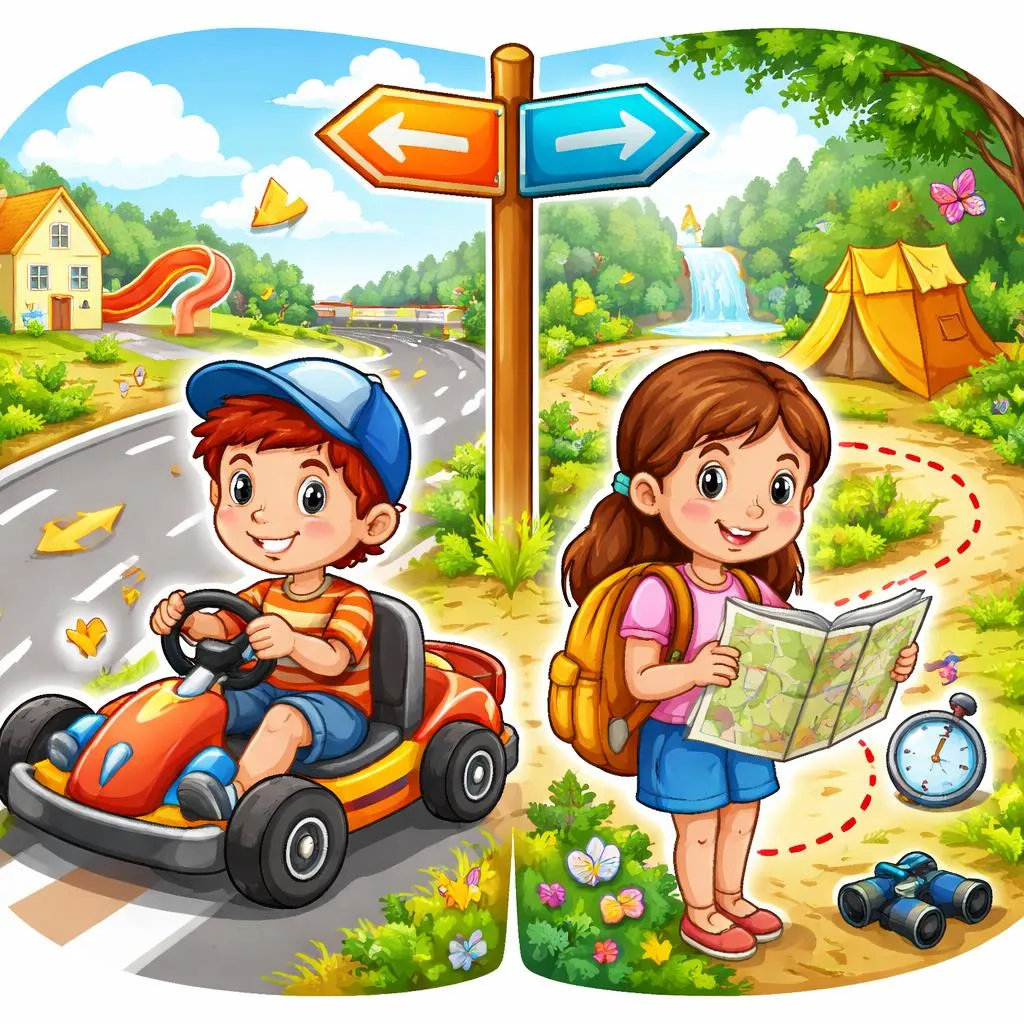

Fun Introduction
Last Saturday, Mia played at the pond. She had a small wooden boat. She used a stick to steer it. The boat moved left and right. She dodged lily pads and frogs. Her hands felt the water splash. Later, Mia joined a scavenger hunt. She had a map and a compass. She navigated to the hidden treasure. She looked at the map carefully. She chose paths between trees. Both actions involved going somewhere. But steering was quick and hands-on. Navigating was slow and thoughtful. Mia wondered about the difference. She asked her dad. Dad smiled and explained. Steering is for immediate control. Navigating is for planning the way. Let’s learn together.
Word Breakdown
Core Principle
We reject boring dictionary definitions. We use pictures in your mind. We add functions and memory hooks. This helps you remember forever.
Steer To Do
Image: Imagine holding a go-kart steering wheel. Your hands twist left and right. That is steer to do. It means guiding something directly.
Function: It is for immediate control. Like steer a bike around a puddle. Or steer a remote-control car.
Sensory Description: You feel the wheel vibrate. You hear tires crunch. Your fingers grip tightly.
Memory Anchor: A captain steering a ship. See the focused hands? That is steer to do.
Navigate To Do
Image: Think of looking at a map on a phone. You trace a blue line. That is navigate to do. It means finding the best route.
Function: It is for planning a journey. Like navigate to the museum. Or navigate through a maze.
Sensory Description: You see digital maps glow. You hear the GPS voice. Your brain solves puzzles.
Memory Anchor: A hiker reading a compass. See the thoughtful gaze? That is navigate to do.
Advanced Comparison
Steer is physical and instant. Navigate is mental and planned. Steer uses hands to move. Navigate uses tools to decide. Use steer when you control now. Use navigate when you plan ahead.
Scene Comparison
Scene One happens at the park. Leo steers his remote-control truck. He turns the wheel sharply. The truck avoids a bench. He laughs with friends. This is steer to do—quick reactions.
Scene Two takes place on a nature trail. Emma navigates with a map. She checks landmarks like big rocks. She leads her group to the waterfall. This is navigate to do—careful planning.
Scene Three occurs in the kitchen. Ben steers a spoon in the batter. He makes smooth circles. Mia navigates to the spice rack. She finds cinnamon among jars. Notice the shift. Steering is doing. Navigating is deciding.
Pitfalls Deep Reminder
Mistake One is saying “I navigated my bike around the puddle.” Why wrong? Bikes need steering with hands. Navigating is for maps. Funny result? You look at a map while biking. Correct phrase is I steered my bike around the puddle. Memory trick: Steer is for vehicles.
Mistake Two is saying “I steered using the GPS to the zoo.” Why wrong? GPS helps navigate. Steering is for the wheel. Funny result? You grab the GPS like a wheel. Correct phrase is I navigated using the GPS to the zoo. Memory trick: Navigate is for routes.
Mistake Three is saying “The captain navigated the ship through waves.” Why wrong? Waves need steering hands. Navigating is for charts. Funny result? Captain reads a map in a storm. Correct phrase is The captain steered the ship through waves. Memory trick: Steer in rough conditions.
Mistake Four is saying “I steered to the hidden treasure with a map.” Why wrong? Maps help navigate. Steering is for the final approach. Funny result? You hold the map like a steering wheel. Correct phrase is I navigated to the hidden treasure with a map. Memory trick: Navigate to find places.
Interactive Exercises
Read each sentence. Pick steer or navigate.
I will ___ the toy boat away from the rocks. (steer/navigate)
She ___ through the forest using a compass. (steer/navigate)
We ___ the go-kart around the track. (steer/navigate)
He ___ to the new candy store on his phone. (steer/navigate)
They ___ the remote-control plane through hoops. (steer/navigate)
Act with a friend. Use the phrases.
Scene A: Hands-On Steering
A: I need to steer this boat now.
B: Turn left to avoid the log.
Scene B: Thoughtful Navigating
A: I will navigate us to the playground.
B: Check the map for shortcuts.
Spot the Mistake
Which sentence sounds odd? Explain why.
Sentence: I navigated the bicycle with my hands.
Reason: Bicycles are steered, not navigated. Use steer instead.
Sentence: I steered to the library using Google Maps.
Reason: Maps help navigate. Use navigate instead.
Sentence: The pilot navigated the plane during turbulence.
Reason: Turbulence needs steering. Use steer instead.
Create Sentences
Use both phrases.
Steer to do: I steer my sled down the hill.
Navigate to do: I navigate to my friend’s house.
Bonus Challenge
You are in a kayak going through rapids. Do you steer or navigate? Answer: Steer. You need immediate control.
Rhyme Time
Steer it left, steer it right.
Navigate by day and night.
Hands on wheel? Choose steer.
Map in hand? Navigate clear.
Homework Task
Pick one activity. Complete it this week. Share with family.
Option One: Observation Journal. Get a small notebook. Draw three pictures. Write a sentence under each.
Picture One: You steer something. Sentence: I steered my toy car today.
Picture Two: You navigate something. Sentence: I navigated with a map in the park.
Picture Three: You steer something else. Sentence: I steered my bike around a hole.
Show your journal to a parent. Explain the differences.
Option Two: Role Play. With a parent, act out moments. Use phrases correctly.
You: Mom, I will steer the shopping cart now.
Parent: Watch out for the cans.
You: Dad, I will navigate to the new pool.
Parent: Show me the map.
Practice until it feels natural.
Option Three: Sharing Time. Tomorrow at school, tell a friend. Describe one steer and one navigate. Say: Yesterday I steered my scooter. I navigated to the library. Ask your friend about theirs.
Life Practice
Week Challenge: Try one task. Complete within seven days. Share your success.
Task One: Observation Log. For three days, note steer and navigate moments. Draw icons.
Day One: Steer a toy. Draw a wheel icon.
Day Two: Navigate with map. Draw a map icon.
Day Three: Steer a bike. Draw a bike icon.
Show your log to your teacher. Place it on the classroom wall.
Task Two: Action Demo. Use both phrases in real actions.
Step One: Pretend to steer. Say: I steer to avoid obstacles.
Step Two: Pretend to navigate. Say: I navigate to find the way.
Demonstrate to a sibling. Explain the difference.
Task Three: Social Mission. Use phrases with others.
Steer to help a friend. Say: I steer the ball away from the net.
Navigate to guide a friend. Say: I navigate us to the shortcut.
Record a short voice message. Send it to your teacher.
Task Four: Creative Story. Write a short tale. Include both phrases.
Title: The Lost Compass.
Story: I steered the raft across the lake. Then I navigated home using a star. What an adventure!
Share your story in class.
Remember, practice makes perfect. Use these phrases often. Soon they will feel easy.