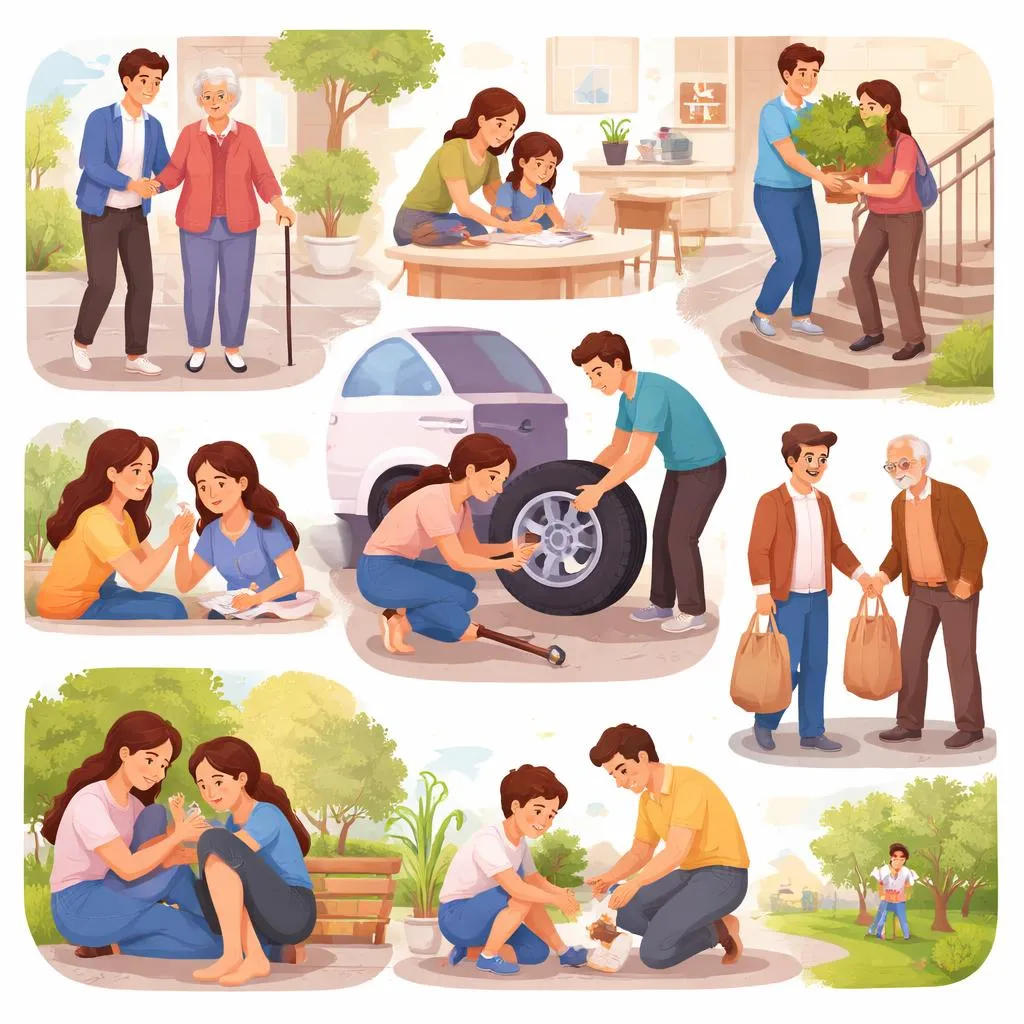

Fun Introduction
Last Saturday, Mia joined a school play. She felt nervous backstage. Her friend Sarah stood nearby. Sarah supported Mia with encouraging words. Mia smiled and felt braver. Later, Mia tripped on a cable. The stage manager rushed over. He aided Mia by checking her ankle. Both actions helped Mia. But supporting lifted her spirit. Aiding fixed her problem. Let’s explore the difference.
Word Breakdown
Core Principle
We reject boring dictionary definitions. We use pictures in your mind. We add functions and memory hooks. This helps you remember forever.
Support To Do
Image: Imagine a friend cheering for you at a race. They shout your name loudly. That is support to do. It means giving encouragement or backing.
Function: It is for emotional or moral help. Like support a teammate after a loss. Or support a friend’s dream.
Sensory Description: You hear kind words. You feel warmth in your chest. Your confidence grows.
Memory Anchor: A crowd clapping at a performance. See the smiling faces? That is support to do.
Aid To Do
Image: Think of a lifeguard throwing a floating ring. They pull you to safety. That is aid to do. It means giving practical or material help.
Function: It is for physical or concrete assistance. Like aid a lost tourist with directions. Or aid a classmate with a heavy box.
Sensory Description: You feel hands helping. You see tools being used. Your problem gets solved.
Memory Anchor: A first-aid kit with bandages. See the helpful supplies? That is aid to do.
Advanced Comparison
Support is emotional and uplifting. Aid is practical and fixing. Support cheers you on. Aid lends a hand. Use support for feelings. Use aid for actions.
Emotional Dimension Comparison
Support to do = a warm hug. It feels good inside. Aid to do = a helping hand. It fixes things outside.
Spatial Dimension Comparison
Support to do = standing behind you. You feel backed. Aid to do = stepping in front. You get direct help.
Scene Comparison
Scene One happens at school. Leo misses a goal in soccer. His teammates support him by saying it is okay. They pat his back. Leo smiles and feels better. This is support to do—emotional boost.
Scene Two takes place in the library. Emma drops her books everywhere. The librarian aids her by picking them up. They stack neatly together. Emma thanks her gratefully. This is aid to do—practical help.
Scene Three occurs during a storm. Ben feels scared of thunder. His dad supports him by sitting close. Dad tells stories to calm him. Later, Dad aids Ben by fixing a broken window. Notice the shift. Supporting comforts. Aiding repairs.
Pitfalls Deep Reminder
Mistake One is saying “I aided my friend’s sad feelings with a tissue.” Why wrong? Sad feelings need supporting with words. Aiding is for physical needs. Funny result? Friend thinks you are wiping tears off a table. Correct phrase is support my friend’s sad feelings. Memory trick: Support is for hearts.
Mistake Two is saying “I supported the injured bird by feeding it.” Why wrong? Feeding is aiding with food. Supporting is cheering. Funny result? Bird expects a pep talk. Correct phrase is aid the injured bird by feeding it. Memory trick: Aid is for bodies.
Mistake Three is saying “I aided my sister’s confidence by buying new shoes.” Why wrong? Confidence needs supporting with praise. Aiding is buying supplies. Funny result? Sister thinks shoes will make her brave. Correct phrase is support my sister’s confidence with praise. Memory trick: Support builds courage.
Mistake Four is saying “I supported the broken toy by gluing it.” Why wrong? Gluing is aiding the toy. Supporting is cheering for the toy. Funny result? Toy feels loved but stays broken. Correct phrase is aid the broken toy by gluing it. Memory trick: Aid fixes things.
Interactive Exercises
Choose the Right Phrase
Read each sentence. Pick support or aid.
I ___ my friend after she failed the test. (support/aid)
She ___ the homeless man with warm clothes. (support/aid)
We ___ the team by waving flags. (support/aid)
He ___ the lost dog by giving water. (support/aid)
They ___ the artist by buying her painting. (support/aid)
Mini Theater
Act with a friend. Use the phrases.
Scene A: Emotional Boost
A: I feel nervous about the spelling bee.
B: I will support you with cheers.
Scene B: Practical Help
A: My bike chain fell off.
B: I will aid you by fixing it.
Spot the Mistake
Which sentence sounds odd? Explain why.
Sentence: I aided my grandma’s loneliness with a phone call.
Reason: Loneliness needs support. Use support instead.
Sentence: I supported the leaking pipe with a wrench.
Reason: Leaks need aid. Use aid instead.
Sentence: We aided the singer’s stage fright with applause.
Reason: Stage fright needs support. Use support instead.
Create Sentences
Use both phrases.
Support to do: I support my brother when he is sad.
Aid to do: I aid my neighbor with yard work.
Bonus Challenge
Your friend is crying because she lost her toy. Do you support or aid her? Answer: Support. She needs comfort first.
Rhyme Time
Support the heart, aid the hand.
One cheers up, one helps land.
Feeling low? Choose support.
Need a fix? Aid to resort.
Homework Task
Pick one activity. Complete it this week. Share with family.
Option One: Observation Journal. Get a small notebook. Draw three pictures. Write a sentence under each.
Picture One: You support someone. Sentence: I supported my friend with kind words.
Picture Two: You aid someone. Sentence: I aided my dad with carrying boxes.
Picture Three: You support someone else. Sentence: I supported my sister’s dance recital.
Show your journal to a parent. Explain the differences.
Option Two: Role Play. With a parent, act out moments. Use phrases correctly.
You: Mom, I will support you when you are tired.
Parent: Thank you, that makes me feel better.
You: Dad, I will aid you with the groceries.
Parent: Good, please carry the heavy bag.
Practice until it feels natural.
Option Three: Sharing Time. Tomorrow at school, tell a friend. Describe one support and one aid. Say: Yesterday I supported my teammate. I aided my teacher with papers. Ask your friend about theirs.
Life Practice
Week Challenge: Try one task. Complete within seven days. Share your success.
Task One: Observation Log. For three days, note support and aid moments. Draw icons.
Day One: Support a friend. Draw a heart icon.
Day Two: Aid a sibling. Draw a helping hand icon.
Day Three: Support a classmate. Draw a smile icon.
Show your log to your teacher. Place it on the classroom wall.
Task Two: Action Demo. Use both phrases in real actions.
Step One: Give emotional support. Say: I support you with kind words.
Step Two: Give practical aid. Say: I aid you by holding the door.
Demonstrate to a sibling. Explain the difference.
Task Three: Social Mission. Use phrases with others.
Support a friend who is upset. Say: I support you, it will be okay!
Aid a classmate with a heavy project. Say: I aid you by carrying supplies.
Record a short voice message. Send it to your teacher.
Task Four: Creative Story. Write a short tale. Include both phrases.
Title: The Kindness Club.
Story: I supported Mia with her fears. Then I aided Leo with his broken toy. What a helpful day!
Share your story in class.
Remember, practice makes perfect. Use these phrases often. Soon they will feel easy.