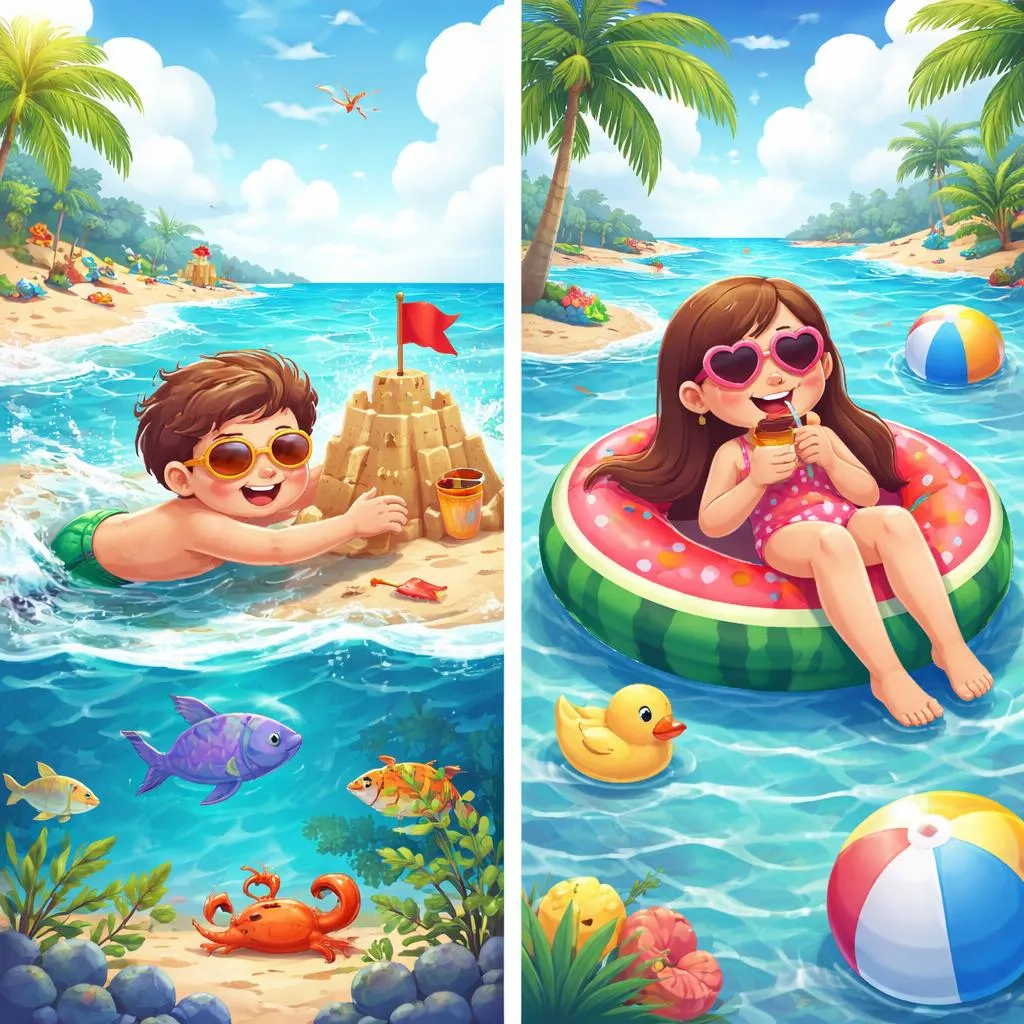

Fun Introduction
Last Saturday, Mia went to the community pool. She jumped into the deep end. She swam to the other side quickly. Her arms splashed water everywhere. She felt strong and fast. Later, Mia lay on her back. She floated to the shallow area. Her body stayed still on the water. Both actions happened in the pool. But swimming was active and moving. Floating was calm and staying. Mia wondered about the difference. She asked her swimming coach. Coach smiled and explained. Swimming is for going places. Floating is for resting. Let’s learn together.
Word Breakdown
Core Principle
We reject boring dictionary definitions. We use pictures in your mind. We add functions and memory hooks. This helps you remember forever.
Swim To Do
Image: Imagine a dolphin racing through waves. It kicks powerfully with fins. That is swim to do. It means moving actively through water.
Function: It is for traveling or playing. Like swim to the dock. Or swim to catch a ball.
Sensory Description: You hear splashing sounds. You feel your muscles working. Your breath comes in puffs.
Memory Anchor: A dolphin leaping in the sea. See the strong strokes? That is swim to do.
Float To Do
Image: Think of a leaf resting on a pond. It stays still on the surface. That is float to do. It means staying on top without effort.
Function: It is for relaxing or waiting. Like float to rest your arms. Or float to watch clouds.
Sensory Description: You feel water supporting you. You hear gentle ripples. Your body feels weightless.
Memory Anchor: A leaf drifting on a lake. See the peaceful stillness? That is float to do.
Advanced Comparison
Swim is active and directional. Float is passive and stationary. Swim uses energy to move. Float uses buoyancy to stay. Use swim when you need to go somewhere. Use float when you want to rest.
Scene Comparison
Scene One happens at the pool party. Leo swims to the diving board. He wants to jump again. His strokes are fast and steady. This is swim to do—active movement.
Scene Two takes place on a hot afternoon. Emma floats on her back. She looks at the blue sky. Her arms spread wide like wings. This is float to do—peaceful rest.
Scene Three occurs at the lake. Ben swims to the raft. He races his friends across the water. Mia floats beside the raft. She waits for her turn to climb. Notice the shift. Swimming is for competition. Floating is for cooling off.
Pitfalls Deep Reminder
Mistake One is saying “I floated to the other side of the pool.” Why wrong? Getting across needs swimming. Floating stays in one spot. Funny result? You drift back to the start. Correct phrase is I swam to the other side. Memory trick: Float is for staying put.
Mistake Two is saying “I swam to rest my tired legs.” Why wrong? Resting needs floating still. Swimming tires you more. Funny result? Your legs get even more tired. Correct phrase is I floated to rest my legs. Memory trick: Swim is for exercise.
Mistake Three is saying “The boat floated to the island quickly.” Why wrong? Boats move by floating, but “floated to” implies no power. Funny result? The island thinks the boat is stuck. Correct phrase is The boat sailed to the island. Memory trick: Use sail or motor for powered movement.
Mistake Four is saying “I swam on my back to relax.” Why wrong? Relaxing on your back is floating. Swimming uses energy. Funny result? You splash water in your own face. Correct phrase is I floated on my back to relax. Memory trick: Float is for lazy poses.
Interactive Exercises
Read each sentence. Pick swim or float.
I will ___ to the deep end for a dive. (swim/float)
She ___ on her back to look at the sky. (swim/float)
We ___ across the lake to the picnic spot. (swim/float)
He ___ near the edge to catch his breath. (swim/float)
They ___ in the lazy river for fun. (swim/float)
Act with a friend. Use the phrases.
Scene A: Active Swimming
A: I need to swim to the other side.
B: Kick your legs harder.
Scene B: Peaceful Floating
A: I will float here and rest.
B: Close your eyes and breathe.
Spot the Mistake
Which sentence sounds odd? Explain why.
Sentence: I floated to win the swimming race.
Reason: Races need swimming fast. Use swim instead.
Sentence: I swam to take a nap on the water.
Reason: Napping needs floating still. Use float instead.
Sentence: The rubber duck swam across the bathtub.
Reason: Rubber ducks float, they don’t swim. Use float instead.
Create Sentences
Use both phrases.
Swim to do: I swim to the diving board every day.
Float to do: I float on my back after practice.
Bonus Challenge
You drop your goggles in the pool. Do you swim or float to get them? Answer: Swim. You need to move to them.
Rhyme Time
Swim it fast, float it slow.
One moves ahead, one stays below.
Need to travel? Choose swim.
Want to rest? Float and stay trim.
Homework Task
Pick one activity. Complete it this week. Share with family.
Option One: Observation Journal. Get a small notebook. Draw three pictures. Write a sentence under each.
Picture One: You swim to do something. Sentence: I swam to the middle of the pool.
Picture Two: You float to do something. Sentence: I floated on my back like a star.
Picture Three: You swim to do something else. Sentence: I swam to retrieve my diving ring.
Show your journal to a parent. Explain the differences.
Option Two: Role Play. With a parent, act out moments. Use phrases correctly.
You: Mom, I will swim to the other side now.
Parent: Keep your head up.
You: Dad, I will float here to rest.
Parent: Good, relax your arms.
Practice until it feels natural.
Option Three: Sharing Time. Tomorrow at school, tell a friend. Describe one swim and one float. Say: Yesterday I swam to the deep end. I floated on my back afterward. Ask your friend about theirs.
Life Practice
Week Challenge: Try one task. Complete within seven days. Share your success.
Task One: Observation Log. For three days, note swim and float moments. Draw icons.
Day One: Swim laps. Draw a swimmer icon.
Day Two: Float on back. Draw a cloud icon.
Day Three: Swim to a toy. Draw a ring icon.
Show your log to your teacher. Place it on the classroom wall.
Task Two: Action Demo. Use both phrases in real actions.
Step One: Swim actively. Say: I swim to get stronger.
Step Two: Float peacefully. Say: I float to relax my body.
Demonstrate to a sibling. Explain the difference.
Task Three: Social Mission. Use phrases with others.
Swim to help a friend. Say: I swim to bring you the ball.
Float to wait for a friend. Say: I float here until you finish.
Record a short voice message. Send it to your teacher.
Task Four: Creative Story. Write a short tale. Include both phrases.
Title: The Pool Adventure.
Story: I swam to the treasure chest. Then I floated back with my prize. What fun!
Share your story in class.
Remember, practice makes perfect. Use these phrases often. Soon they will feel easy.