
Fun Introduction
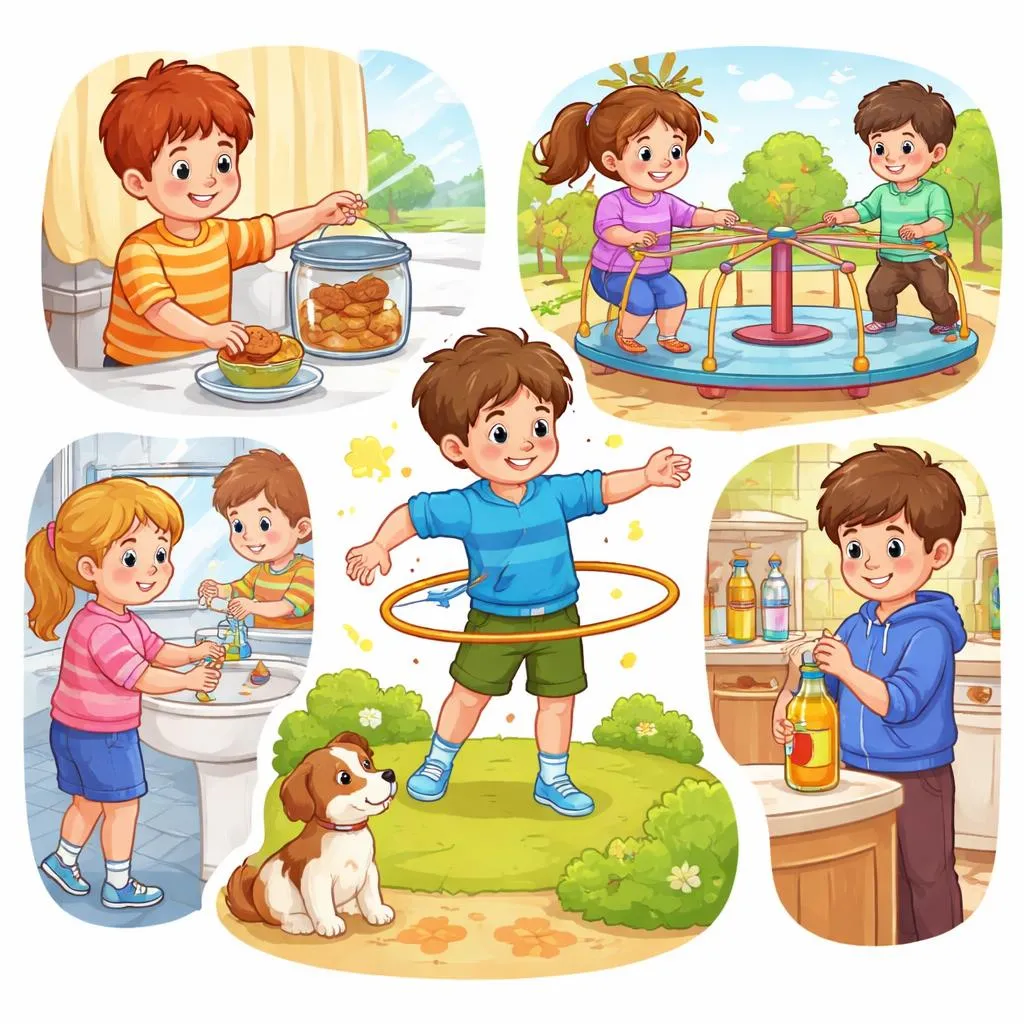
Last Saturday, Mia played with her toy car. She turned to avoid a chair leg. The car changed direction quickly. Later, Mia spun her fidget spinner. It rotated on her finger. Both actions involved circular motion. But turning was about changing direction. Rotating was about spinning around. Mia wondered about the difference. She asked her dad. Dad smiled and explained. Turning shifts where you face. Rotating spins around a point. Let’s learn together.
Word Breakdown
Core Principle
We reject boring dictionary definitions. We use pictures in your mind. We add functions and memory hooks. This helps you remember forever.
Turn To Do
Image: Imagine turning a doorknob to enter a room. Your hand twists the knob. That is turn to do. It means changing direction or position.
Function: It is for shifting focus or path. Like turn to face your friend. Or turn to walk home.
Sensory Description: You hear a click. You feel your body pivot. Your eyes look a new way.
Memory Anchor: A steering wheel in a car. See the hands moving left? That is turn to do.
Rotate To Do
Image: Think of a basketball spinning on a finger. It twirls around and around. That is rotate to do. It means spinning around a central point.
Function: It is for full circular motion. Like rotate to show your new shoes. Or rotate a spinner in a game.
Sensory Description: You hear a whirring sound. You feel dizzy if you spin. Your view goes round and round.
Memory Anchor: A spinning top on a table. See the blur of colors? That is rotate to do.
Advanced Comparison
Turn is about changing direction. Rotate is about spinning in place. Turn moves you to a new facing. Rotate keeps you centered. Use turn when you change where you look. Use rotate when you spin around.
Scene Comparison
Scene One happens in the classroom. Leo turns to listen to the teacher. He faces the front desk. His chair stays still. This is turn to do—changing direction.
Scene Two takes place in the gym. Emma rotates during a dance. She spins around once. Her arms stretch out. This is rotate to do—full spin.
Scene Three occurs at the park. Ben turns to avoid a puddle. He steps to the side. Mia rotates on the merry-go-round. She goes around and around. Notice the shift. Turning is a shift. Rotating is a circle.
Pitfalls Deep Reminder
Mistake One is saying “I rotated the doorknob to enter.” Why wrong? Doorknobs turn, they do not spin fully. Funny result? Door thinks it is a merry-go-round. Correct phrase is I turned the doorknob to enter. Memory trick: Doorknobs turn.
Mistake Two is saying “I turned the wheel on my scooter.” Why wrong? Scooter wheels rotate. Turning would change direction. Funny result? Scooter thinks it is steering. Correct phrase is I rotated the wheel on my scooter. Memory trick: Wheels rotate.
Mistake Three is saying “The Earth turns around the Sun.” Why wrong? Earth orbits, which is turning. Rotating is spinning on its axis. Funny result? Earth thinks it is a top. Correct phrase is The Earth turns around the Sun. Memory trick: Planets turn in orbit.
Mistake Four is saying “I rotated to face my friend.” Why wrong? Facing someone needs turning. Rotating would spin you away. Funny result? Friend sees your back. Correct phrase is I turned to face my friend. Memory trick: Facing is turning.
Interactive Exercises
Read each sentence. Pick turn or rotate.
I will ___ to see the blackboard clearly. (turn/rotate)
She ___ the fidget spinner on her desk. (turn/rotate)
We ___ to walk toward the playground. (turn/rotate)
He ___ the basketball on his finger. (turn/rotate)
They ___ to wave at the bus driver. (turn/rotate)
Act with a friend. Use the phrases.
Scene A: Simple Turning
A: I need to turn now.
B: Which way are you going?
Scene B: Full Rotating
A: Watch me rotate three times.
B: You look dizzy already.
Spot the Mistake
Which sentence sounds odd? Explain why.
Sentence: I rotated the key in the lock.
Reason: Keys turn in locks. Use turn instead.
Sentence: The fan blades turned in the ceiling.
Reason: Fan blades rotate. Use rotate instead.
Sentence: I turned on the merry-go-round.
Reason: Merry-go-rounds rotate. Use rotate instead.
Create Sentences
Use both phrases.
Turn to do: I turn to greet my teacher every morning.
Rotate to do: I rotate my wrist to show my watch.
Bonus Challenge
You want to see what is behind you. Do you turn or rotate? Answer: Turn. You change direction briefly.
Rhyme Time
Turn it this way, rotate it round.
One shifts your gaze, one spins unbound.
Change your view? Choose turn.
Spin in place? Rotate and earn.
Homework Task
Pick one activity. Complete it this week. Share with family.
Option One: Observation Journal. Get a small notebook. Draw three pictures. Write a sentence under each.
Picture One: You turn something. Sentence: I turned to look at the bird.
Picture Two: You rotate something. Sentence: I rotated my pencil on the desk.
Picture Three: You turn something else. Sentence: I turned to walk home.
Show your journal to a parent. Explain the differences.
Option Two: Role Play. With a parent, act out moments. Use phrases correctly.
You: Mom, I will turn to face the window.
Parent: Good, let the light in.
You: Dad, I will rotate the spinner for game night.
Parent: May the best spinner win.
Practice until it feels natural.
Option Three: Sharing Time. Tomorrow at school, tell a friend. Describe one turn and one rotate. Say: Yesterday I turned to see my friend. I rotated my fidget spinner. Ask your friend about theirs.
Life Practice
Week Challenge: Try one task. Complete within seven days. Share your success.
Task One: Observation Log. For three days, note turn and rotate moments. Draw icons.
Day One: Turn to look. Draw an eye icon.
Day Two: Rotate a toy. Draw a spinner icon.
Day Three: Turn to walk. Draw a foot icon.
Show your log to your teacher. Place it on the classroom wall.
Task Two: Action Demo. Use both phrases in real actions.
Step One: Turn smoothly. Say: I turn to be polite.
Step Two: Rotate playfully. Say: I rotate just for fun.
Demonstrate to a sibling. Explain the difference.
Task Three: Social Mission. Use phrases with others.
Turn to help a friend. Say: I turn to listen to you.
Rotate to entertain a friend. Say: I rotate my toy for you.
Record a short voice message. Send it to your teacher.
Task Four: Creative Story. Write a short tale. Include both phrases.
Title: The Spinning Adventure.
Story: I turned to find a hidden path. Then I rotated to celebrate. What joy!
Share your story in class.
Remember, practice makes perfect. Use these phrases often. Soon they will feel easy.