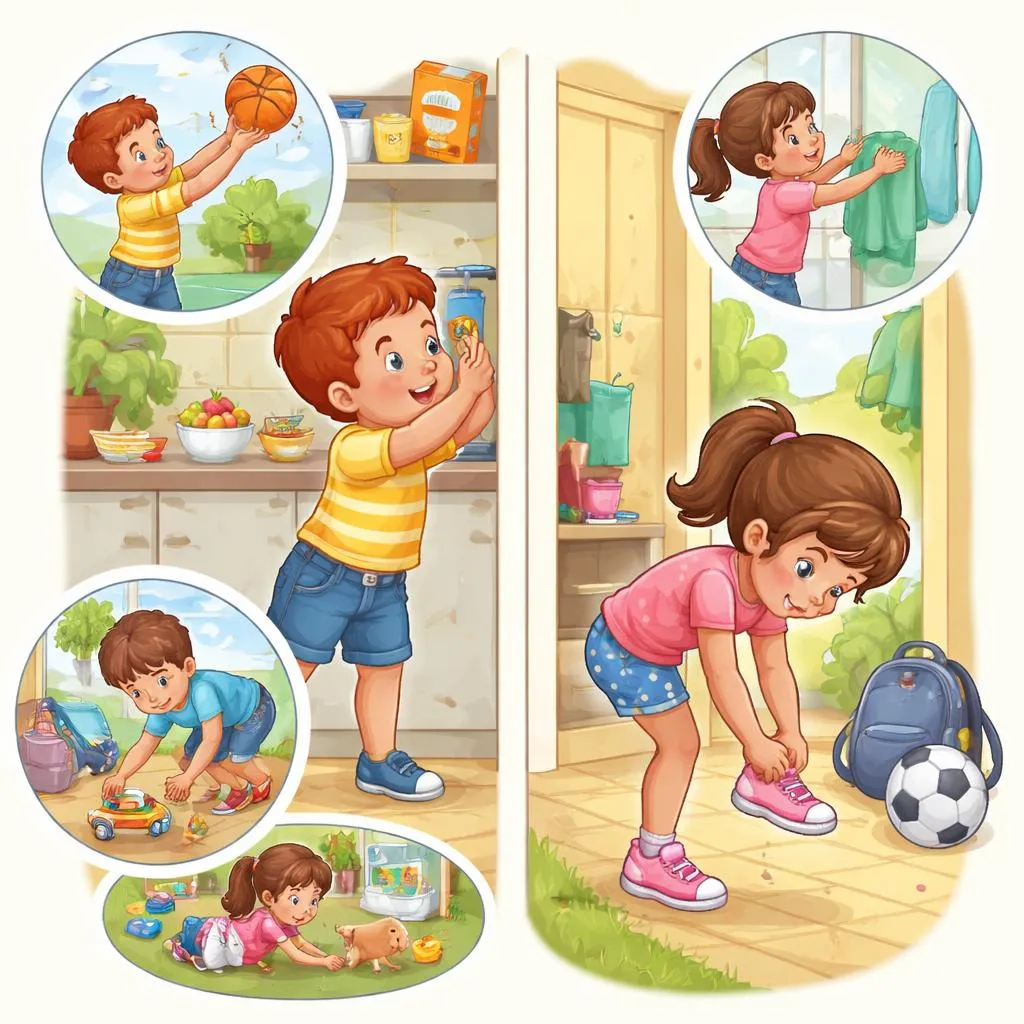

Fun Introduction
Last Sunday, Mia played in her backyard. She held a wet towel. She twisted it hard to squeeze out water. Her hands turned in opposite directions. Later, Mia saw a shiny coin. She bent down to pick it up. Her knees curved forward. Both actions changed shapes. But twisting involved spiraling force. Bending involved curving smoothly. Mia wondered about the difference. She asked her dad. Dad smiled and explained. Twisting turns things around. Bending curves them gently. Let’s learn together.
Word Breakdown
Core Principle
We reject boring dictionary definitions. We use pictures in your mind. We add functions and memory hooks. This helps you remember forever.
Twist To Do
Image: Imagine wringing out a wet towel. Your hands turn opposite ways. That is twist to do. It means spiraling with force.
Function: It is for turning things tightly. Like twist a bottle cap. Or twist a rubber band.
Sensory Description: You feel resistance in your palms. You hear a cracking sound. Your muscles work against each other.
Memory Anchor: A pretzel’s twisted shape. See the tight spiral? That is twist to do.
Bend To Do
Image: Think of a tree branch bowing in wind. It curves without breaking. That is bend to do. It means curving smoothly.
Function: It is for flexing gently. Like bend to tie your shoe. Or bend to pet a cat.
Sensory Description: You feel your joints move. You hear fabric stretch. Your body becomes rounded.
Memory Anchor: A straw bent at a joint. See the smooth curve? That is bend to do.
Advanced Comparison
Twist uses spiraling force. Bend uses gentle curving. Twist turns things around. Bend curves them without turning. Use twist for tight turns. Use bend for smooth curves.
Scene Comparison
Scene One happens in the kitchen. Leo twists a jar lid open. He grips hard and turns. The lid pops off. This is twist to do—tight spiraling.
Scene Two takes place in the hallway. Emma bends to tie her shoelaces. She curves her back forward. Her fingers work quickly. This is bend to do—gentle curving.
Scene Three occurs at the playground. Ben twists a Rubik’s cube. He spins layers around. Mia bends under a low branch. She curves her body down. Notice the shift. Twisting is forceful. Bending is flexible.
Pitfalls Deep Reminder
Mistake One is saying “I bent the bottle cap open.” Why wrong? Caps need twisting force. Bending is too gentle. Funny result? Cap stays stuck forever. Correct phrase is I twisted the bottle cap open. Memory trick: Caps twist.
Mistake Two is saying “I twisted to pick up my pencil.” Why wrong? Pencils need bending down. Twisting would spin you. Funny result? You look like a dancing top. Correct phrase is I bent to pick up my pencil. Memory trick: Picking up needs bending.
Mistake Three is saying “I twisted my knee playing soccer.” Why wrong? Knees bend, they do not twist. Twisting hurts joints. Funny result? Knee thinks it is a rubber band. Correct phrase is I bent my knee playing soccer. Memory trick: Joints bend.
Mistake Four is saying “I bent the key in the lock.” Why wrong? Keys twist in locks. Bending would break them. Funny result? Key snaps in half. Correct phrase is I twisted the key in the lock. Memory trick: Keys twist.
Interactive Exercises
Read each sentence. Pick twist or bend.
I will ___ the wet cloth to dry it. (twist/bend)
She ___ down to hug her little brother. (twist/bend)
We ___ the rubber band into a ball. (twist/bend)
He ___ his elbow to reach the shelf. (twist/bend)
They ___ the doorknob to enter. (twist/bend)
Act with a friend. Use the phrases.
Scene A: Forceful Twisting
A: I need to twist this lid off.
B: Use a rubber grip.
Scene B: Gentle Bending
A: I will bend to tie your laces.
B: Thank you for helping me.
Spot the Mistake
Which sentence sounds odd? Explain why.
Sentence: I bent the jar lid to open it.
Reason: Lids need twisting. Use twist instead.
Sentence: I twisted my back to pick up the toy.
Reason: Backs bend, they do not twist. Use bend instead.
Sentence: The wire bent when I pulled it.
Reason: Wires twist, they do not bend. Use twist instead.
Create Sentences
Use both phrases.
Twist to do: I twist my hair into a bun.
Bend to do: I bend to smell a flower.
Bonus Challenge
You need to open a tight pickle jar. Do you twist or bend? Answer: Twist. You need spiraling force.
Rhyme Time
Twist it tight, bend it low.
One turns with might, one curves just so.
Spiral force? Choose twist.
Smooth curve? Bend and persist.
Homework Task
Pick one activity. Complete it this week. Share with family.
Option One: Observation Journal. Get a small notebook. Draw three pictures. Write a sentence under each.
Picture One: You twist something. Sentence: I twisted the towel to dry it.
Picture Two: You bend something. Sentence: I bent to pet my dog.
Picture Three: You twist something else. Sentence: I twisted the cap off my drink.
Show your journal to a parent. Explain the differences.
Option Two: Role Play. With a parent, act out moments. Use phrases correctly.
You: Mom, I will twist the lid for you.
Parent: It is stuck very tight.
You: Dad, I will bend to tie my shoes.
Parent: Good, keep them snug.
Practice until it feels natural.
Option Three: Sharing Time. Tomorrow at school, tell a friend. Describe one twist and one bend. Say: Yesterday I twisted a rubber band. I bent to pick up my pencil. Ask your friend about theirs.
Life Practice
Week Challenge: Try one task. Complete within seven days. Share your success.
Task One: Observation Log. For three days, note twist and bend moments. Draw icons.
Day One: Twist a lid. Draw a jar icon.
Day Two: Bend to pick up. Draw a coin icon.
Day Three: Twist a key. Draw a key icon.
Show your log to your teacher. Place it on the classroom wall.
Task Two: Action Demo. Use both phrases in real actions.
Step One: Twist forcefully. Say: I twist to open tight things.
Step Two: Bend gently. Say: I bend to reach low things.
Demonstrate to a sibling. Explain the difference.
Task Three: Social Mission. Use phrases with others.
Twist to help a friend. Say: I twist the cap for you.
Bend to help a friend. Say: I bend to tie your laces.
Record a short voice message. Send it to your teacher.
Task Four: Creative Story. Write a short tale. Include both phrases.
Title: The Twisted Tale.
Story: I twisted the rope to climb. Then I bent to enter the cave. What adventure!
Share your story in class.
Remember, practice makes perfect. Use these phrases often. Soon they will feel easy.