
Fun Introduction
Last Saturday, Mia had a busy morning. She walked to the library quickly. Her new book was waiting. She hurried past houses and trees. Her feet tapped fast on the sidewalk. Later, Mia strolled to the park with her dad. They moved slowly and talked. Mia pointed at colorful flowers. She breathed in the fresh air. Both actions used walking. But one was fast and focused. The other was slow and happy. Mia wondered about the difference. She asked her dad. Dad smiled and explained. Walking gets you places. Strolling lets you enjoy the way. Let’s learn together.
Word Breakdown
Core Principle
We reject boring dictionary definitions. We use pictures in your mind. We add functions and memory hooks. This helps you remember forever.
Walk To Do
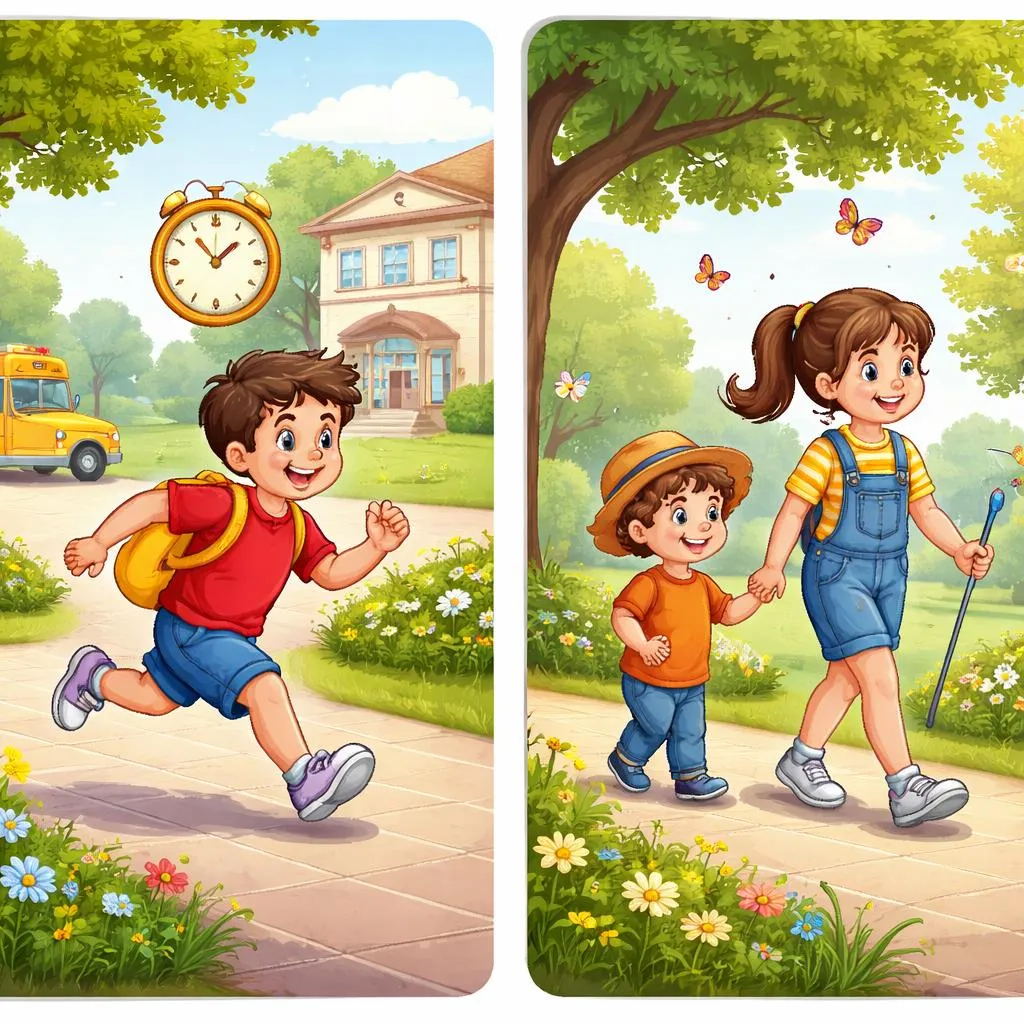
Image: Imagine a kid power-walking to school. Arms swing with purpose. That is walk to do. It means moving steadily to reach a goal.
Function: It is for getting somewhere. Like walk to the bus stop. Or walk to the store.
Sensory Description: You hear quick footsteps. You feel your heart beat faster. Your eyes look ahead.
Memory Anchor: A student rushing to class. See the determined stride? That is walk to do.
Stroll To Do
Image: Think of a kid wandering in a garden. Stopping to smell roses. That is stroll to do. It means moving slowly to enjoy the view.
Function: It is for relaxing moments. Like stroll to see the sunset. Or stroll with a friend.
Sensory Description: You hear birds singing. You feel calm and happy. Your eyes wander around.
Memory Anchor: A family walking in the park. See the gentle pace? That is stroll to do.
Advanced Comparison
Walk is purposeful and direct. Stroll is leisurely and wandering. Walk focuses on the destination. Stroll focuses on the journey. Use walk when you need to arrive. Use stroll when you want to enjoy.
Scene Comparison
Scene One happens on a school morning. Leo walks to the bus stop. He checks his watch nervously. The bus is coming soon. He says, “Hurry, we must walk faster!” This is walk to do—goal-driven.
Scene Two takes place on a sunny afternoon. Emma strolls through the neighborhood. She stops to pet a cat. She smiles at neighbors. She says, “Look at that pretty butterfly!” This is stroll to do—joyful wandering.
Scene Three occurs on a weekend errand. Ben walks to the grocery store. He carries a list from mom. He buys milk and bread. On the way back, Ben strolls home. He eats an ice cream cone. Notice the shift. Walking is for tasks. Strolling is for treats.
Pitfalls Deep Reminder
Mistake One is saying “I strolled to catch the school bus.” Why wrong? Buses leave on time. Strolling is too slow. Funny result? You miss the bus and walk all the way. Correct phrase is I walked to catch the school bus. Memory trick: Walk is for catching rides.
Mistake Two is saying “I walked to enjoy the sunset.” Why wrong? Sunsets need slow appreciation. Walking is too fast. Funny result? You see the sun set while running. Correct phrase is I strolled to enjoy the sunset. Memory trick: Stroll is for pretty views.
Mistake Three is saying “I strolled to the dentist appointment.” Why wrong? Dentists expect punctuality. Strolling is too relaxed. Funny result? Dentist thinks you forgot. Correct phrase is I walked to the dentist appointment. Memory trick: Walk is for important meetings.
Mistake Four is saying “I walked through the art museum.” Why wrong? Art needs slow looking. Walking is too quick. Funny result? You miss the best paintings. Correct phrase is I strolled through the art museum. Memory trick: Stroll is for galleries.
Interactive Exercises
Read each sentence. Which phrase fits best?
I will ___ to the playground to meet my friends. (walk/stroll)
She ___ to the ice cream truck before it leaves. (walk/stroll)
We ___ around the lake to feed the ducks. (walk/stroll)
He ___ to the library to return his books. (walk/stroll)
They ___ down the street to see holiday lights. (walk/stroll)
Act with a friend. Use the phrases.
Scene A: Quick Walk
A: I need to walk to the store now.
B: I will come with you.
Scene B: Slow Stroll
A: Let’s stroll to the park together.
B: We can look at flowers.
Spot the Mistake
Which sentence sounds odd? Explain why.
Sentence: I strolled to the airport to catch my flight.
Reason: Airports need walking fast. Use walk instead.
Sentence: I walked to admire the rainbow.
Reason: Rainbows need strolling slowly. Use stroll instead.
Sentence: I strolled to the principal’s office.
Reason: Offices need walking seriously. Use walk instead.
Create Sentences
Use both phrases.
Walk to do: I walk to school every morning.
Stroll to do: I stroll in the garden after dinner.
Bonus Challenge
You see a friend far away. Do you walk or stroll to say hi? Answer: Walk. You want to reach them.
Rhyme Time
Walk it fast, stroll it slow.
One has a goal, one lets go.
Need to arrive? Choose walk.
Want to enjoy? Stroll and talk.
Homework Task
Pick one activity. Complete it this week. Share with family.
Option One: Observation Journal. Get a small notebook. Draw three pictures. Write a sentence under each.
Picture One: You walk to do something. Sentence: I walked to the post office.
Picture Two: You stroll to do something. Sentence: I strolled with my dog.
Picture Three: You walk to do something else. Sentence: I walked to piano lessons.
Show your journal to a parent. Explain the differences.
Option Two: Role Play. With a parent, act out moments. Use phrases correctly.
You: Mom, I will walk to the bakery for bread.
Parent: Come back quickly.
You: Dad, I will stroll to the pond tonight.
Parent: Bring your flashlight.
Practice until it feels natural.
Option Three: Sharing Time. Tomorrow at school, tell a friend. Describe one walk and one stroll. Say: Yesterday I walked to the library. I strolled home watching clouds. Ask your friend about theirs.
Life Practice
Week Challenge: Try one task. Complete within seven days. Share your success.
Task One: Observation Log. For three days, note walk and stroll moments. Draw icons.
Day One: Walk to school. Draw a school icon.
Day Two: Stroll in park. Draw a tree icon.
Day Three: Walk to store. Draw a cart icon.
Show your log to your teacher. Place it on the classroom wall.
Task Two: Action Demo. Use both phrases in real actions.
Step One: Walk purposefully. Say: I walk to finish my errand.
Step Two: Stroll happily. Say: I stroll to enjoy the breeze.
Demonstrate to a sibling. Explain the difference.
Task Three: Social Mission. Use phrases with others.
Walk to help a neighbor. Say: I walk to carry your groceries.
Stroll to chat with a friend. Say: I stroll to hear your news.
Record a short voice message. Send it to your teacher.
Task Four: Creative Story. Write a short tale. Include both phrases.
Title: The Neighborhood Adventure.
Story: I walked to the market for apples. Then I strolled home eating one. What a sweet day!
Share your story in class.
Remember, practice makes perfect. Use these phrases often. Soon they will feel easy.