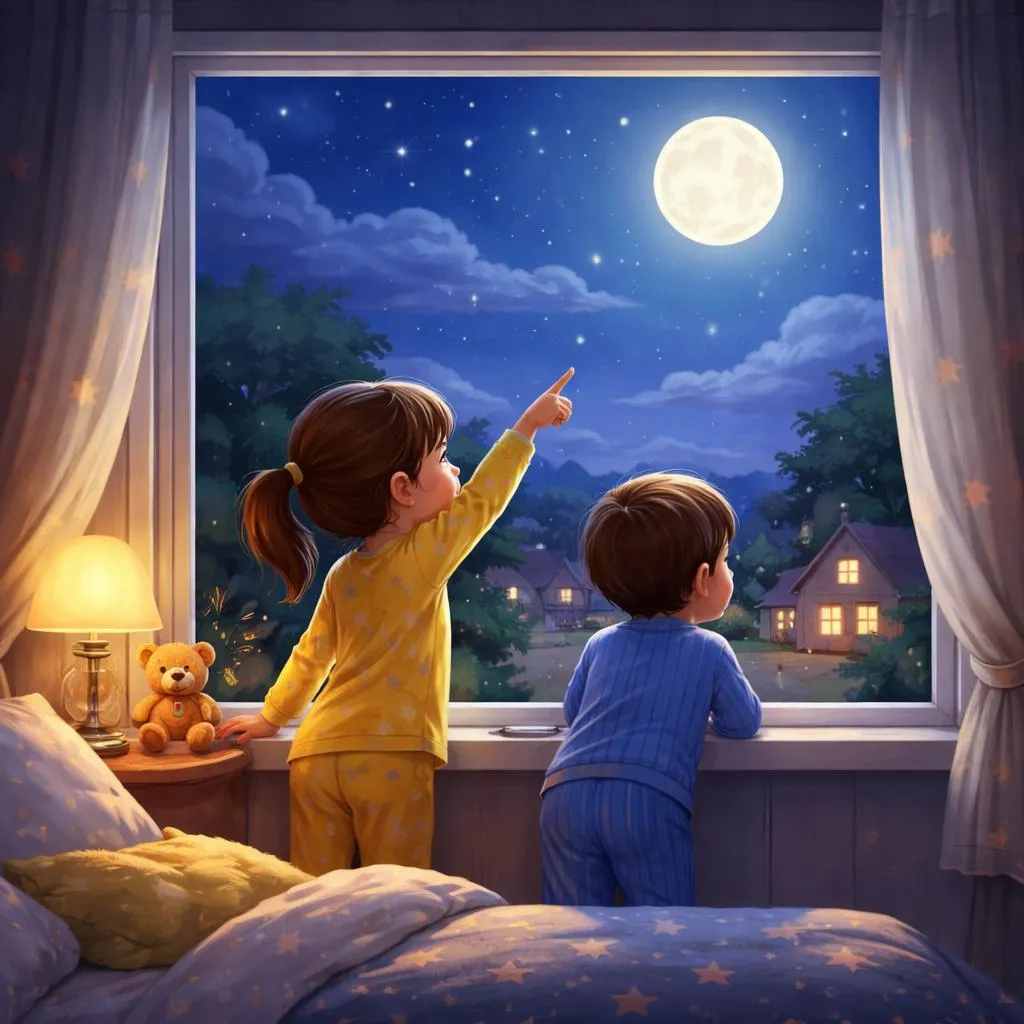

What Do These Expressions Mean? “It's nighttime” and “the moon is out” both mean that the sun has set and the sky is dark. They tell a child that the period of darkness has arrived. Children hear these words at bedtime or when looking out after sunset. Both describe the dark part of the day.
“It's nighttime” means the time of day between sunset and sunrise. It is a general statement. A child says it when they see it is dark outside. It is factual.
“The moon is out” means the moon is visible in the night sky. It is more specific and visual. A child says it when they see the glowing moon. It feels more magical.
These expressions seem similar. Both mean “it is not daytime.” Both describe night. But one is a general time period while one is a specific observation.
What's the Difference? One is about the general time of day. One is about the moon’s visibility. “It's nighttime” is a period. Evening, night, and early morning before dawn. It is the opposite of “daytime.”
“The moon is out” means the moon has risen and can be seen. It is an observation on clear nights. It is not true on cloudy nights or when the moon is new. It is more specific.
Think of a child at 9 PM. It is dark. “It's nighttime” is true. If the sky is clear, “the moon is out” is also true. One is a time period. One is a sighting.
One is for general knowledge. The other is for direct observation. “It's nighttime” for a cloudy night when you cannot see the moon. “The moon is out” for a clear night with a visible moon. Use the first for the time. Use the second for the sight.
Also, “the moon is out” feels more poetic and special. “Nighttime” is neutral.
When Do We Use Each One? Use “it's nighttime” for the general period of darkness. Use it at bedtime, after sunset, or when talking about daily routines. Use it even when it is cloudy. It fits time talk.
Examples at home: “It's nighttime. Time to go to sleep.” “It's nighttime, so the stars are out.” “I like reading books at nighttime.”
Use “the moon is out” for direct observation of the moon. Use it on clear nights when the moon is visible. Use it to comment on the beauty of the sky. It fits seeing talk.
Examples for sight: “Look, the moon is out! It's so bright.” “The moon is out early tonight.” “I love when the moon is out and the sky is clear.”
Children can use both. “Nighttime” for time. “Moon is out” for sight. Both describe night.
Example Sentences for Kids It's nighttime: “It's nighttime. The stars are hidden by clouds.” “Bats come out at nighttime.” “I wear pajamas during nighttime.”
The moon is out: “The moon is out. It’s a crescent shape.” “The moon is out and shining on the lake.” “I can see the moon is out through my window.”
Notice “nighttime” is a time period. “The moon is out” is a visual fact. Children learn both. One for clock. One for eyes.
Parents can use both. A cloudy night: “it's nighttime.” A clear night: “the moon is out.” Children learn different night words.
Common Mistakes to Avoid Some children say “the moon is out” on a cloudy night when they cannot see it. That can be confusing. The moon is behind clouds, but not “out” in the visible sense. Say “it's nighttime” instead.
Wrong: “The moon is out” (clouds cover the moon). Better: “It's nighttime, but the moon is hiding behind clouds.”
Another mistake: saying “nighttime” for a moony evening even when the moon is visible. That is fine, but “the moon is out” is more precise for visibility. Use the specific word when it fits.
Wrong: “The moon is out at noon.” (false) Right: “It's daytime at noon.”
Some learners think “nighttime” begins when the moon is out. Nighttime begins at sunset, regardless of the moon. The moon can be out in the daytime sometimes too. Teach the difference.
Also avoid saying “the moon is out” when the moon is setting. “Out” means risen, not setting. Say “the moon is going down” for moonset.
Easy Memory Tips Think of “nighttime” as a clock on the wall. Time period. Neutral. For the time of day.
Think of “the moon is out” as a glowing circle in the sky. Visible. Magical. For observation.
Another trick: remember the visibility. “Nighttime” = time, even if cloudy. “The moon is out” = you can see it. Any sky gets “nighttime.” Visible moon gets “the moon is out.”
Parents can say: “Night for a dark hour. Moon out for a glowing tower.”
Practice at home. Cloudy night: “it's nighttime.” Clear night: “the moon is out.”
Quick Practice Time Let us try a small exercise. Choose the better phrase for each situation.
A child looks outside at 10 PM. The sky is pitch black with thick clouds. No moon. a) “The moon is out.” b) “It's nighttime.”
A child looks outside at 9 PM. The sky is clear, and they see a bright full moon. a) “It's nighttime.” b) “Look, the moon is out!”
Answers: 1 – b. A cloudy, moonless dark sky fits the time period “nighttime.” 2 – b. A visible moon in a clear sky fits the observation “the moon is out.”
Fill in the blank: “When I go to bed and the sky is dark but cloudy, I say ______.” (“It's nighttime” is the time-based, neutral, cloudy-night choice.)
One more: “When I see a beautiful full moon shining through my window, I say ______.” (“The moon is out” fits the visible, magical, observational description.)
Night is full of wonder. “It's nighttime” names the hours. “The moon is out” celebrates the sight. Teach your child both. A child who learns both will tell time by the clock and by the moon.