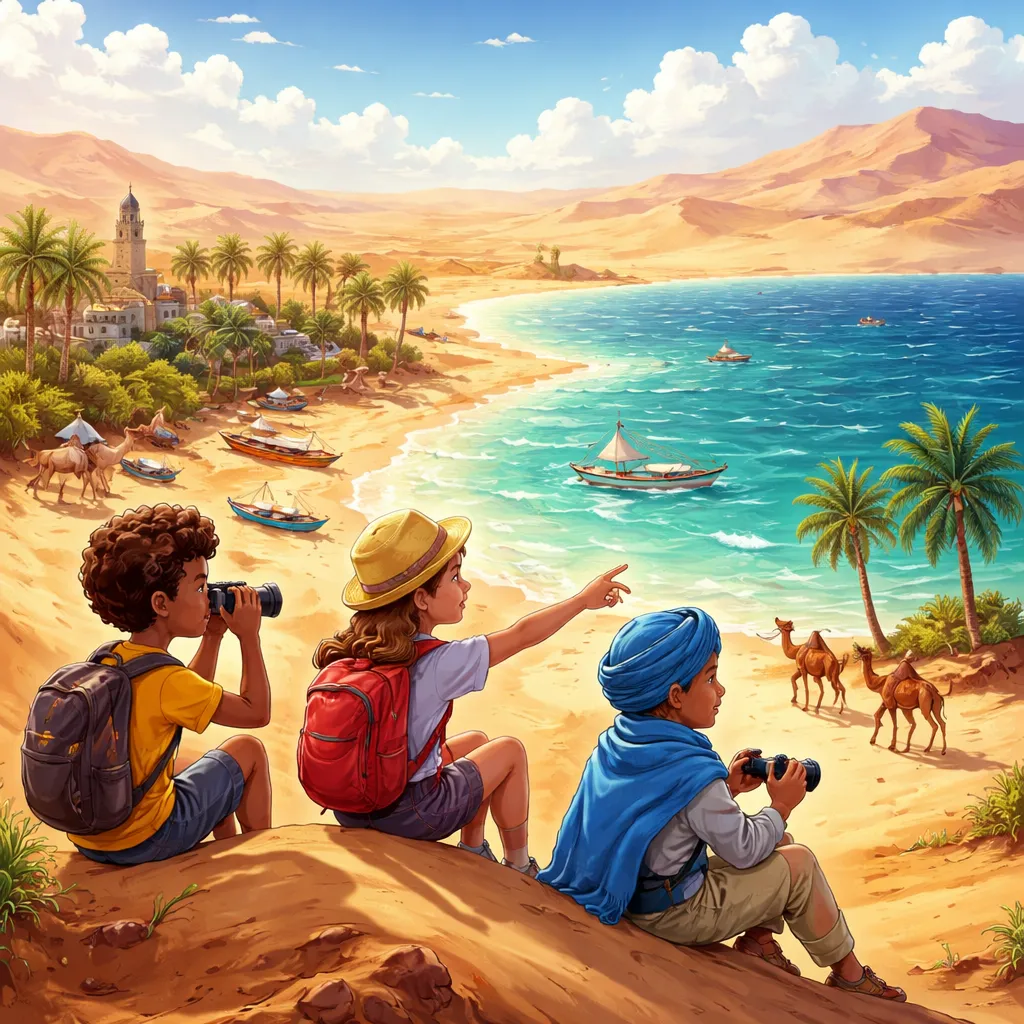

Introduction to Mauritania
Language learning transports us to lands where sand meets sea in a dramatic embrace. Today we explore a vast country where the Sahara Desert rolls all the way to the Atlantic Ocean. This nation holds ancient trading cities and endless dunes. Children will discover a place where trains carry iron ore across hundreds of miles of desert. They will learn about cities built from salt and stone. Exploring Mauritania builds reading skills while revealing a land of extremes. Every fact shows how people adapt to harsh environments. Every word invites young readers to imagine a world of sand, sea, and ancient traditions.
Where Is Mauritania?
Mauritania lies in West Africa along the Atlantic coast. It sits at the edge of the Sahara Desert. The country shares borders with Western Sahara, Algeria, Mali, and Senegal. The Atlantic Ocean forms its western boundary. The capital city is Nouakchott. Nouakchott stands on the coast where desert meets the sea. It is one of the largest cities in the Sahara region. Most of Mauritania sits within the Sahara Desert. The country ranks as one of the largest nations in Africa by land area. Yet most of that land remains empty desert. The Senegal River forms the southern border. This river brings life to an otherwise dry landscape. Finding Mauritania on a map shows a vast country bridging North and West Africa.
Interesting Facts About Mauritania
Mauritania offers many remarkable facts for young learners. It is one of the least densely populated countries in the world. Vast stretches of desert have almost no people. Another interesting fact involves the country's name. Mauritania comes from the ancient Berber kingdom of Mauretania. The name means land of the Moors. The country also holds a unique natural wonder. The Eye of the Sahara is a massive circular formation in the desert. Astronauts use it as a landmark from space. This geological feature stretches over thirty miles across.
Mauritania also has a famous train. The iron ore train ranks as one of the longest trains in the world. It stretches over one and a half miles long. People ride on top of the iron ore cars to travel across the desert. Another fun fact involves ancient cities. Chinguetti was a major trading and religious center hundreds of years ago. Its libraries hold thousands of ancient manuscripts. Some buildings in Chinguetti were constructed from salt blocks. The country also has coastal attractions. The Banc d'Arguin National Park protects wetlands where millions of birds gather. Migrating birds travel here from Europe each year. These facts show children a country of desert grandeur and coastal riches.
Key Vocabulary About Mauritania
Let us build vocabulary for this vast land. These words help children describe what they learn.
Desert: a dry area with little rain and few plants.
Dune: a hill of sand formed by wind.
Ore: rock or earth containing valuable metal.
Manuscript: a handwritten document or book.
Wetland: land covered with shallow water.
Caravan: a group of travelers journeying together.
Plateau: a flat, high area of land. Introduce these words with pictures and stories. Show the massive iron ore train crossing the desert. Show the ancient manuscripts in Chinguetti. Let children say each word aloud. These vocabulary words give children the language to explore Mauritania's unique landscape and history.
Simple Sentences for Reading Practice
Short sentences help new readers build confidence. Use these sentences about Mauritania for practice.
Mauritania is a country in West Africa.
The capital city is Nouakchott.
The Sahara Desert covers most of the country.
The Atlantic Ocean forms the western border.
A very long train carries iron ore.
Ancient libraries hold old manuscripts.
Birds gather in the coastal wetlands. Read each sentence together. Let children point to the words. Encourage them to repeat after you. Use pictures to show each fact. These simple sentences prepare young readers for longer passages.
Short Reading Passage About Mauritania
Here is a short passage for children to read together.
“Mauritania stretches across West Africa where the Sahara Desert meets the Atlantic Ocean. The capital, Nouakchott, sits on the coast. Most of the country lies within the desert. Sand dunes roll across the land for hundreds of miles. In the desert, a famous train carries iron ore. The train stretches so long that it takes hours to pass. People ride on top of the ore cars to travel across the sand. In the north, the ancient city of Chinguetti holds treasures. Its libraries contain thousands of handwritten manuscripts. Scholars once traveled here to study. The city also has buildings made from salt blocks. Along the coast, the Banc d'Arguin National Park protects wetlands. Millions of birds come here each year. They rest and feed in the shallow waters. The Eye of the Sahara sits in the desert. This giant circle of rock is so large that astronauts see it from space. Mauritania is a land of desert, coast, and ancient history.”
Read this passage slowly together. Pause to talk about each idea. Ask children to find vocabulary words in the text. This activity builds reading fluency and deepens understanding.
Fun Questions About Mauritania
Questions make reading interactive and engaging. Use these to start conversations with young learners.
What ocean borders Mauritania to the west?
What is the capital city of Mauritania?
What does the famous train carry across the desert?
What ancient city holds libraries with old manuscripts?
What national park protects coastal wetlands?
What geological feature can astronauts see from space? Let children answer in complete sentences. Encourage them to use new vocabulary. Ask them to imagine riding on the long iron ore train. What would they see from the top? Creative questions make the topic personal and exciting.
Tips for Learning English with This Topic
Use Mauritania to create rich English learning experiences. Start with a map activity. Let children find Mauritania on the coast of West Africa. Point out how the desert reaches all the way to the ocean. Discuss how this location creates a unique environment. This connects geography to the concept of desert-coast transition.
Next, introduce the vocabulary through a sensory activity. Create a small desert scene using sand in a shallow tray. Add toy trains or draw tracks across the sand. Talk about how the iron ore train crosses the desert. Let children move the train and describe what they see. Use the word "dune" to describe sand hills.
Read the passage aloud with a sense of vastness. Let your voice stretch out for the long distances. After reading, let children draw a scene from Mauritania. One child might draw the long iron ore train crossing sand dunes. Another might draw the Eye of the Sahara from space. Let them label their drawings with vocabulary words.
Incorporate a science and history connection. Talk about how the Eye of the Sahara formed. Explain in simple terms how erosion created this circle. Discuss why ancient scholars gathered in Chinguetti. This shows children that language learning reading connects to science and history.
Use music and movement to enhance the experience. Listen to traditional Mauritanian music with string instruments and voices. Let children move like a caravan crossing the desert. Pretend to ride on the iron ore train. Physical activity reinforces learning in joyful ways.
Encourage children to share their knowledge. Let them tell a family member about the longest train in the world. They can explain why birds gather at the coastal park. Teaching others builds confidence and deepens understanding.
Connect Mauritania to your child's world. Ask, “What trains have we seen?” Compare them to the iron ore train. Talk about birds in your area that migrate. Compare them to the millions of birds at Banc d'Arguin. Ask about deserts or sandy places you have visited. These connections help children see that language learning reading is about understanding places both near and far. By exploring Mauritania together, you give children a rich experience. They learn new words, discover a land where desert meets ocean, and grow their love for reading. This vast West African nation becomes a meaningful part of their learning journey.