
What Is This Plant?
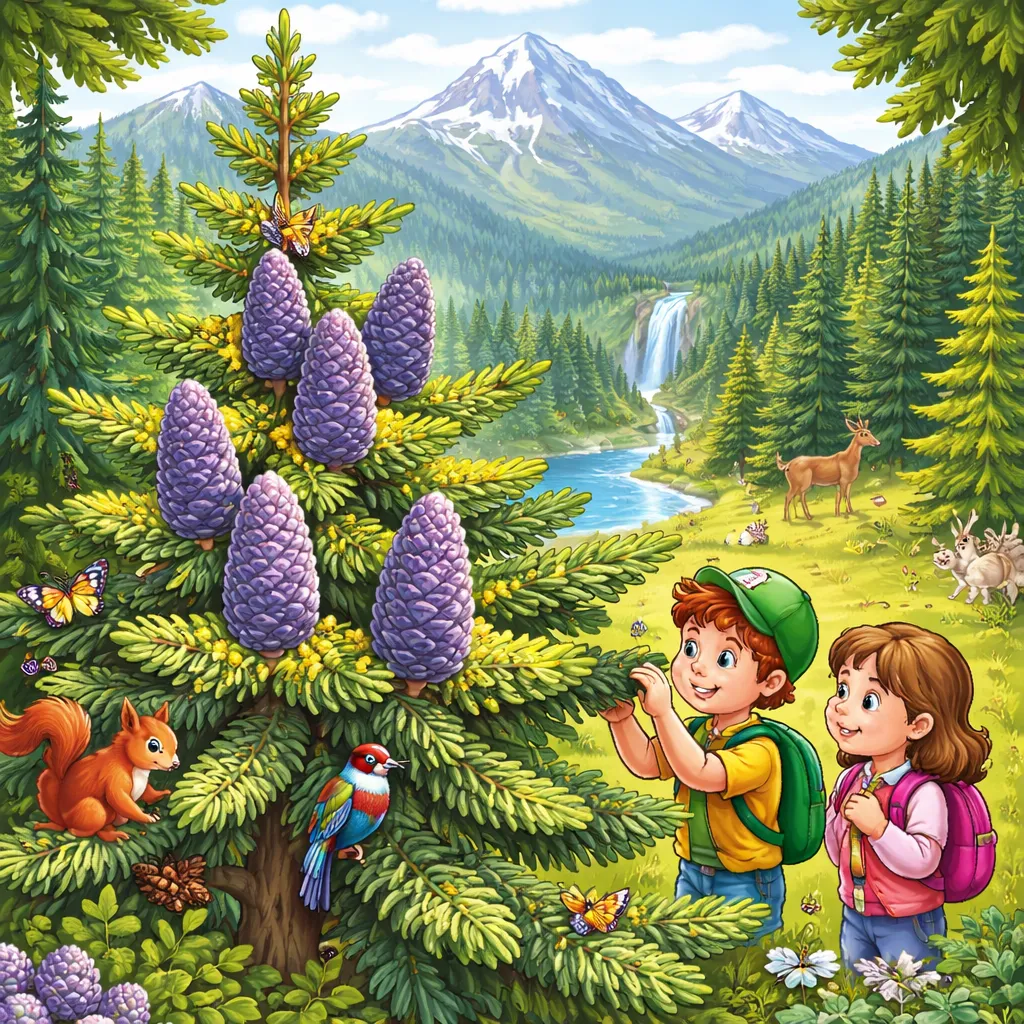
The fir plant is a tall, evergreen tree with flat, soft needles and upright cones that grow on the branches. It grows in mountain forests. The tree has a straight trunk that tapers to a point. The branches grow in whorls. The needles are flat and soft. They are not sharp like pine needles. They grow singly from the branches. The needles are dark green on top and have white stripes underneath. The cones are unique. They grow upright on the branches. They do not hang down like pine cones. The cones are cylindrical and stand straight up. They fall apart when they release seeds. For children, fir trees are like Christmas trees. They have soft needles and funny upright cones. Parents can take children to see fir trees in the mountains or plant one in the yard. Children love the soft needles and the upright cones. This plant teaches children about mountain ecosystems, evergreen trees, and the beauty of forests.
English Learning About This Plant
The English name “fir” comes from the Old English word “fyrh.” The pronunciation is “fur.” The International Phonetic Alphabet (IPA) is /fɜːr/. The word has one syllable. Children can say it: fur. When we learn about fir plant, we learn words for its parts. The needle is the flat, soft leaf with white stripes underneath. The cone is the upright, cylindrical structure that holds the seeds. The branch is the part that holds the needles and cones. The whorl is the circle of branches at one level on the trunk. The resin is the sticky sap that comes from the trunk. These words help children describe this mountain tree.
There is a famous saying about firs. They are popular Christmas trees. Another saying goes, “The fir tree stands tall in the mountains, reaching for the sky.” Parents can share these words with their child. They become gentle lessons about reaching high and staying strong. Firs are native to the Northern Hemisphere.
Plant Facts and Scientific Knowledge
The fir plant belongs to the genus Abies. There are about 50 species. Firs are members of the pine family, Pinaceae. They are conifers. They are evergreen. They keep their needles all year. They are native to the mountains of North America, Europe, Asia, and North Africa.
Fir needles are flat and soft. They are not sharp. They grow singly from the branches. The needles are attached to the branch by a base that looks like a suction cup. When the needle falls, the base remains. The needles are dark green on top. They have two white stripes underneath. These stripes are rows of stomata for gas exchange.
Fir cones are unique. They grow upright on the branches. They do not hang down. The cones are cylindrical. They can be two to eight inches long. They grow at the top of the tree. When the seeds are ripe, the cones fall apart. You rarely find a whole fir cone on the ground.
Fir trees are important. They provide wood for building. They are used as Christmas trees. They provide habitat for wildlife. They also help clean the air.
Firs have symbolic meaning. They represent strength, hope, and the Christmas season. They are symbols of the mountains. They are trees of endurance.
How to Grow and Care for This Plant
Growing a fir plant requires patience. Plant a young fir tree in spring or fall. Choose a sunny spot. Firs need full sun to partial shade. They need well-drained soil. They like cool, moist conditions.
Dig a hole twice as wide as the root ball. Place the tree in the hole. Fill with soil. Water well. Children can help by holding the tree straight while you fill the hole.
Water young firs regularly during the first year. They need consistent moisture. Do not let the soil dry out. Once established, they are more drought-tolerant. Mulch around the base keeps the soil moist.
Firs need little fertilizer. A light feeding in spring is enough. Do not overfeed. Prune only to remove dead branches. Firs do not need much pruning.
Firs grow slowly. They can take many years to become large. Be patient. They will reward you with a beautiful, symmetrical tree.
Benefits of Growing This Plant
Growing a fir plant brings many gifts to a family. First, firs are beautiful. They have a perfect, symmetrical shape. The soft needles are lovely to touch. Second, firs are classic Christmas trees. They bring holiday joy.
Firs clean the air. They absorb carbon dioxide and release oxygen. Children learn that trees help us breathe.
Firs provide habitat for wildlife. Birds and squirrels live in them. Children can watch the animals.
Firs also teach about patience. They grow slowly. Children learn that growth takes time.
What Can We Learn From This Plant
A fir plant teaches children about reaching high. The tree grows tall and straight. It reaches for the sky. Children learn that they can reach for their goals. They can grow tall.
Firs also teach about patience. They grow slowly. They take years to become large. Children learn that growth takes time. They can be patient.
Another lesson is about giving. Firs are used as Christmas trees. They bring joy to families. Children learn that they can give joy to others.
Firs also teach about the mountains. They grow in high places. Children learn that different trees grow in different places. They can appreciate the diversity of nature.
Fun Learning Activities
There are many simple activities to help children learn about fir plant. One activity is a needle study. Look at a fir needle. It is flat and soft. There are white stripes underneath. Compare it to a pine needle. This builds observation.
Another activity is a cone study. Look for fir cones on the tree. They grow upright. If you find a whole cone, touch it. The scales are soft. See how the cone falls apart. This teaches about seed dispersal.
A nature journal works well for firs. Draw the tall, symmetrical tree. Draw the flat needles with white stripes. Draw the upright cones. Label the parts: needle, cone, branch, whorl. Write the date when you saw the tree.
For art, try painting firs. Use dark green paint for the needles. Use brown for the trunk and cones. Paint the tall, pointed tree. This creates a mountain forest picture.
Vocabulary games are fun too. Write the words fir, needle, cone, upright, whorl, and mountain on cards. Say each word. Ask your child to point to the part on the tree. Practice saying fir together.
Finally, try a Christmas tree activity. Talk about how firs are used as Christmas trees. Decorate a small fir tree with ornaments. This connects the tree to holiday traditions.
Through these activities, children build a deep connection with a tree that stands tall in the mountains. They learn new words, study upright cones, and discover the joy of patience. The fir plant becomes a symbol of reaching high and giving joy. Each time they see a fir tree, children remember that they can reach for the sky. They remember that growth takes time. This mountain tree opens a world of forest wonder, cone science, and the lasting lesson that the trees with soft needles and upright cones teach us to stand tall and give joy.