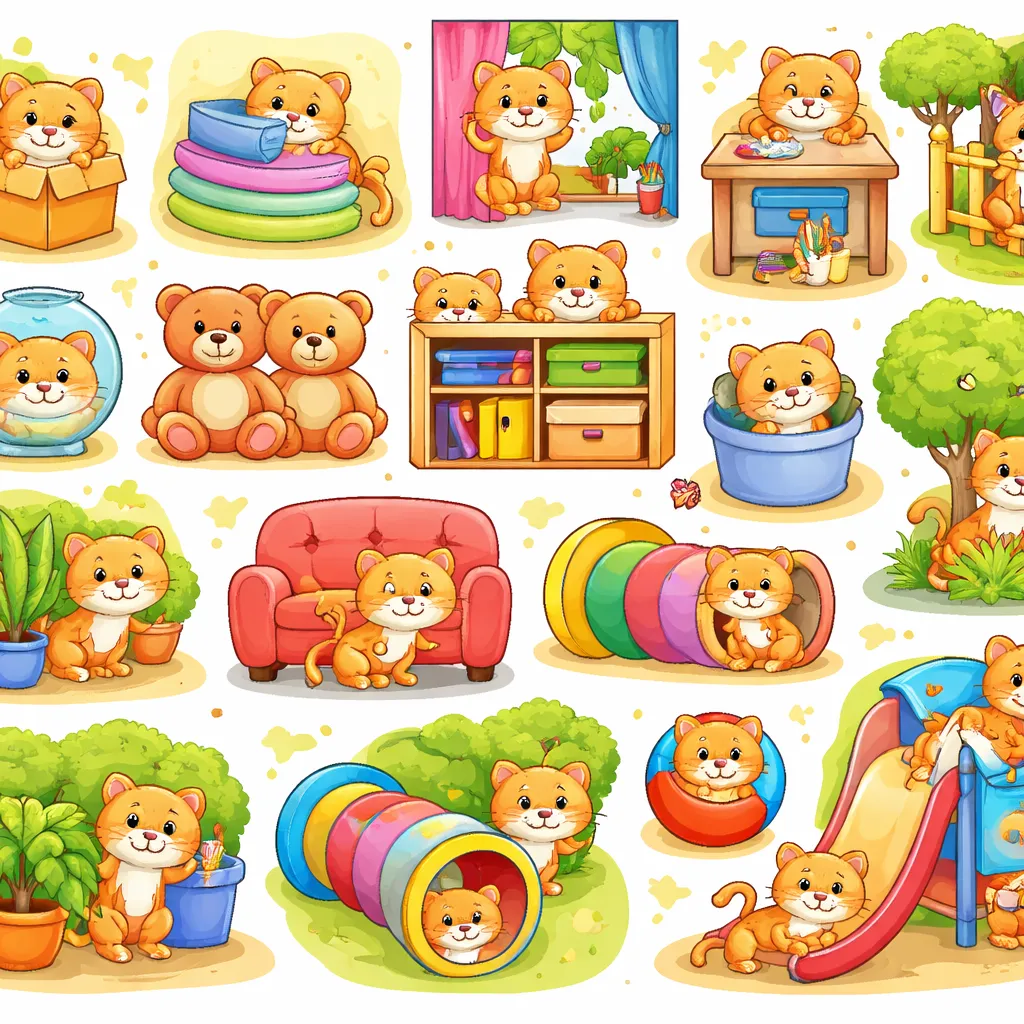

Hello, little explorer! Is the toy on the bed? Is the dog under the table? Are you at school? Words like 'on', 'under', and 'at' are very special. They are prepositions. A preposition is a word that shows where or when something is. It shows the relationship between things. Think of it as a little map word. Today, we will find one hundred of the most common prepositions. Your guide is Pip the Preposition Pirate. Pip has a treasure map. He uses prepositions to find the 'X'! He will show you how to use these map words at home, in the park, at school, and outside. Let's go on a word hunt!
What Is a Preposition? A preposition is a word that shows location, time, or direction. It connects a noun or pronoun to another word in the sentence. It often tells us where something is. The ball is on the box. The ball is in the box. The ball is under the box. 'On', 'in', and 'under' are prepositions. They show the ball's place. They can also tell us when. I eat at noon. I sleep at night. 'At' is a preposition. We will discover one hundred of these helpful map words.
Why Learn These Map Words? Prepositions help you give clear directions. They help your ears listen. You can understand where things are. "Put the cup on the table." You know exactly what to do. They help your mouth speak. You can tell people where to find things. "My toy is under my bed." They help your eyes read. You can follow the action in a story. "The cat ran up the tree." They help your hand write. You can write notes and stories that make sense. "We played at the park after school." Knowing these one hundred most common prepositions helps you navigate your world.
What Do Prepositions Show Us? Pip says prepositions can draw three kinds of maps. Let's read them!
Prepositions of Place (Where?): These are the most common! They show location. in, on, at, under, over, above, below, between, beside, next to, behind, in front of, inside, outside, near, far from. "The cat is on the chair." "I stand beside my mom."
Prepositions of Time (When?): These show time. at, on, in, before, after, during, until, since, for. "I go to bed at eight." "My birthday is on Monday."
Prepositions of Direction/Movement (Which way?): These show movement from one place to another. to, from, into, onto, off, around, through, across, up, down, along, past. "I walk to school." "The ball rolled across the floor."
How Can You Find a Preposition? You can be a preposition hunter! Ask these questions.
Ask: Where is it? Look for words that tell you a location. The answer is often a preposition of place. The book is on the table. The dog is in the house.
Ask: When is it? Look for words that tell you a time. The answer is often a preposition of time. I play after lunch. We sleep at night.
Look for a small word before a noun or pronoun. Prepositions are often short words. They are usually followed by a noun or pronoun. in the box, on me, with you, at home. The word 'the', 'my', 'you', or 'home' is the object of the preposition.
Look for words that link places, times, or things. Words like 'to', 'for', 'with', 'of' show a relationship. "I go to the park." "This is for you."
Pip shows us. Look at "The bird flew through the sky before noon." Find the nouns: 'bird' and 'sky'. Ask: Where did it fly? Through the sky. 'Through' is a preposition. Ask: When did it fly? Before noon. 'Before' is a preposition.
How Do We Use These Map Words? A preposition is almost always part of a phrase. The pattern is: [Preposition] + [Noun/Pronoun]. This is called a prepositional phrase. "in the car", "with my friend", "after you".
This phrase can tell 'where': Put the toy on the shelf. It can tell 'when': I will see you after school. It can tell 'how': I cut the paper with scissors.
The phrase usually comes after the verb or at the start of a sentence. "The cat is on the mat." "After dinner, we read a book."
Let's Fix Some Mixed-Up Maps. Sometimes we use the wrong map word. Let's fix the directions.
Confusing 'in', 'on', 'at' for place. "I am in school." This means inside the building. "I am at school." This is more general, meaning the school location. For surfaces, use 'on'. "The book is on the desk."
Using 'to' when you need 'at'. "I am to home." 'To' shows movement toward home. If you are already there, use 'at' or 'in'. "I am at home." or "I am in my house."
Forgetting the preposition. "I am looking my shoes." You look for something. "I am looking for my shoes."
Using the wrong preposition of time. "I will see you in Monday." For days, use 'on'. "I will see you on Monday." For clock time, use 'at'. "I will see you at three o'clock."
Can You Be the Map Maker? You are great at this! Let's play. Where is your toy? Is it on the bed? Say: "It is on the bed." Is it under the bed? Say: "It is under the bed." Are you sitting at the table? Say: "I am at the table." Perfect! You are giving great directions.
Pip's Pirate Map: 100 Most Common Prepositions. Here is your treasure map of one hundred common prepositions. Use them to find your way!
Place (Where? - 50 words): about, above, across, after, against, along, among, around, at, before, behind, below, beneath, beside, between, beyond, by, down, from, in, inside, into, near, off, on, onto, opposite, out, outside, over, past, through, throughout, to, toward, under, underneath, up, upon, within, without, ahead of, away from, close to, in front of, in the middle of, next to, on top of, out of.
Time (When? - 25 words): about, after, around, as, at, before, by, during, for, from, in, on, since, through, throughout, till, until, to, toward, within, without, prior to, ahead of.
Direction/Movement/Other (25 words): about, above, across, along, among, around, at, before, behind, below, beneath, beside, between, beyond, by, down, for, from, in, into, of, off, on, onto, out, outside, over, past, through, to, toward, under, up, upon, with, without, according to, because of, due to, instead of.
Examples in Your World.
At Home: "The cat is on the sofa. The milk is in the fridge. I sleep in my bed. I eat at the table. I play with my sister."
At the Playground: "I go down the slide. The ball rolled under the bench. I swing with my friend. We play until dinner. I climb up the ladder."
At School: "My book is in my bag. Sit beside me. Write with a pencil. School starts at nine. Line up behind me."
In Nature: "The bird is in the tree. The worm is under the rock. We walk through the park. The sun goes down at night. The fish swims in the water."
You Are Now a Word Navigator! You did it! You know that a preposition is a map word. It shows where, when, or how things are related. You can find prepositions by asking "where" or "when". You know place words like in, on, under. You know time words like at, on, in. You know direction words like to, from, up. Pip the Pirate gives you a golden map. You have learned one hundred of the most common prepositions. You can now give perfect directions.
Here is what you learned from our treasure hunt. You know a preposition shows a relationship between things. You can use prepositions to tell where something is. You can use prepositions to tell when something happens. You have a big list of one hundred common map words.
Now, let's do some life practice! Your mission is today. Give directions to find your favorite toy. Use two prepositions. Say: "My toy is in the box under my bed." Then, tell your family about your day using 'at', 'on', and 'with'. Say: "I was at school. I drew on paper with crayons." Keep using your map words!