
Introduction to Netherlands
Language learning transports us to a land below sea level, where windmills turn against the sky. Today we explore a country famous for its canals, tulips, and bicycles. This nation has shaped the sea itself to create its homeland. Children will discover a place where people ride bikes more than they drive cars. They will learn about colorful fields of flowers stretching to the horizon. Exploring Netherlands builds reading skills while revealing a country of innovation and beauty. Every fact uncovers something unique. Every word invites young readers to imagine life in this low-lying land.
Where Is Netherlands?
Netherlands lies in Western Europe along the North Sea. It shares borders with Germany to the east and Belgium to the south. The North Sea forms its northern and western boundaries. The capital city is Amsterdam. Amsterdam sits on a network of canals that ring through the city. The seat of government is in The Hague. The country covers about sixteen thousand square miles. Much of the land sits below sea level. Dikes and dunes protect the country from the sea. Finding Netherlands on a map shows a small country on the coast of Western Europe. Its location made it a center of trade for centuries.
Interesting Facts About Netherlands
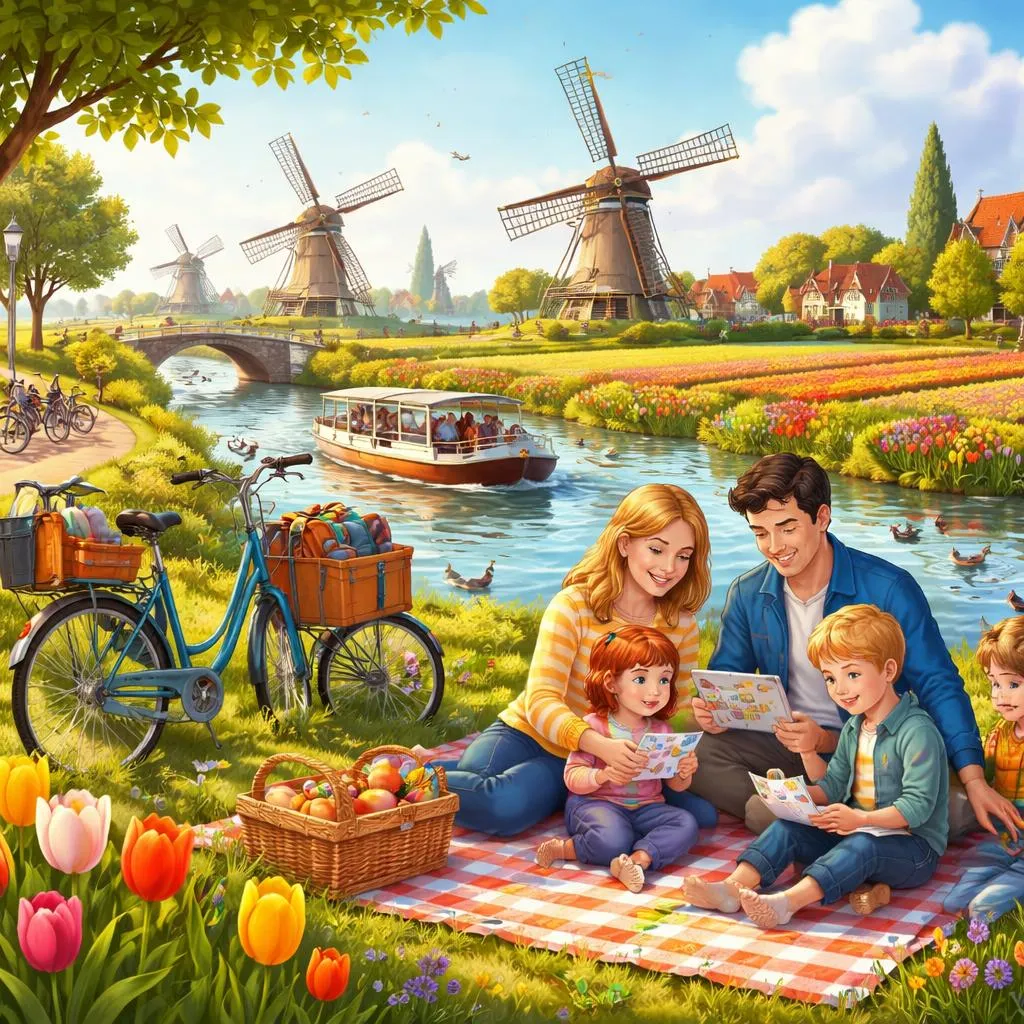
Netherlands offers countless fascinating facts for young learners. Much of the country lies below sea level. Dutch people built dikes to hold back the water. Without these barriers, much of the country would be underwater. Another interesting fact involves windmills. Windmills once pumped water from the land and ground grain. Today, over one thousand windmills still stand. Kinderdijk has nineteen windmills in one area, recognized by UNESCO.
Netherlands also has a famous flower industry. The country produces about three billion tulip bulbs each year. In spring, fields burst with red, yellow, and purple flowers. The Keukenhof garden draws visitors from around the world. Another fun fact involves bicycles. Netherlands has more bicycles than people. Amsterdam alone has over eight hundred thousand bikes. Bike lanes crisscross every city.
The country also has a unique relationship with water. Canals form a network through cities. Amsterdam has over one hundred miles of canals and fifteen hundred bridges. Another interesting fact involves cheese. The Dutch produce famous cheeses like Gouda and Edam. Traditional cheese markets still operate in some cities. Netherlands also has a royal family. King Willem-Alexander serves as the current monarch. These facts show children a country shaped by water, flowers, and cycling.
Key Vocabulary About Netherlands
Let us build vocabulary for this low-lying nation. These words help children describe what they learn.
Dike: a wall built to hold back water.
Polder: land reclaimed from the sea or a river.
Windmill: a structure with sails that uses wind power.
Canal: a man-made waterway for boats.
Tulip: a brightly colored flower that grows from a bulb.
Bicycle: a two-wheeled vehicle powered by pedaling.
Bicycle Lane: a path designated for cyclists. Introduce these words with pictures and stories. Show a dike holding back water. Show rows of colorful tulips. Let children say each word aloud. These vocabulary words give children the language to explore Netherlands' unique landscape and culture.
Simple Sentences for Reading Practice
Short sentences help new readers build confidence. Use these sentences about Netherlands for practice.
Netherlands is a country in Western Europe.
The North Sea borders Netherlands to the west.
The capital city is Amsterdam.
Much of the land lies below sea level.
Windmills once pumped water from the land.
Fields of tulips bloom in spring.
People ride bicycles everywhere. Read each sentence together. Let children point to the words. Encourage them to repeat after you. Use pictures to show each fact. These simple sentences prepare young readers for longer passages.
Short Reading Passage About Netherlands
Here is a short passage for children to read together.
“Netherlands sits along the North Sea in Western Europe. Much of this land lies below sea level. The Dutch built dikes to keep the ocean out. They created polders—land reclaimed from the water. Windmills once pumped water from these polders. Today, windmills still stand as symbols of this battle against the sea. Canals cut through cities like Amsterdam. Boats glide along the water. Bicycles fill the streets. More bikes than people live in this country. In spring, the land explodes with color. Tulip fields stretch for miles. Red, yellow, pink, and purple stripes cover the landscape. Farmers grow billions of tulip bulbs each year. The capital, Amsterdam, draws visitors with its narrow houses and historic bridges. The government meets in The Hague. Dutch people enjoy cheese from local markets. Gouda and Edam names come from towns here. Netherlands shows how people can work with nature to create a homeland.”
Read this passage slowly together. Pause to talk about each idea. Ask children to find vocabulary words in the text. This activity builds reading fluency and deepens understanding.
Fun Questions About Netherlands
Questions make reading interactive and engaging. Use these to start conversations with young learners.
What sea borders Netherlands to the west?
What is the capital city of Netherlands?
Why does much of Netherlands lie below sea level?
What flowers are Netherlands famous for?
How many bicycles are there compared to people?
What is a polder? Let children answer in complete sentences. Encourage them to use new vocabulary. Ask them to imagine riding a bicycle through Amsterdam. What would they see along the canals? Creative questions make the topic personal and exciting.
Tips for Learning English with This Topic
Use Netherlands to create rich English learning experiences. Start with a map activity. Let children find Netherlands on the coast of Western Europe. Point out how much land lies near or below sea level. Discuss why dikes and windmills became so important.
Next, introduce the vocabulary through a hands-on activity. Create a simple dike using clay or sand. Let children build a wall to hold back water in a shallow tray. For windmills, make paper windmills and watch them spin in the wind. Use the words "dike," "polder," and "windmill" during the activity.
Read the passage aloud with energy and appreciation. Let your voice reflect the ingenuity of the Dutch people. After reading, let children draw a scene from Netherlands. One child might draw a windmill beside a canal with tulips in the background. Another might draw a bicycle lane filled with riders. Let them label their drawings with vocabulary words. Add blue for water and bright colors for the tulips.
Incorporate a science and engineering connection. Talk about how dikes work to hold back water. Discuss how windmills use wind power to pump water. This shows children that language learning reading connects to understanding how people solve problems.
Use music and movement to enhance the experience. Listen to Dutch folk music. Let children move like windmill sails turning. Pretend to ride a bicycle through a city. Physical activity reinforces learning in joyful ways.
Encourage children to share their knowledge. Let them tell a family member about the land below sea level. They can explain why tulips are so important in Netherlands. Teaching others builds confidence and deepens understanding.
Connect Netherlands to your child's world. Ask, “What flowers grow near our home?” Compare them to tulip fields. Ask about how water is managed in your area. Compare to dikes and canals. These connections help children see that language learning reading is about understanding how different places face different challenges. By exploring Netherlands together, you give children a rich experience. They learn new words, discover a land of windmills and flowers, and grow their love for reading. This European nation becomes a meaningful part of their learning journey.