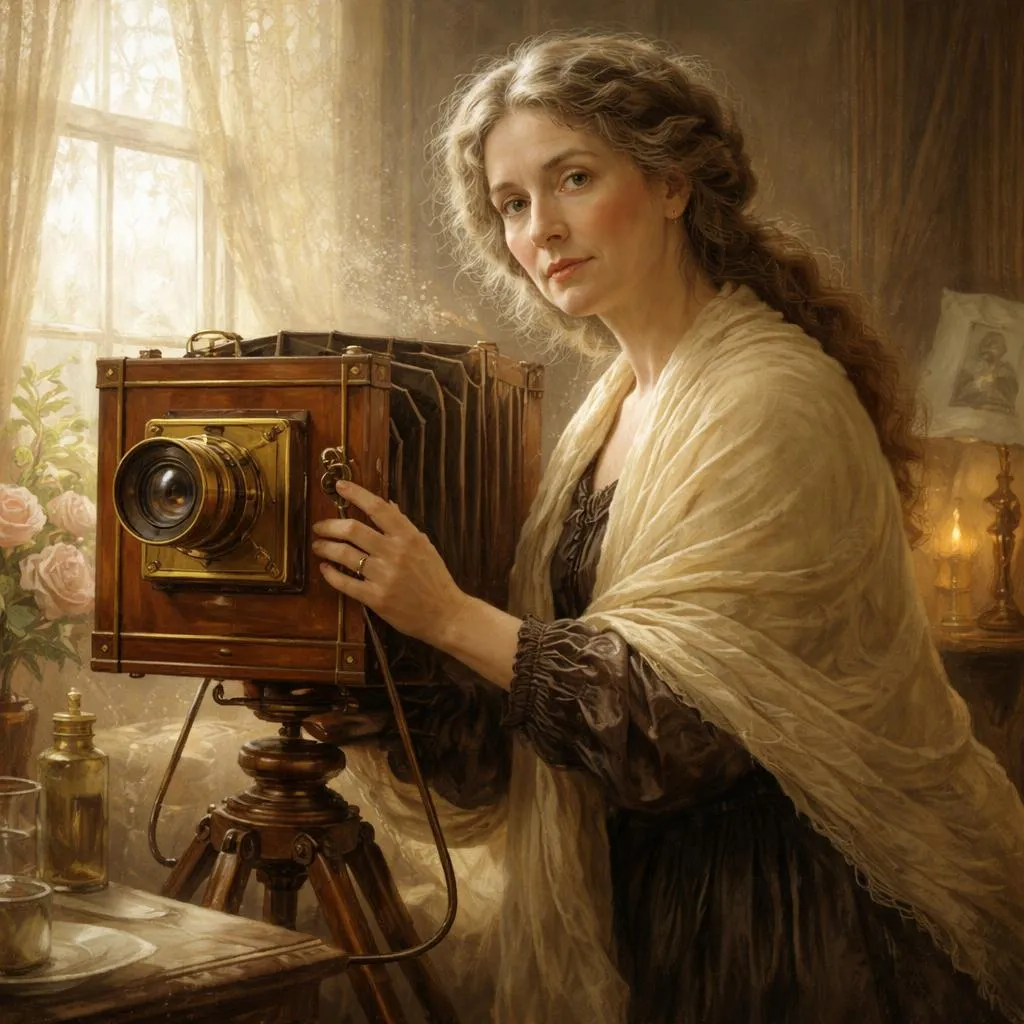

Have you ever seen a photo of a woman that looks blurry, like a dream? The edges are soft. The light is glowing. The face looks like an angel. That is a Julia Margaret Cameron photograph. She took photos that looked like paintings from the Renaissance. This Celebrity Story: Julia Margaret Cameron will introduce you to a woman who started photography late in life. She was 48 years old. Her daughter gave her a camera. She was hooked. She turned a chicken coop into a studio. She bothered her famous friends to sit for her. She photographed the poet Alfred Lord Tennyson. She photographed the scientist Charles Darwin. She photographed the actress Ellen Terry. Her photos were not sharp. Critics laughed at her. She did not care. She said, "I longed to arrest the beauty of the living."
Let us meet the grandmother of artistic photography. Julia Margaret Cameron invented the close-up portrait.
Who Is This Celebrity?
Julia Margaret Cameron was a British photographer. She lived from 1815 to 1879. She is one of the most important portrait photographers in history. She started photography when she was 48. She only worked for 11 years. In that short time, she created a body of work that changed photography forever.
Why is she famous? She made photography into an art form. Before her, photography was mostly used for documentation. Sharp focus. Plain backgrounds. She made it soft. She made it dreamy. She created allegorical images. She dressed her subjects in costumes. She photographed them as characters from Shakespeare or the Bible. Her portraits are intimate and powerful. She influenced generations of photographers.
Early Life and Childhood
Julia Margaret Cameron was born in Calcutta, India. Her father was a British official. Her mother was from a French aristocratic family. She was the second of five daughters. The family was wealthy. She grew up in India. She returned to England for her education.
She was not a beautiful child. She had dark skin and dark hair. Her sisters were fair. She felt like an outsider.
She loved to read. She loved poetry. She also loved to draw. She wanted to be an artist. Her family discouraged her. Women were not supposed to be artists.
She married Charles Cameron in 1838. He was a lawyer. He was much older. He was also kind. They moved to India. He worked for the government. She raised a family. She had six children. She also wrote. She published poetry.
In 1848, the family returned to England. They lived in London. She socialized with artists and writers. She was friends with the poet Alfred Lord Tennyson.
In 1860, they moved to the Isle of Wight. They lived near Tennyson. She was 45. She was bored. She wanted something to do.
Education and Learning Journey
Julia Margaret Cameron did not study photography. There were no photography schools. She learned from a friend. She learned to use a large-format camera. The camera was heavy. The exposure times were long. A subject had to sit still for minutes.
She learned to develop film. She learned to print. She used a process called the wet-plate collodion process. It was messy and dangerous. She worked with chemicals. She worked in the dark. She loved it.
Her daughter gave her a camera in 1863. She was 48. She converted a chicken coop into a darkroom. She used a glass skylight as her studio. She begged her friends and servants to pose for her.
She photographed everyone. The poet Tennyson. The scientist Darwin. The painter Watts. Her maids. Her children. Her friends. She took over 900 photographs in 11 years.
She did not want sharp focus. She wanted soft focus. She wanted the lens to be slightly out of focus. She said it made the images more spiritual. The critics said she could not focus her camera. She said she knew exactly what she was doing.
How Did They Become Successful?
Julia Margaret Cameron became successful in her lifetime. She was not a commercial success. She did not make much money. But she was respected by other artists.
She sent her photographs to the Victoria and Albert Museum in London. The museum bought many of her prints. She was given a solo exhibition. She was praised by the poet Tennyson. He asked her to illustrate his book "Idylls of the King." She made 25 photographs for the book. They are masterpieces.
She also made photographic illustrations for a translation of the Bible. She spent months on the project. She used friends and neighbors as models. The images are dramatic and powerful.
She was not accepted by the photographic establishment. They wanted sharp focus. She gave them soft focus. They wanted documentary realism. She gave them allegory. They laughed. She ignored them.
She continued to work until her death in 1879. She was 64 years old. She died in Sri Lanka. She had traveled there to visit her husband's family.
Big Ideas and Achievements
Julia Margaret Cameron's biggest idea was that photography could be art. It could be as expressive as painting. It could tell stories. It could capture the soul.
Her greatest achievement is her portrait of the poet Tennyson. He looks wise and tired. His beard is wild. His eyes are deep. The photo is in the National Portrait Gallery in London.
Another huge achievement is her portrait of the scientist Charles Darwin. He looks like a prophet. His heavy brow. His long beard. The photo is iconic.
She also made a series of portraits of the young actress Ellen Terry. Terry was 16. She was beautiful. Cameron photographed her as the Greek goddess of love, Venus. The photos are dreamy and sensual.
She also photographed the painter G.F. Watts. He looks like an old sage. His eyes pierce the camera.
She also made many photographs of children. They are dressed as angels. They are soft and innocent.
She influenced many photographers. The soft-focus portraits of the 20th century owe a debt to Cameron.
Challenges and Difficult Times
Julia Margaret Cameron faced many challenges. First, she started late. She was 48. Most photographers start young.
Second, she was a woman. The field was dominated by men. They dismissed her.
Third, her technique was unconventional. She intentionally used soft focus. Critics said she was incompetent.
Fourth, she was not wealthy. She had to beg for supplies. She used thin paper because it was cheap.
Fifth, she died in Sri Lanka. Her work was forgotten for decades. In the 20th century, it was rediscovered. Now she is a giant.
Fun Facts About the Celebrity
Julia Margaret Cameron was very short. She was just over five feet tall.
Another fun fact: She called her subjects "victims." She said she victimized them into sitting for her.
She used her maids as models. They dressed as angels and saints.
She was messy. Her darkroom was a disaster. Chemicals were everywhere.
One more fact: She named her camera "the head of my soul."
Why Is This Celebrity Important Today?
Julia Margaret Cameron is important because she was the first person to treat photography as art. Before her, photography was a tool. She made it a vision.
She is also important because she started late. She was 48. It is never too late to find your passion.
Her influence is seen in every soft-focus portrait. Every photographer who tries to capture the soul of a subject is following Cameron.
Parents can use her story to teach children that it is never too late to start something new.
What Can Kids Learn from This Story?
Kids can learn wonderful lessons from Julia Margaret Cameron. First, it is never too late. Cameron started photography at 48. You are never too old to learn something new. You are never too old to find your passion.
Second, ignore the critics. People laughed at Cameron's photos. She ignored them. She knew what she wanted. Do not let critics stop you.
Third, ask people to pose. Cameron asked her famous friends to sit for her. She was not shy. Ask people to be in your art. They might say yes.
Finally, make art for yourself. Cameron did not make much money. She made art because she loved it. Make art because you love it.
Quick Quiz or Practice Time
Let us see what you learned from this Celebrity Story: Julia Margaret Cameron. Answer these questions with a parent or by yourself.
How old was Julia Margaret Cameron when she received her first camera?
What did she convert into a darkroom?
What famous poet was Cameron's neighbor and friend?
What did critics say about Cameron's soft focus?
What did Cameron name her camera?
Here is a fun activity. Take a photo of a family member. Ask them to sit very still. Use natural light from a window. Then, using a photo editing app, add a soft blur. Make it dreamy. You are photographing like Julia Margaret Cameron.
Another activity. Look up Julia Margaret Cameron's portrait of Charles Darwin. He looks like a prophet. Then draw a portrait of someone you think is wise. Your grandparent. Your teacher. Try to capture their wisdom.
Julia Margaret Cameron was born in India. She moved to England. She married. She had children. She was bored. Her daughter gave her a camera. She was 48. She turned a chicken coop into a darkroom. She photographed poets and scientists. She used soft focus. Critics laughed. She ignored them. She made art. She died. Her work was forgotten. It was rediscovered. Now she is a legend. Her story teaches us that it is never too late. To ignore critics. To ask people to pose. To make art for ourselves. That is the real lesson of this celebrity story.