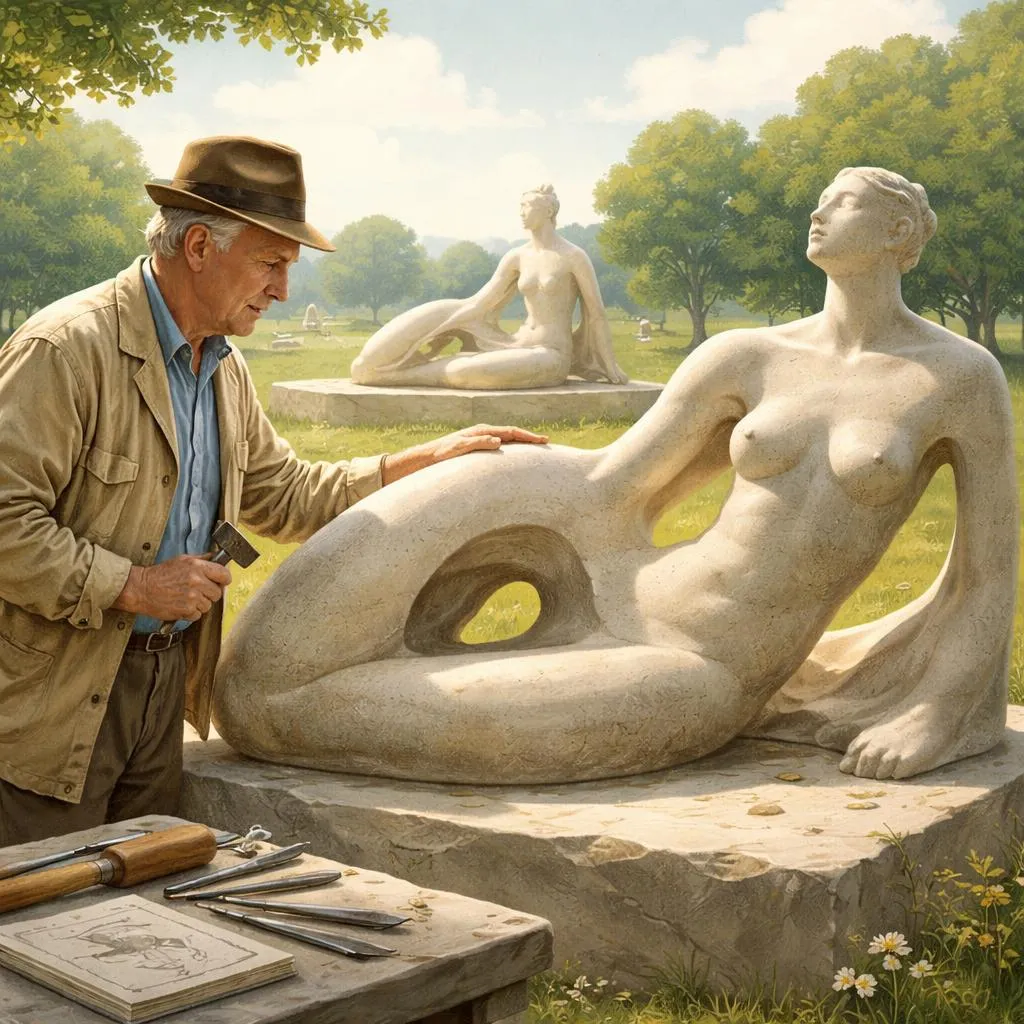

Have you ever seen a huge stone woman lying on her side? Her body is smooth and curved. She looks like a hill. She also looks like a person. And there is a hole where her middle should be. You can see through her. That is a Henry Moore sculpture. This Celebrity Story: Henry Moore will introduce you to an artist who made the human body look like a landscape. He carved figures that felt ancient and modern at the same time. He placed his sculptures in fields and parks. He wanted them to become part of nature. He survived two world wars. He saw terrible things. He turned that pain into peaceful, powerful art.
Let us meet the sculptor of mothers and children. Henry Moore changed how we see the human body.
Who Is This Celebrity?
Henry Moore was a British sculptor. He lived from 1898 to 1986. He is one of the most famous sculptors of the 20th century. He is best known for his large bronze and stone sculptures of reclining figures. These figures are often women. They have holes through their bodies. The holes are as important as the solid parts.
Why is he famous? He took the human figure and simplified it into abstract shapes. A woman became a series of hills and valleys. A mother and child became two rounded forms leaning together. He also created sculptures for public spaces. You can see his work in parks and plazas around the world. He donated many sculptures to the Tate Gallery in London. He also made drawings of people hiding in subway tunnels during World War II. Those drawings are also famous.
Early Life and Childhood
Henry Moore was born in Castleford, a mining town in northern England. He was the seventh of eight children. His father was a coal miner. His mother stayed home with the children.
The town was rough and dirty. Coal dust covered everything. But the countryside was nearby. Young Henry loved to walk in the fields. He loved the shapes of rocks and tree roots.
He was a good student. He wanted to become a sculptor. His father wanted him to become a teacher. Teaching was a safer job. Henry became a teacher. He taught at a school for young boys. He hated it.
When World War I broke out, he volunteered for the army. He was 18 years old. He fought in the Battle of Cambrai. He was gassed. He was injured. He saw friends die. The war changed him forever.
After the war, he received a government grant to study art. He finally became an art student. He was 21 years old.
Education and Learning Journey
Henry Moore studied at the Leeds School of Art. He learned to draw. He also studied at the Royal College of Art in London. He learned to sculpt.
He was interested in non-European art. He visited the British Museum. He looked at ancient Egyptian, Mexican, and African sculptures. Those artists simplified the human body into powerful shapes. He was inspired.
He also traveled to Paris. He saw the work of modern sculptors like Constantin Brancu?i. Brancu?i simplified forms to their essence. Moore was influenced.
He began to carve directly into stone and wood. He did not make clay models first. He worked with the material. He let the stone guide him.
In the 1920s, he started making reclining figures. He said the reclining figure allowed him to explore form in three dimensions. The figure could twist and turn. It could have holes.
He became a teacher at the Royal College of Art. He was a good teacher. He encouraged his students to experiment.
How Did They Become Successful?
Henry Moore became successful in the 1930s. He was part of a group of avant-garde artists in London. They called themselves Unit One. They exhibited together. Critics noticed Moore's work.
His sculptures were abstract. They were not realistic. Some people hated them. But collectors bought them.
In the 1940s, World War II broke out. Moore was too old to fight. He was asked to draw scenes of Londoners sheltering from bombs. The London subway stations became dormitories. People slept on the platforms. Moore drew them. He drew families huddled together. He drew rows of sleeping figures. These drawings became famous. They showed the resilience of ordinary people.
After the war, Moore's reputation grew. He received commissions for public sculptures. He made "King and Queen" for a Scottish hillside. He made "Reclining Figure" for the UNESCO building in Paris. He made "Knife Edge Two Piece" for the Houses of Parliament in London.
He became a celebrity. He was interviewed on television. His face was on magazine covers. He was awarded the Order of Merit, one of Britain's highest honors.
He continued to work until his death in 1986. He was 88 years old.
Big Ideas and Achievements
Henry Moore's biggest idea was that the human body could be abstract and still feel human. He said, "The human figure is the most important thing in sculpture."
His greatest achievement is his reclining figures. He made hundreds of them. They are in museums and parks all over the world. The Tate Gallery in London has a huge collection. The Art Gallery of Ontario in Canada also has many.
Another huge achievement is his large public sculptures. He believed that sculpture should be outside, not just in museums. He placed his work in fields, parks, and plazas. People could walk around them. Children could climb on them. The sculptures became part of everyday life.
He also achieved something rare: he became wealthy and famous from sculpture. Most sculptors struggle. Moore was a commercial success. He sold his work for high prices. He used his wealth to help young artists.
He also made many drawings and prints. His drawings of sleeping figures during the war are masterpieces. His late drawings of elderly people are also powerful.
He influenced generations of sculptors. You can see his influence in the work of Barbara Hepworth and other British sculptors.
Challenges and Difficult Times
Henry Moore faced many challenges. First, he grew up poor in a mining town. His father worked underground. Henry knew hardship.
Second, World War I was traumatic. He was gassed. He saw his friends die. He never forgot.
Third, he struggled to find his style. His early work was influenced by others. He had to find his own voice.
Fourth, his work was attacked by critics. Some called it ugly. Some said it was not art. He ignored them.
Fifth, World War II interrupted his work. He spent years drawing shelters instead of sculpting. But those drawings became an important part of his legacy.
Fun Facts About the Celebrity
Henry Moore kept found objects in his studio. He collected bones, stones, and driftwood. The shapes of these objects influenced his sculptures.
Another fun fact: He was a great teacher. He taught at the Royal College of Art for many years. His students loved him.
He loved music. He listened to classical music while he worked.
He was a practical joker. He liked to play tricks on his friends.
One more fact: He designed a stained-glass window for a church in England. It is very unusual for a sculptor to design windows.
Why Is This Celebrity Important Today?
Henry Moore is important because he brought modern sculpture to the public. Before him, modern sculpture was mostly in galleries. He placed his work in parks and plazas. Anyone could see it.
He is also important because he showed that abstraction can be warm. Some abstract art is cold and intellectual. Moore's sculptures are warm. They feel like human bodies. They feel like hills and valleys. They are comforting.
His influence is everywhere. Every time you see a large, abstract public sculpture, you are seeing Moore's influence.
Parents can use his story to teach children about turning pain into art. Moore saw terrible things in the war. He turned that pain into peaceful, strong sculptures.
What Can Kids Learn from This Story?
Kids can learn wonderful lessons from Henry Moore. First, look at nature. Moore found shapes in rocks, bones, and tree roots. Nature is full of inspiration. Go outside. Look at stones. Look at branches. Draw them.
Second, holes matter. Moore put holes in his sculptures. The holes are as important as the solid parts. In art, what you leave out matters as much as what you put in.
Third, make big art. Moore made sculptures that were larger than people. You can make big art too. Draw on large paper. Build with large blocks.
Finally, be gentle. Moore's sculptures are gentle. They curve. They protect. They hold. Your art can be gentle too.
Quick Quiz or Practice Time
Let us see what you learned from this Celebrity Story: Henry Moore. Answer these questions with a parent or by yourself.
What kind of figure did Henry Moore sculpt most often?
What war did Moore fight in as a young man?
What did Moore draw during World War II?
Where did Moore like to place his sculptures?
What country was Henry Moore from?
Here is a fun activity. Get a piece of clay or play-doh. Make a reclining figure. Do not make it realistic. Make it simple. Make it smooth. Then put a hole in the middle. You have made a Henry Moore sculpture.
Another activity. Look up a Henry Moore sculpture online with your parent. "Reclining Figure" is a good one. Notice the curves. They look like hills. Then go outside. Find a stone or a branch that looks like a person. Draw it. You are seeing like Henry Moore.
Henry Moore grew up in a coal mining town. He fought in World War I. He was gassed. He saw death. He became a sculptor. He carved women who looked like hills. He put holes in their bodies. He placed them in parks and fields. He drew people hiding in subway tunnels. He became famous. He gave his art to museums. His sculptures are all over the world. They are warm. They are strong. They are peaceful. His story teaches us to find beauty in simple shapes. To turn pain into peace. To make art that everyone can see. That is the real lesson of this celebrity story.