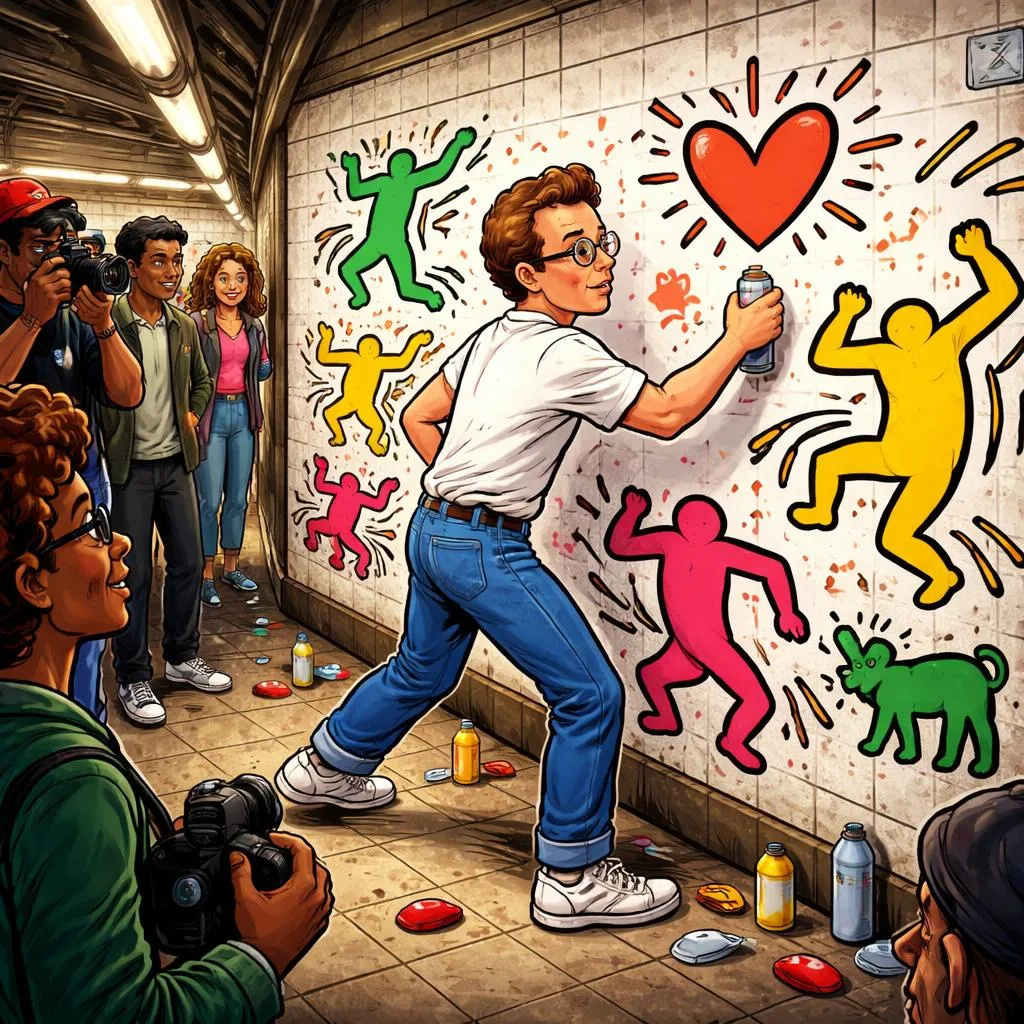

Have you ever seen a drawing of a crawling baby? Or a barking dog? Or a figure with a radiant heart? Those simple, bold drawings belong to Keith Haring. He drew them everywhere. On subway walls. On buildings. On t-shirts. On people's bodies. This Celebrity Story: Keith Haring will introduce you to an artist who believed that art belongs to everyone. He grew up in a small town in Pennsylvania. He moved to New York City in the 1970s. He started drawing in the subway with white chalk. Thousands of people saw his art every day. He became famous in just a few years. He used his art to fight against racism, apartheid, and the AIDS crisis. He died young. But his art lives on.
Let us meet the artist of the people. Keith Haring made art that was simple, fun, and serious all at once.
Who Is This Celebrity?
Keith Haring was an American artist. He lived from 1958 to 1990. He died when he was only 31 years old. In that short time, he became one of the most famous artists of his generation. He drew in a style that looked like cartoons. But his work was full of meaning.
Why is he famous? He created a visual language that anyone could understand. His crawling baby meant the future. His barking dog meant authority. His radiant heart meant love and energy. He drew these symbols on subway walls. He drew them on buildings. He drew them on canvas. He believed art should be seen by everyone, not just rich people in galleries. He also used his art to support social causes. He raised money for children's charities and AIDS research. His work is still reproduced on t-shirts, shoes, and posters all over the world.
Early Life and Childhood
Keith Haring was born in Reading, Pennsylvania. He grew up in a small town called Kutztown. His father was an engineer. His mother was a homemaker. He had three younger sisters.
Young Keith loved to draw. His father taught him how to draw cartoons. He drew all the time. He drew on paper. He drew on his schoolbooks. He drew on anything he could find.
He loved Dr. Seuss and Walt Disney cartoons. He loved the funny pages in the newspaper. He wanted to become a cartoonist when he grew up.
He also loved music. He listened to rock and roll. He went to concerts. He saw how music made people move and feel happy. He wanted his art to have that same energy.
As a teenager, he felt different from other kids. He knew he was gay. That was hard in a small town in the 1970s. He kept that part of himself hidden. He focused on his art.
He went to a small art school for a while. He did not like it. He wanted to make popular art, not fine art. He left school and moved to New York City. He was 20 years old.
Education and Learning Journey
Keith Haring moved to New York City in 1978. He enrolled in the School of Visual Arts. That is an art school in Manhattan. He studied painting. But his real education happened on the streets.
New York City in the late 1970s was wild and exciting. Graffiti covered the subway trains. Breakdancers danced in the streets. Hip-hop music blasted from boomboxes. Keith loved it all.
He met other young artists. He met Jean-Michel Basquiat and Kenny Scharf. They became friends. They inspired each other.
He started drawing in the subway. In the subway stations, there were empty black panels where ads were supposed to go. Keith drew on them with white chalk. His drawings were simple and bold. He drew crawling babies, barking dogs, flying saucers, and dancing figures.
Commuters saw his drawings every day. They started to look for them. They wrote him letters. They called the transit authority to complain. But Keith kept drawing. He made hundreds of subway drawings. He became famous without a gallery. He became famous because ordinary people loved his work.
How Did They Become Successful?
Keith Haring became successful through word of mouth. People saw his subway drawings and wanted to know who made them. Art dealers started calling him.
In 1982, he had his first solo exhibition in a New York gallery. The show sold out. He was 24 years old.
He started painting on canvas. He painted on vinyl tarps. He painted on anything. His style was instantly recognizable. He used thick black lines and bright colors. His figures were simple and flat. They looked like hieroglyphics from the future.
He also started painting murals. He painted a mural on the Berlin Wall. He painted a mural in Australia. He painted a mural in a children's hospital. He painted a mural on the floor of the Boiler Room at the School of Visual Arts. That floor is now a protected landmark.
In 1986, he opened his own store. He called it the Pop Shop. He sold t-shirts, buttons, and posters with his designs. He wanted his art to be affordable. A shirt cost a few dollars. A painting cost thousands. He believed everyone should be able to own his art.
Critics hated the Pop Shop. They said he was selling out. He did not care. He said art should be for everyone.
Big Ideas and Achievements
Keith Haring's biggest idea was that art is for everybody. He did not want his work locked up in museums. He wanted it on the streets, on t-shirts, on buttons, and on subway walls.
His greatest achievement is his visual language. He created symbols that anyone could understand. You do not need to read English to understand his art. A crawling baby means the future everywhere. A barking dog means danger everywhere. A radiant heart means love everywhere.
Another huge achievement is his activism. In the 1980s, the AIDS crisis was killing thousands of people. Many people were scared of AIDS patients. Keith was not. He used his art to raise awareness. He created a famous poster that said "Ignorance = Fear." He raised money for AIDS research. He marched in protests.
He also created art for children. He painted murals in hospitals and schools. He believed that children should grow up around beautiful art. He illustrated books for kids.
In 1989, he created the Keith Haring Foundation. The foundation gives money to AIDS organizations and children's charities. It continues his work today.
Challenges and Difficult Times
Keith Haring faced many challenges. First, he was gay at a time when many people hated gay people. He lost friends to AIDS. He was scared for his own health.
Second, he faced criticism from the art world. Galleries wanted him to be more serious. Critics said his work was too simple. He ignored them.
Third, he was diagnosed with AIDS in 1988. He knew he was going to die. He was only 30 years old. He worked even harder. He created as much art as he could before he died.
Fourth, he was in constant pain. AIDS made him weak. He kept painting anyway. He knew his time was short.
He died in 1990. He was 31 years old. His funeral was attended by thousands of people. He was buried in Pennsylvania.
Fun Facts About the Celebrity
Keith Haring drew over 5,000 subway drawings between 1980 and 1985. That is more than three a day.
Another fun fact: He once drew a mural on the body of the singer Grace Jones. She wore it on stage.
He was friends with Madonna. She was just becoming famous. They lived in the same building. He designed a jacket for her.
He loved to dance. He went to clubs almost every night. Dancing inspired his art.
One more fact: His last painting was called "Unfinished Painting." He left part of it blank. He said it represented the lives cut short by AIDS.
Why Is This Celebrity Important Today?
Keith Haring is important because he made art accessible. You can buy a Keith Haring t-shirt for twenty dollars. You can see his murals for free. He believed art should not be only for rich people.
He is also important because he used his art to fight for justice. He spoke out against apartheid in South Africa. He spoke out against racism. He spoke out for AIDS patients when no one else would.
His style influences graphic designers, street artists, and cartoonists. His symbols are recognized around the world.
Parents can use his story to teach children about using their talents to help others. Keith Haring was a great artist. But he was also a great activist. He used his fame to make the world better.
What Can Kids Learn from This Story?
Kids can learn many lessons from Keith Haring. First, art can be simple and still be powerful. Keith drew simple figures. They looked like stick figures. But they made people feel things. You do not need to draw perfectly. You just need to say something.
Second, share your art. Keith painted on subway walls so everyone could see. Do not hide your drawings in a notebook. Hang them on the fridge. Give them to friends. Put them on your door.
Third, stand up for what you believe. Keith used his art to fight against AIDS and racism. Your art can have a message too. Draw a picture about protecting the planet. Write a poem about kindness.
Finally, make the most of your time. Keith knew he was dying. He worked faster. He loved harder. You do not know how much time you have. Do what you love today.
Quick Quiz or Practice Time
Let us see what you learned from this Celebrity Story: Keith Haring. Answer these questions with a parent or by yourself.
What did Keith Haring draw on in the subway?
Name three of Keith Haring's famous symbols.
What was the name of Keith's store in New York?
What disease did Keith have that killed him?
How old was Keith when he died?
Here is a fun activity. Look up images of Keith Haring's art online with your parent. Notice how simple the figures are. Then try to draw your own Keith Haring-style figure. Draw a crawling baby. Draw a barking dog. Use thick black lines. Use bright colors.
Another activity. Think about a message you want to share. It could be "Save the Planet" or "Be Kind." Create a symbol for that message. Draw it over and over. Put it on your notebook. Put it on your shirt. You are making your own visual language, just like Keith Haring.
Keith Haring lived a short, bright life. He grew up in a small town. He moved to New York. He drew on subway walls with white chalk. He became famous. He painted murals around the world. He opened the Pop Shop so everyone could afford his art. He used his art to fight AIDS and injustice. He died at 31. But his art never died. His crawling baby still crawls. His barking dog still barks. His radiant heart still shines. His story teaches us that art is for everyone. Art can be fun and serious at the same time. Art can save lives. That is the real lesson of this celebrity story.