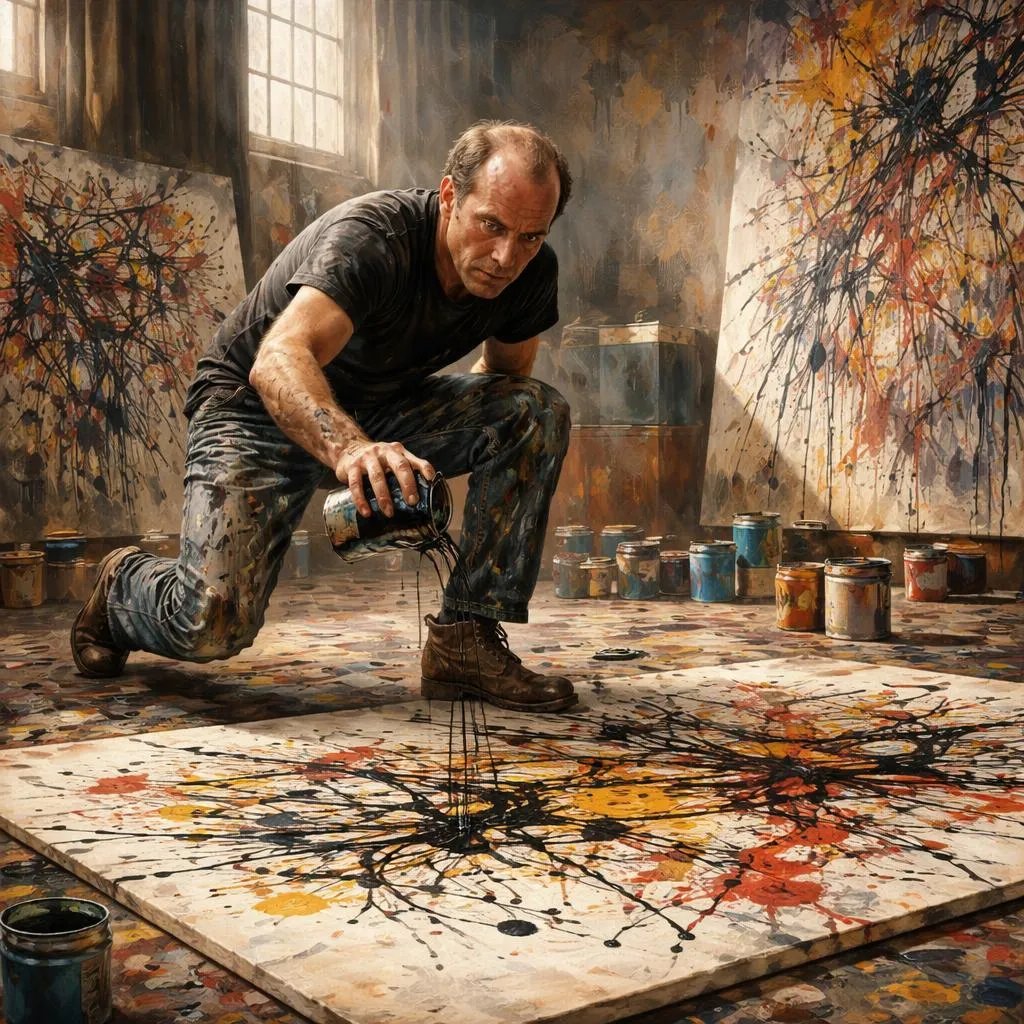

Have you ever seen a painting that looks like a tangle of lines and drips? No faces. No trees. No houses. Just splashes of color. That is a Jackson Pollock painting. People either love it or hate it. This Celebrity Story: Jackson Pollock will introduce you to an artist who broke every rule. He did not use an easel. He did not use a brush to touch the canvas. He laid his canvas on the floor. He dripped paint from sticks. He threw sand and glass into the paint. He made art that looked like nothing before. He became the most famous American painter of his time. He proved that art could be an act of energy, not just a picture of something.
Let us meet the man who painted with his whole body. Jackson Pollock changed how we think about art.
Who Is This Celebrity?
Jackson Pollock was an American painter. He lived from 1912 to 1956. He invented a new way of painting called "drip painting" or "action painting." He laid his canvases on the floor. He walked around them. He dripped and poured paint from cans. He used sticks, brushes, and even syringes.
Why is he famous? He created abstract art that was pure energy. His most famous paintings have no recognizable objects. They are just lines, drips, and splatters. But they feel alive. They feel like jazz music or a thunderstorm. He became the leader of a movement called Abstract Expressionism. That movement put American art on the world map. Before Pollock, the center of the art world was Paris. After Pollock, it was New York. He changed art history.
Early Life and Childhood
Jackson Pollock was born in Cody, Wyoming. His family moved a lot. They lived in Arizona and California. His father was a farmer and a surveyor. His mother was a strict woman who encouraged her sons to become artists.
Jackson was the youngest of five sons. He was a difficult child. He got into fights. He was expelled from school. He did not fit in.
He discovered art when he was a teenager. He went to a high school in Los Angeles that had an art program. He studied painting. He was not a natural talent. He struggled. But he loved it.
His older brother Charles was also an artist. Charles moved to New York to study art. Jackson followed him. He moved to New York City in 1930. He was 18 years old. He studied under a famous teacher named Thomas Hart Benton. Benton painted realistic scenes of American life. Pollock learned traditional painting from him. But he would later rebel against everything Benton taught.
Education and Learning Journey
Jackson Pollock studied at the Art Students League in New York. He learned how to draw the human body. He learned how to paint realistic scenes. He was a good student. But he felt trapped.
He wanted to express feelings, not just copy what he saw. He started looking at other kinds of art. He studied Mexican muralists. He studied Native American sand painting. He studied surrealism, an art movement about dreams and the unconscious.
In the 1930s, he worked for the government. The government paid artists to paint murals on public buildings. Pollock painted several murals. They were dark and emotional. People noticed his talent.
He also went to therapy. He had problems with alcohol. He was depressed. His therapist encouraged him to paint his feelings. That advice changed his life. He stopped trying to paint pretty pictures. He started painting his inner world.
In the early 1940s, he met a woman named Lee Krasner. She was also an artist. She believed in him. They moved to a small house in East Hampton, New York. She gave him a barn to use as a studio. That barn became famous.
How Did They Become Successful?
Jackson Pollock became successful by inventing a new technique. In 1947, he started dripping paint. He laid a canvas on the floor. He mixed house paint with thinner so it would drip easily. He used sticks and hardened brushes. He walked around the canvas. He dripped paint from above. He threw sand and broken glass into the wet paint.
The results were unlike anything anyone had seen. Critics were confused. But a famous photographer took pictures of Pollock at work. The photos showed a handsome man in jeans and boots, moving like a dancer around his canvas. The public loved the photos. Pollock became a celebrity.
In 1949, Life magazine published an article about him. The headline asked: "Is he the greatest living painter in the United States?" That article made him famous. His paintings started selling for high prices.
His most famous painting from this period is called "Lavender Mist." It is a huge canvas covered in drips of gray, pink, and lavender. It does not show anything. But it feels like a foggy morning. It feels calm and wild at the same time.
He had his first solo exhibition in 1950. It was a success. He was the king of the art world.
Big Ideas and Achievements
Jackson Pollock's biggest idea was that the act of painting is more important than the finished picture. He called it "action painting." The energy he put into the painting became the subject of the painting.
His greatest achievement is the painting "Number 1, 1948" (also called "Lavender Mist"). This painting hangs in the National Gallery of Art in Washington, D.C. Millions of people have seen it. It represents the peak of his drip technique.
Another huge achievement is his influence. He inspired generations of artists to experiment. He showed that art could be about process, not product. He gave artists permission to be messy and free.
He also made American art famous. Before Pollock, European artists were the stars. He proved that an American cowboy from Wyoming could be a genius.
He also mentored other artists. Lee Krasner, his wife, became a famous painter herself. Many young artists visited his studio. He encouraged them to find their own voices.
Challenges and Difficult Times
Jackson Pollock faced terrible challenges. First, he struggled with alcoholism. He started drinking as a teenager. He could not control it. He would be sober for months. Then he would relapse. The drinking hurt his art and his relationships.
Second, he was insecure. Even when he became famous, he doubted himself. He would destroy his own paintings. He would tear them up and burn them.
Third, the pressure of fame was too much. He hated being a celebrity. He retreated to his house in East Hampton. He drank more.
Fourth, his marriage was troubled. He loved Lee Krasner. But he was jealous and angry. He treated her badly when he drank.
Fifth, in 1956, he crashed his car while driving drunk. He died in the accident. He was 44 years old. His death shocked the art world. Lee Krasner managed his legacy after his death. She made sure his art was remembered.
Fun Facts About the Celebrity
Jackson Pollock drove a 1950 Oldsmobile. He loved that car. He crashed it the night he died.
Another fun fact: He hated the nickname "Jack the Dripper." A magazine gave him that name. He thought it was silly.
He loved jazz music. He listened to jazz while he painted. He said the rhythm of jazz influenced his drips.
He kept a pet crow. He found it injured and nursed it back to health. The crow lived in his studio.
One more fact: His paintings are so large that they do not fit in most houses. They were meant for museums.
Why Is This Celebrity Important Today?
Jackson Pollock is important because he made art about energy. Before him, art was about representing something. A painting of a tree. A portrait of a person. He said art could be about movement, rhythm, and feeling. That idea changed everything.
He is also important because he showed that mistakes can be beautiful. His drips were accidents. He splattered paint where he did not intend. He kept the accidents. He said the accidents were part of the art.
His paintings are still studied. Art students learn his techniques. His work hangs in every major museum.
Parents can use his story to teach children about trying new things. Pollock did not follow the rules. He invented his own way. You can too.
What Can Kids Learn from This Story?
Kids can learn wonderful lessons from Jackson Pollock. First, art does not have to look like something. Pollock's paintings look like drips and splatters. But they are full of feeling. Your art can be abstract too. Draw your anger. Paint your joy. Scribble your sadness.
Second, process matters. Pollock loved the act of painting. He loved walking around his canvas. He loved dripping paint. Enjoy the process of making art. Do not just focus on the final product.
Third, be brave. Pollock painted in a way no one had ever seen. People laughed at him. He kept going. Be brave enough to be different.
Finally, take care of yourself. Pollock struggled with alcohol. It destroyed his life and his art. If you feel sad or angry, talk to someone. Find healthy ways to express your feelings. Art is a healthy way. Drinking is not.
Quick Quiz or Practice Time
Let us see what you learned from this Celebrity Story: Jackson Pollock. Answer these questions with a parent or by yourself.
What was Jackson Pollock's painting technique called?
Where did Pollock lay his canvases?
What famous magazine asked if Pollock was the greatest living painter?
What was the name of Pollock's wife, who was also an artist?
How old was Pollock when he died?
Here is a fun activity. Put a large piece of paper on the floor. Put on some music with a good beat. Dip a stick or a brush into paint. Drip the paint onto the paper. Walk around the paper. Let your body move. Do not try to make anything. Just drip. You are an action painter.
Another activity. Look up a photo of Jackson Pollock's "Lavender Mist" online with your parent. Stare at it for one minute. Do not try to find shapes. Just feel the colors and lines. Then close your eyes. What do you remember? Talk about how the painting makes you feel.
Jackson Pollock lived a wild, short life. He grew up in Wyoming and California. He moved to New York. He studied traditional painting. He rebelled. He laid his canvas on the floor. He dripped paint from sticks. He threw sand and glass. He became famous. People called him "Jack the Dripper." He hated that name. He drank too much. He died in a car crash at 44. His paintings hang in museums around the world. People still argue about whether they are art. But no one can deny their energy. His story teaches us to try new things. To break the rules. To make art with our whole bodies. That is the real lesson of this celebrity story.