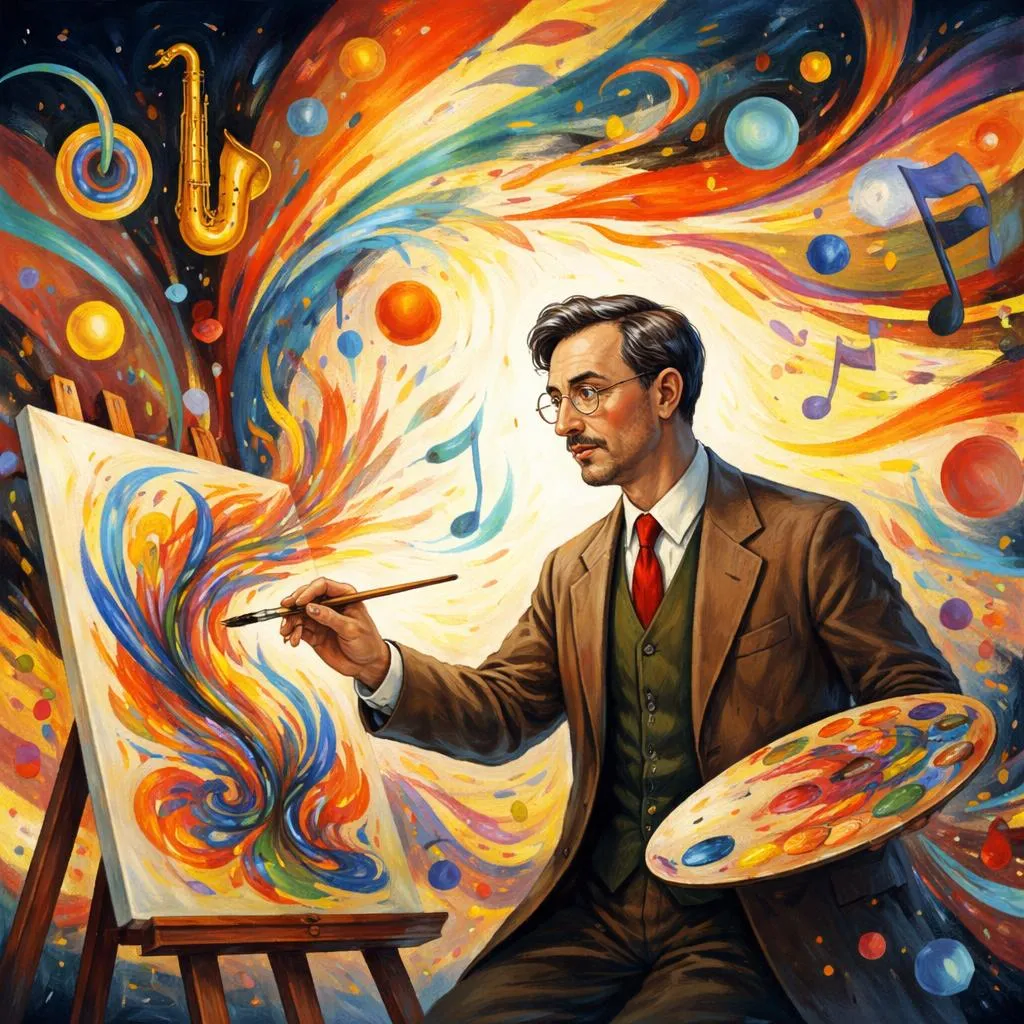

Have you ever seen a painting with no people, no trees, and no houses? Just swirls of color. Bright reds. Deep blues. Flying yellows. The shapes float like music. That is a Wassily Kandinsky painting. He wanted to paint music. He wanted to make colors sing. This Celebrity Story: Wassily Kandinsky will introduce you to the father of abstract art. He was born in Russia. He was trained as a lawyer. He did not become an artist until he was 30 years old. One day, he saw one of his paintings upside down. He realized it was more beautiful that way. It did not need to show anything. It just needed to make you feel. He spent the rest of his life painting feelings, not things.
Let us meet the man who heard colors and saw sounds. Kandinsky believed that art was like music. It could speak directly to your soul.
Who Is This Celebrity?
Wassily Kandinsky was a Russian painter and art theorist. He lived from 1866 to 1944. He is credited with painting the first purely abstract artwork. Abstract art does not show recognizable objects. It shows colors, shapes, and lines. Kandinsky believed that abstract art could express spiritual truths.
Why is he famous? He invented abstract art. Before him, all art showed something. A landscape. A portrait. A bowl of fruit. He said, why do we need to show things? Why not just show feelings? He painted swirling colors that felt like music. He wrote a book called "Concerning the Spiritual in Art." That book changed how people thought about painting. He also taught at the Bauhaus, a famous art school in Germany. His work influenced generations of artists.
Early Life and Childhood
Wassily Kandinsky was born in Moscow, Russia. His family moved to Odessa when he was young. His father was a businessman. His mother was a homemaker. He had a comfortable childhood.
He learned to play the piano and the cello. He loved music. He said music was the most spiritual art form. Music did not need words. It just needed notes. He wanted painting to be like that.
He also loved color. He remembered being a child and seeing the bright colors of Moscow. The gold domes of churches. The red of banners. The blue of the sky. Those colors stayed in his mind.
He was a good student. He studied law and economics at the University of Moscow. He was successful. He became a law professor. He had a stable career. But he was not happy.
When he was 30 years old, he went to an art exhibition. He saw a painting by Claude Monet. It showed a haystack. But the haystack was just a blur of color. Kandinsky was confused. He did not recognize the haystack. He thought the painting was beautiful anyway. That moment changed his life.
Education and Learning Journey
Wassily Kandinsky decided to become an artist when he was 30 years old. He moved to Munich, Germany. He enrolled in art school. He had to learn how to draw and paint.
He was older than the other students. He had to start from the beginning. He learned quickly. He was talented.
He also traveled. He went to Italy, France, and Tunisia. He looked at art. He painted landscapes. He painted in a style called Expressionism. Expressionist paintings are colorful and emotional. They are not realistic.
He started a group of artists called "The Blue Rider." The name came from a painting of a blue horse and rider. The group believed that art should be spiritual. Art should express inner feelings, not outer reality.
In 1911, he painted his first abstract watercolor. It has no recognizable objects. Just colors and lines. Art historians call it the first abstract painting.
He also wrote his book, "Concerning the Spiritual in Art." The book explained his ideas. He said each color has a sound. Yellow sounds like a trumpet. Blue sounds like a cello. Red sounds like a drum. He said a painting could be a visual symphony.
How Did They Become Successful?
Wassily Kandinsky became successful after World War I. Before the war, his work was known only in small circles. After the war, his fame grew.
The Russian Revolution of 1917 changed his life. He returned to Russia. He worked for the new government. He helped organize art schools. But he did not like the direction of Soviet art. The government wanted art to be realistic and political. Kandinsky wanted art to be abstract and spiritual.
He returned to Germany in 1921. He was invited to teach at the Bauhaus. The Bauhaus was a famous art school. It brought together artists, architects, and designers. Kandinsky taught color theory and design.
At the Bauhaus, he painted his most famous works. He painted circles, triangles, and lines. He called his paintings "Compositions" and "Improvisations." They looked like musical scores.
When the Nazis came to power in 1933, they closed the Bauhaus. They called Kandinsky's art "degenerate." He fled to France. He lived there for the rest of his life.
He continued painting. His later work was softer. He used shapes that looked like biological forms. He painted until he died in 1944 at age 78.
Big Ideas and Achievements
Wassily Kandinsky's biggest idea was that art could be completely abstract. It did not need to represent anything. It just needed to express emotion. He called this "inner necessity."
His greatest achievement is the painting "Composition VII." It is a huge canvas filled with swirling colors and shapes. It looks like an explosion. Many art historians call it the greatest abstract painting ever made.
Another huge achievement is his book "Concerning the Spiritual in Art." It is still in print. Artists still read it. It changed how people think about color and form.
He also created the theory of color synesthesia. Synesthesia is when you hear a sound and see a color. Or see a color and hear a sound. Kandinsky had synesthesia. He heard colors. He saw sounds. He tried to paint what he heard.
He influenced every abstract artist who came after him. Jackson Pollock, Mark Rothko, and many others learned from Kandinsky.
Challenges and Difficult Times
Wassily Kandinsky faced many challenges. First, he started his art career late. He was 30 years old. He had to compete with younger artists.
Second, World War I forced him to leave Germany. He lost his studio and many paintings.
Third, the Russian Revolution forced him to leave Russia. He did not fit in with Soviet art.
Fourth, the Nazis forced him to leave Germany again. They called his art degenerate. He was too old to start over. But he did. He moved to France and learned a new language.
Fifth, he struggled with poverty in France. He lived simply. He painted in a small studio. He kept working.
Through every challenge, he kept painting. He believed in abstract art. He believed it could change the world.
Fun Facts About the Celebrity
Wassily Kandinsky was a trained lawyer. He could have been a judge. He chose art instead.
Another fun fact: He had synesthesia. He heard colors. He saw sounds. The note C major was yellow. The note F sharp was blue.
He loved the color blue. He said blue was the color of the sky and the sea. It was the color of spirituality.
He named his paintings like musical compositions. "Improvisation." "Composition." "Impression."
One more fact: He painted a portrait of his wife using only shapes. A circle for her head. A triangle for her nose. He said he painted her soul, not her face.
Why Is This Celebrity Important Today?
Wassily Kandinsky is important because he invented abstract art. That might be the biggest change in art history since the Renaissance. He gave artists permission to paint feelings instead of things.
He is also important because he connected art and music. Now we think of painting as visual music. That was his idea.
His influence is everywhere. Graphic design. Architecture. Fashion. Abstract art is everywhere. It started with Kandinsky.
Parents can use his story to teach children about expressing feelings. You do not need to draw a happy face to show happiness. You can paint a yellow swirl. That is happiness.
What Can Kids Learn from This Story?
Kids can learn wonderful lessons from Wassily Kandinsky. First, it is never too late. Kandinsky did not become an artist until he was 30. You can start something new at any age.
Second, use all your senses. Kandinsky heard colors. He saw sounds. Pay attention to how colors make you feel. Does red feel hot? Does blue feel calm? Trust your senses.
Third, abstract art is real art. You do not need to draw a tree or a dog. You can paint a circle and call it joy. You can paint a line and call it sadness. That is art too.
Finally, follow your own path. People thought Kandinsky was crazy. He kept painting. He believed in his vision. You should believe in yours.
Quick Quiz or Practice Time
Let us see what you learned from this Celebrity Story: Wassily Kandinsky. Answer these questions with a parent or by yourself.
What is Kandinsky known for inventing?
What musical instrument did Kandinsky play as a child?
What did Kandinsky call his paintings like musical pieces?
What condition did Kandinsky have where he heard colors?
Where did Kandinsky teach?
Here is a fun activity. Put on a piece of music without words. Classical music works well. Close your eyes. See what colors you see. Then paint those colors on paper. Do not paint anything recognizable. Just colors and shapes. You are painting music like Kandinsky.
Another activity. Look up "Composition VII" by Wassily Kandinsky online with your parent. Stare at it for one minute. Do not try to find shapes. Just feel the colors. Then close your eyes. What do you feel? Talk about it.
Wassily Kandinsky was a lawyer who became an artist. He was 30 years old. He saw a painting of a haystack. He did not recognize the haystack. He saw only color. He thought it was beautiful. He decided to paint only color. He painted music. He heard colors and saw sounds. He invented abstract art. The Nazis called his art degenerate. He fled to France. He kept painting. He painted swirling shapes that float like notes. He believed art could touch your soul without showing anything real. His story teaches us to follow our dreams, even late. To trust our senses. To paint our feelings. That is the real lesson of this celebrity story.