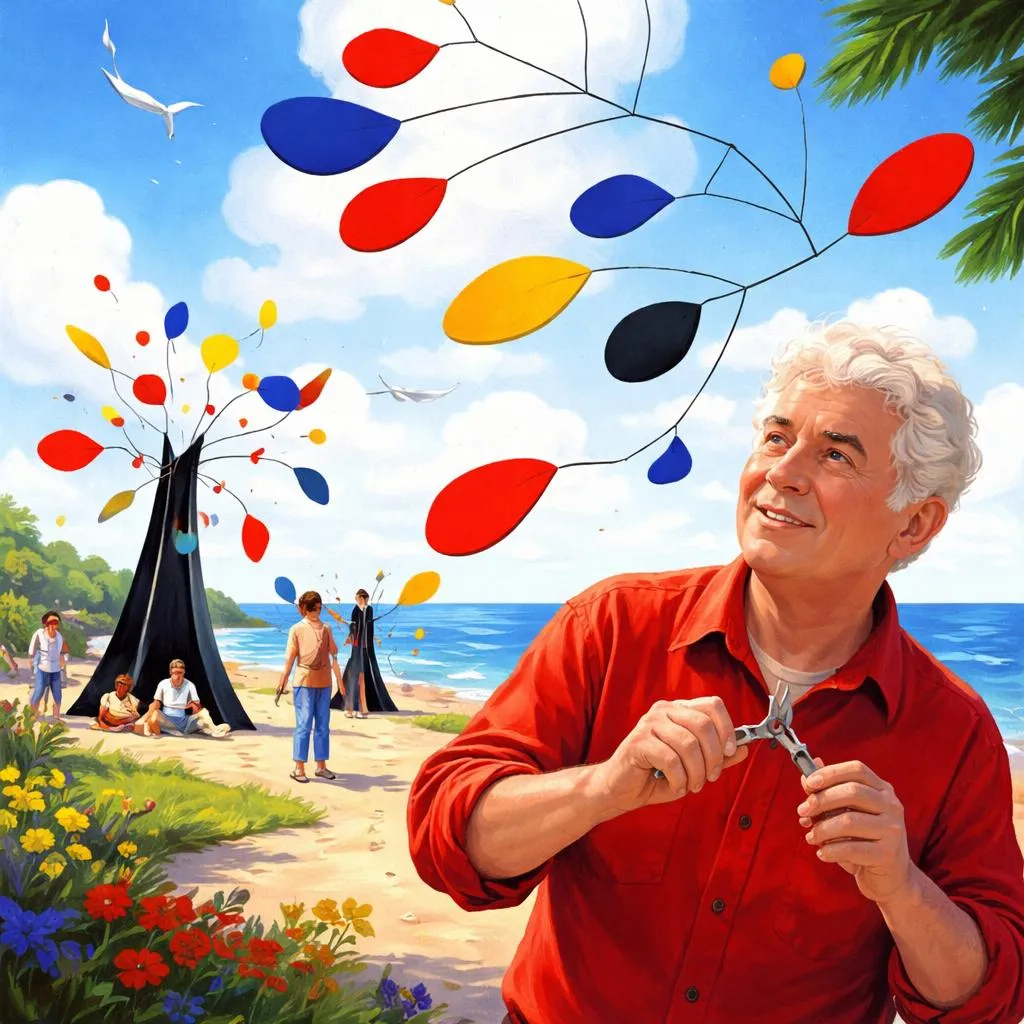

Have you ever seen a sculpture hanging from the ceiling with colorful shapes that float and spin? You touch it gently. It moves. The shapes dance. That is a mobile. Alexander Calder invented it. This Celebrity Story: Alexander Calder will introduce you to the artist who made sculptures move. He was born into a family of artists. He studied engineering. He combined the two. He used wire, metal, and paint. He made abstract shapes that hung in the air. He also made large outdoor sculptures called stabiles. They stand on the ground. They are big and colorful. You can walk around them. Calder’s art is joyful. It makes you smile.
Let us meet the inventor of the mobile. Alexander Calder brought movement to modern art.
Who Is This Celebrity?
Alexander Calder was an American sculptor. He lived from 1898 to 1976. He is best known for inventing the mobile. A mobile is a hanging sculpture that moves. Air currents make it turn. The shapes balance each other. He also made stabiles. Those are large, standing sculptures made of painted steel.
Why is he famous? He changed sculpture forever. Before Calder, sculpture was still. He made it move. He also made it playful. His works are abstract. They look like living creatures. He made circus figures out of wire. He made jewelry. He made paintings. He was endlessly creative. His work is in museums around the world. You can see his mobiles hanging in galleries. They spin slowly. They catch the light. They never stop moving.
Early Life and Childhood
Alexander Calder was born in Lawnton, Pennsylvania. His father was a sculptor. His mother was a painter. His grandfather was also a sculptor. Art was in his blood.
When he was a child, his family moved often. His father received commissions for sculptures. They lived in New York, California, and even Hawaii.
Young Sandy, as he was called, loved to make things. He had a workshop in his basement. He used tools. He made toys. He made jewelry. He made animals out of wire and scraps.
He was not a great student. He did not like school. He was shy. He was more comfortable in his workshop.
His family encouraged him to become an engineer. They thought art was too uncertain. He agreed. He studied mechanical engineering at the Stevens Institute of Technology. He graduated in 1919. He worked as an engineer for several years. He hated it. He wanted to make art.
He enrolled at the Art Students League in New York. He studied painting. He was a good painter. But he missed working with his hands.
Education and Learning Journey
Alexander Calder studied engineering. He learned about mechanics, balance, and structure. That knowledge would be essential for his mobiles.
He also studied art. At the Art Students League, he learned to draw and paint. He was a skilled draftsman.
He took a job drawing for a newspaper. The newspaper sent him to the circus. He drew the ringmaster, the acrobats, and the animals. He loved the circus. He started making his own circus figures out of wire.
He moved to Paris in 1926. Paris was the center of the art world. He met other modern artists. He visited the studios of Joan Miró, Piet Mondrian, and Marcel Duchamp.
He saw Mondrian's studio. The studio had colored rectangles on the walls. Calder thought, "Why not make those rectangles move?" He started experimenting.
He made his first mobile in 1931. It was a motorized sculpture. The parts moved mechanically. He soon replaced the motor with air currents. The mobile became a delicate, floating object.
His friend Marcel Duchamp named these works "mobiles." Mobile means both "movable" and "motive" in French.
His friend Jean Arp named his standing sculptures "stabiles." Stabile means stationary.
How Did They Become Successful?
Alexander Calder became successful in the 1930s. He had his first solo exhibition in Paris in 1931. Critics praised his mobiles.
He returned to the United States in 1933. He continued to make mobiles and stabiles. He also made large public sculptures.
In 1937, he built a stabile called "Whale" for the Museum of Modern Art in New York. It was huge. It was made of steel plates. It looked like a giant animal.
In the 1950s and 1960s, he received many public commissions. He made a stabile for the UNESCO building in Paris. He made a mobile for the airport in Caracas, Venezuela. He made a stabile for the city of Grand Rapids, Michigan. That was the first public art funded by the government.
He became internationally famous. He represented the United States at the Venice Biennale in 1952. He won the Grand Prize for Sculpture.
He continued to work until his death in 1976. He was 78 years old. He died of a heart attack.
Big Ideas and Achievements
Alexander Calder's biggest idea was that sculpture could move. Before him, sculpture was static. He introduced time and chance. A mobile changes every time you look at it.
His greatest achievement is the mobile. He made mobiles of all sizes. Some are tiny. Some are huge. The largest mobile is at the National Gallery of Art in Washington, D.C. It is called "Untitled." It hangs in the central atrium. It is over 75 feet wide.
Another huge achievement is his stabiles. These large outdoor sculptures are made of painted steel. They are abstract. They look like animals or plants or monsters. They are bright red, black, or blue. You can walk around them. They have become icons of modern art.
He also made a series of works called "The Circus." He created a miniature circus out of wire, cloth, and found objects. He performed the circus for his friends. He would manipulate the figures. He would make the lion jump. He would make the acrobats fly. The circus is now in the Whitney Museum of American Art.
He also made jewelry. He created necklaces and bracelets for his friends. He gave them as gifts.
He also made paintings. His late paintings are large, colorful abstractions. They look like his mobiles flattened onto canvas.
Challenges and Difficult Times
Alexander Calder faced many challenges. First, his family wanted him to be an engineer. He tried. He hated it. He had to find the courage to become an artist.
Second, he struggled financially in the early 1930s. The Great Depression was hard. He sold few works. He had to borrow money.
Third, World War II made it hard to get materials. He worked with what he could find. He used tin cans and scrap metal.
Fourth, he had to educate the public. People did not understand mobiles. They thought they were toys. He had to explain that they were serious art.
Fifth, he had to balance art and business. He became very successful. He had to manage his studio. He had assistants. He kept control.
Fun Facts About the Celebrity
Alexander Calder loved to wear colorful clothing. He often wore a bright red shirt and a yellow hat.
Another fun fact: He made his own tools. He designed special pliers and cutters for bending wire.
He had a pet parrot. The parrot would sit on his shoulder while he worked.
He loved to play the banjo. He would play for his friends at parties.
One more fact: He designed a stage set for a ballet. The set included mobiles. The dancers moved among them.
Why Is This Celebrity Important Today?
Alexander Calder is important because he introduced movement into sculpture. Every mobile you see, from baby crib mobiles to large gallery installations, comes from his invention.
He is also important because he brought playfulness to modern art. His work is not serious or scary. It is joyful. It makes you feel light.
His influence is everywhere. You see mobiles in nurseries, restaurants, and offices. You see stabiles in parks and plazas. Calder made the world more colorful and more fun.
Parents can use his story to teach children about combining different interests. Calder was an engineer and an artist. You can be both too. You can be a scientist and a painter. You can be a writer and a musician.
What Can Kids Learn from This Story?
Kids can learn wonderful lessons from Alexander Calder. First, make art that moves. Calder’s mobiles are never still. They respond to the air. Make a mobile for your room. Use paper, wire, or string.
Second, use your hands. Calder made things. He built circuses. He bent wire. He painted steel. Make things with your hands. Build a fort. Make a toy. Sculpt with clay.
Third, be playful. Calder’s art is not serious. It is fun. It is playful. Your art can be fun too. Do not always try to make perfect pictures. Make silly ones. Make colorful ones.
Finally, combine your interests. Calder studied engineering and art. He used both. What do you like? Math and drawing? Science and music? Combine them. You will invent something new.
Quick Quiz or Practice Time
Let us see what you learned from this Celebrity Story: Alexander Calder. Answer these questions with a parent or by yourself.
What did Alexander Calder invent?
What is a standing Calder sculpture called?
What did Calder study in college?
What miniature circus did Calder create?
What artist friend named Calder’s mobiles?
Here is a fun activity. Get a coat hanger. Bend it into a shape. Then hang smaller shapes from it using string. Use paper, cardboard, or foam. Hang your mobile from the ceiling. Watch it move. You are an engineer and an artist like Calder.
Another activity. Look up Alexander Calder’s “The Circus” online with your parent. Watch a video of him performing with his circus figures. Then make your own circus figure out of pipe cleaners or wire. Make it dance.
Alexander Calder was an engineer who became an artist. He invented the mobile. He made sculptures that move with the air. He made stabiles that stand like giants. He built a miniature circus. He made jewelry for his friends. He painted colorful abstractions. He brought playfulness to modern art. His mobiles hang in museums and nurseries. His stabiles stand in parks and plazas. His art makes you smile. His story teaches us to combine skills. To use our hands. To make art that moves. That is the real lesson of this celebrity story.