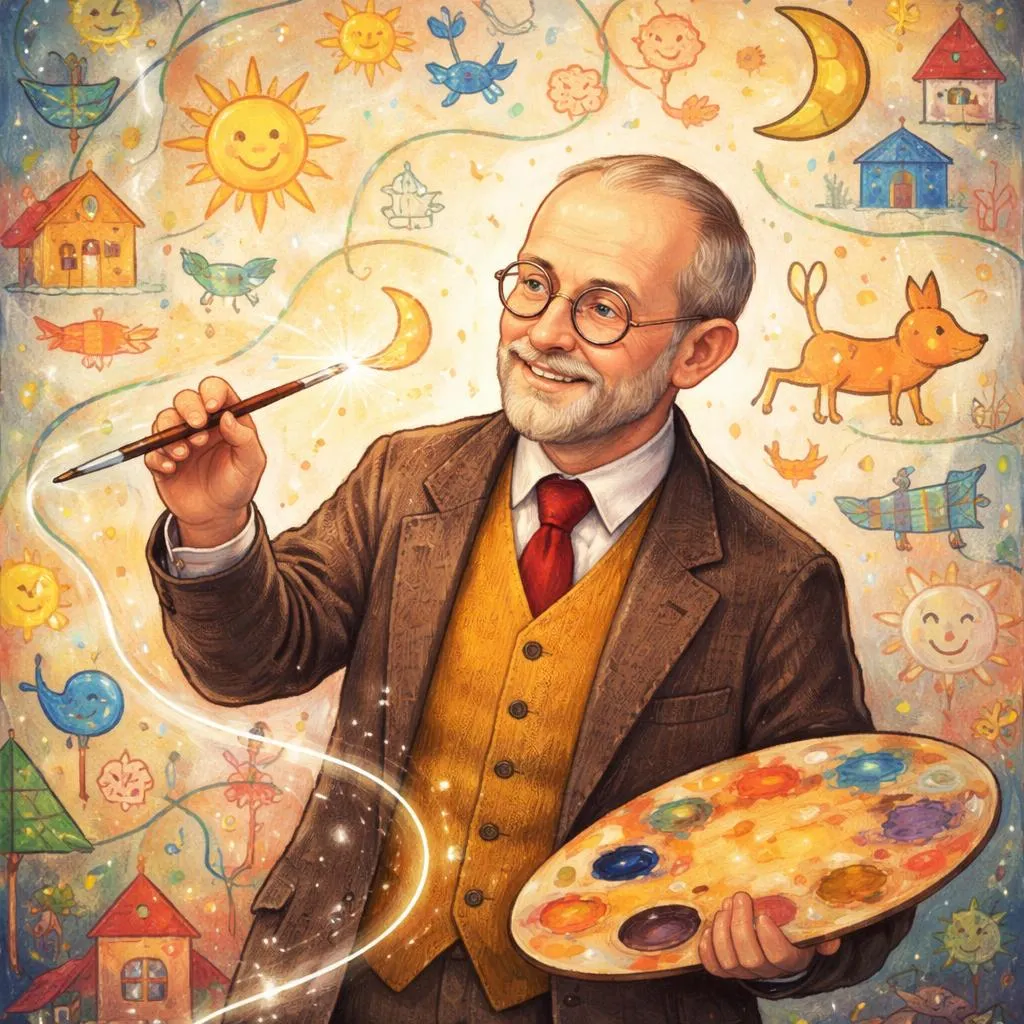

Have you ever looked at a drawing by a young child and seen something special? The lines are wobbly. The colors are bright. The shapes are strange. Paul Klee painted like that on purpose. He believed that children see the world with fresh eyes. He wanted to see that way too. This Celebrity Story: Paul Klee will introduce you to an artist who painted angels, fish, and castles from his imagination. He was born in Switzerland. He was also a musician. He played the violin beautifully. He said that drawing was like taking a line for a walk. His paintings are small, colorful, and full of mystery. He influenced artists all over the world.
Let us meet the painter-poet. Paul Klee wrote about art. He taught about art. He made art that looks simple but feels deep.
Who Is This Celebrity?
Paul Klee was a Swiss-German artist. He lived from 1879 to 1940. He was one of the most original artists of the 20th century. He painted in many styles. He was associated with several movements: Expressionism, Bauhaus, and Surrealism. But he did not fit neatly into any category. He was his own movement.
Why is he famous? He made art that looks like children's drawings. But his art is not childish. It is childlike. That is different. A childlike artist sees the world with wonder. Klee kept that wonder his whole life. He also wrote a famous book about art called "The Thinking Eye." He taught at the Bauhaus, a famous art school in Germany. His paintings are small, colorful, and poetic. He painted angels, fish, birds, and strange creatures. He said, "Art does not reproduce the visible. It makes visible."
Early Life and Childhood
Paul Klee was born in Münchenbuchsee, Switzerland. His father was a German music teacher. His mother was a Swiss singer. Music filled their home. Paul learned to play the violin when he was seven years old. He became very good.
He also loved to draw. He drew on his schoolbooks. He drew in his notebooks. He filled pages with doodles. His grandmother gave him a box of chalk. He drew on everything.
His parents wanted him to be a musician. He was talented. He could have been a professional violinist. But he loved art more. He struggled with the decision.
He decided to study art. He went to the Academy of Fine Arts in Munich, Germany. He studied traditional painting. He learned to draw realistically. He was good at it. But he was bored. He wanted to find his own voice.
He also continued to play violin. He played in orchestras. He married a pianist named Lily Stumpf. Music and art lived together in his home.
Education and Learning Journey
Paul Klee studied at the Academy of Fine Arts in Munich. His teacher was a famous painter named Franz von Stuck. Stuck taught Klee how to draw and paint realistically. Klee learned the rules. Then he broke them.
He was also influenced by other artists. He saw the work of Vincent van Gogh and Pablo Picasso. They were breaking the rules too. Klee was inspired.
He traveled to Italy. He looked at Renaissance art. He studied the old masters. He learned from the past. Then he looked to the future.
His big breakthrough came when he visited Tunisia in 1914. He saw the light. The colors of North Africa were bright and intense. He said, "Color and I are one. I am a painter." He returned to Germany and started painting in color.
He also started teaching at the Bauhaus in 1921. The Bauhaus was a famous art school in Germany. Klee taught design and color theory. He wrote down his lectures. Those lectures became a book called "The Thinking Eye." It is still used by artists today.
He taught that art comes from within. It does not come from copying nature. It comes from feeling.
How Did They Become Successful?
Paul Klee became successful slowly. In his 30s, he was still unknown. He sold very few paintings. He supported himself by teaching and writing reviews.
After his trip to Tunisia in 1914, his work changed. He started using bright colors. He started painting abstract shapes. People noticed.
In the 1920s, he became famous. The Bauhaus brought him recognition. His paintings sold. Museums bought his work. He had solo exhibitions.
His most productive period was the 1930s. He painted thousands of works in a few years. His paintings are small. He worked on a small scale. He said a small painting could contain the universe.
In 1933, the Nazis came to power in Germany. They called Klee's art "degenerate." That meant they thought it was bad for German culture. They removed his paintings from museums. He lost his teaching job. He moved back to Switzerland.
He was heartbroken. But he kept painting. In his last years, he painted over 1,000 works. He was sick. He had a disease called scleroderma. It made his skin hard and made it hard to swallow. He painted until the end. He died in 1940 at age 60.
Big Ideas and Achievements
Paul Klee's biggest idea was that art should look like a child made it. He said, "I want to be as though newborn." He wanted to see the world without filters. He wanted to paint from the unconscious.
His greatest achievement is his body of work. He created over 9,000 works of art. They include paintings, drawings, prints, and puppets. His most famous painting is "The Twittering Machine." It shows strange bird-like creatures on a crank. They look like a child's toy. But they are also haunting.
Another famous work is "Castle and Sun." It shows a city made of colored squares. It looks like a child's building blocks. The colors are warm and happy.
He also wrote "The Thinking Eye." That book changed how artists think about color and form. He taught that color has weight and movement. A yellow square feels different from a blue square.
He also created puppets for his son, Felix. He made over 50 puppets out of junk. They are creepy and wonderful. They are now in museums.
He influenced the Abstract Expressionists, the Color Field painters, and countless children's book illustrators.
Challenges and Difficult Times
Paul Klee faced many challenges. First, he struggled to find his own style. He was in his 30s before he found it. He doubted himself. He kept working.
Second, he was not commercially successful until late. He was poor for many years. He had a family to support. He taught to make ends meet.
Third, World War I was terrible. Klee was called to serve in the German army. He painted camouflage on airplanes. He did not fight on the front lines. But the war still traumatized him.
Fourth, the Nazis destroyed his career in Germany. They called his art "degenerate." They removed over 100 of his paintings from museums. He lost his job. He fled to Switzerland.
Fifth, he suffered from a painful disease. Scleroderma made his skin hard and tight. It was hard to swallow. It was hard to breathe. He painted through the pain. He did not stop.
Fun Facts About the Celebrity
Paul Klee was also a professional violinist. He could have had a career in music. He chose art. But he played violin every day.
Another fun fact: He painted on unusual surfaces. He painted on burlap, on newspaper, and on cardboard. He used whatever he could find.
He was a cat person. He loved cats. His cats would walk across his wet paintings. He did not mind. He said the cat was being creative.
He made puppets for his son. The puppets were made from junk: buttons, wires, and scraps of cloth.
One more fact: His last painting is called "Death and Fire." It shows a skull with a cross. Klee knew he was dying. He painted it anyway.
Why Is This Celebrity Important Today?
Paul Klee is important because he taught us to see like children. Children see wonder everywhere. A leaf is amazing. A puddle is a universe. Klee kept that wonder his whole life.
He is also important because he showed that art and music are connected. His paintings have rhythm. They have melody. They are visual music.
His influence is everywhere. Graphic designers use his colors. Illustrators use his shapes. Children's book artists learn from him.
Parents can use his story to teach children about the value of play. Klee played with paint. He played with lines. Play is not a waste of time. Play is how we learn to create.
What Can Kids Learn from This Story?
Kids can learn beautiful lessons from Paul Klee. First, take a line for a walk. Klee said drawing was like taking a line for a walk. Let your pencil wander. Do not plan. Just let it go. See where the line goes.
Second, use your imagination. Klee painted angels, fish, and castles from his head. He did not copy photographs. Use your imagination. Draw what you dream.
Third, do not be afraid of simple. Klee's paintings look simple. But they are deep. Simple can be powerful.
Finally, keep going. Klee struggled for years. He found his style in his 30s. He painted through war and sickness. He never gave up.
Quick Quiz or Practice Time
Let us see what you learned from this Celebrity Story: Paul Klee. Answer these questions with a parent or by yourself.
What musical instrument did Paul Klee play?
What famous art school did Klee teach at?
What disease did Klee suffer from in his later years?
Name one famous Klee painting.
What did the Nazis call Klee's art?
Here is a fun activity. Take a pencil and a piece of paper. Close your eyes. Let your pencil move. Do not pick it up. Keep it on the paper. Let it wander. Open your eyes. What do you see? A face? A monster? A landscape? Color it in. You have taken a line for a walk, just like Paul Klee.
Another activity. Look up "The Twittering Machine" by Paul Klee online with your parent. It shows strange birds on a crank. Then draw your own twittering machine. Make up your own strange creatures. Give them a crank. Give them a song.
Paul Klee lived a life of music and art. He played violin. He painted color. He taught at the Bauhaus. He was a father. He made puppets for his son. He painted angels and fish. He saw the world with fresh eyes. The Nazis called his art degenerate. He fled to Switzerland. He died of a painful disease. He painted 9,000 works. He never stopped. His story teaches us to keep the wonder of childhood. To take a line for a walk. To see magic in everyday things. That is the real lesson of this celebrity story.