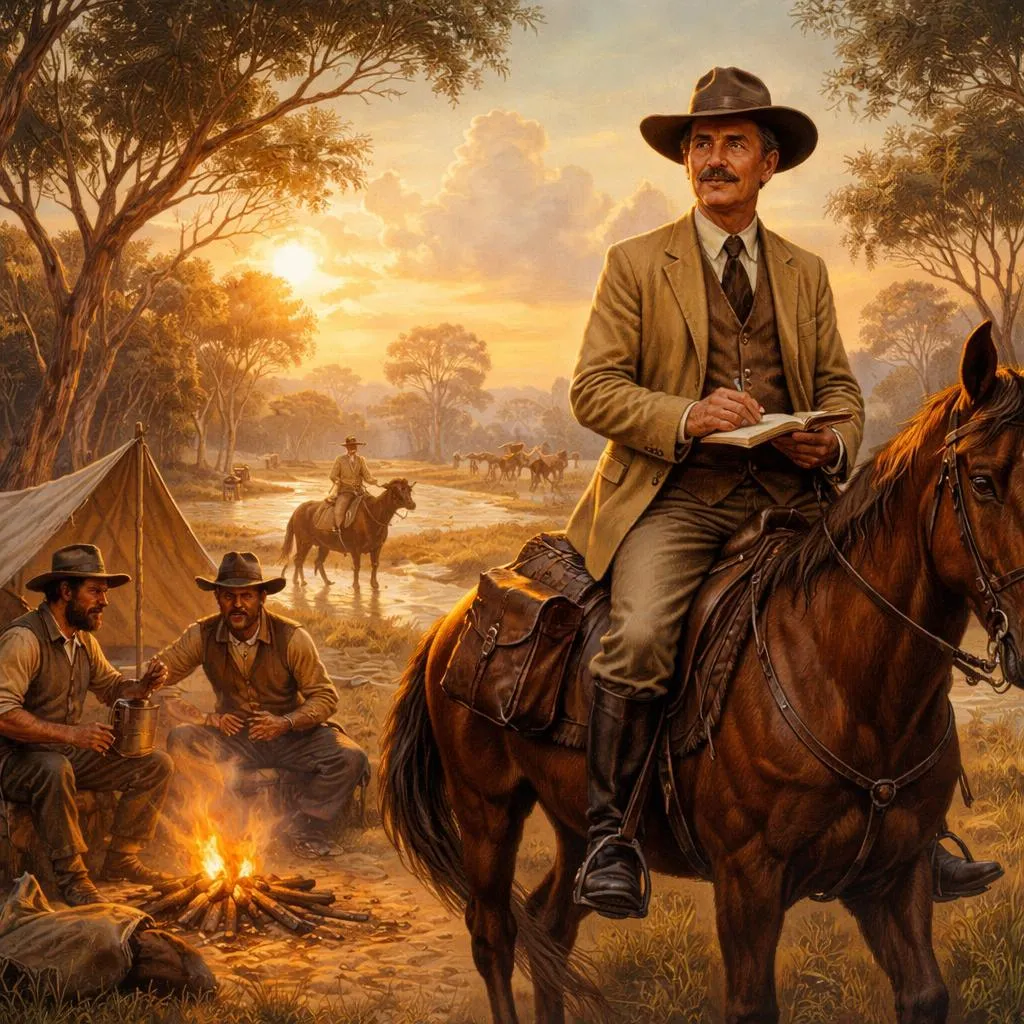

Have you ever heard a song about a swagman who stole a sheep and jumped into a waterhole? That song is "Waltzing Matilda." It is Australia's most famous song. Banjo Paterson wrote the words. This Celebrity Story: Banjo Paterson will introduce you to a man who loved the Australian outback. He was a lawyer, a poet, a journalist, and a war correspondent. He rode horses across the bush. He listened to the stories of drovers, shearers, and swagmen. He turned their lives into poetry. His words captured the spirit of Australia: tough, funny, and free. More than 100 years later, Australians still recite his poems.
Let us meet the man with the banjo name. Banjo Paterson did not play the banjo. That was the name of his horse.
Who Is This Celebrity?
Banjo Paterson was an Australian poet, journalist, and author. He lived from 1864 to 1941. His real name was Andrew Barton Paterson. "Banjo" was his nickname. He took it from a racehorse his family owned. He wrote many famous poems. He also wrote songs and short stories. He even worked as a war correspondent during the Boer War and World War I.
Why is he famous? He wrote "Waltzing Matilda." That song is Australia's unofficial national anthem. Australians sing it at sporting events, school assemblies, and parties. He also wrote "The Man from Snowy River." That poem tells the story of a horseback chase through the mountains. It became a famous movie. His poems celebrate the Australian bush, the people who lived there, and their unique sense of humor. He is one of Australia's most beloved writers.
Early Life and Childhood
Banjo Paterson was born near Orange, New South Wales, Australia. His family lived on a farm called Buckinbah. The farm was in the bush. The land was wild and beautiful. He learned to ride a horse before he could ride a bike.
When he was seven years old, his family moved to a property called Illalong. That was near the town of Yass. There were mountains and rivers. There were sheep and cattle. Banjo loved the outdoor life. He watched sheep shearers work. He listened to their songs. He heard stories from traveling bushmen.
His grandmother taught him at home. She gave him books. He learned to love stories. He read Shakespeare and the Bible. He also read adventure tales. He dreamed of writing his own stories one day.
He started school when he was 10. He went to a small bush school. Then his family sent him to Sydney. Sydney was a big city. He missed the bush. But he studied hard.
Education and Learning Journey
Banjo Paterson went to Sydney Grammar School. That was a good school. He did well in his classes. He especially loved English and history. He also loved sports. He played cricket and rowed boats.
After finishing school, he studied to become a lawyer. He worked at a law firm. He studied at night. It was hard work. He became a solicitor in 1886. That means he could practice law. He started his own law firm. He was successful. But his heart was not in the law.
At night, he wrote poetry. He sent his poems to a magazine called The Bulletin. The Bulletin was famous for publishing new Australian writers. The editor loved Banjo's poems. He published them.
His first famous poem was "The Man from Snowy River." It appeared in The Bulletin in 1890. People loved it. They loved the story of a young man who chased wild horses down a dangerous mountain. They loved the rhythm of the words. They loved the Australian setting. Banjo became famous.
How Did They Become Successful?
Banjo Paterson became successful because he wrote about real Australia. Before him, Australian poets copied English poets. They wrote about English gardens and English seasons. Banjo wrote about the bush. He wrote about droughts, floods, and bushfires. He wrote about swagmen, shearers, and stockmen. He wrote the way Australians talked.
In 1895, he published a book of poems called "The Man from Snowy River and Other Verses." The book sold out immediately. It was reprinted many times. It is still in print today.
That same year, he wrote "Waltzing Matilda." He was staying at a homestead in Queensland. He heard a story about a swagman who stole a sheep and drowned himself. He turned that story into a song. His friend composed the music. The song became famous. It traveled across Australia. Soldiers sang it during World War I. It became Australia's song.
He also wrote for newspapers. He traveled across Australia and the world. He went to New Guinea. He went to South Africa. He went to China. He wrote about what he saw. He became a famous journalist.
During the Boer War, he went to South Africa as a war correspondent. He wrote about the battles. He also drove an ambulance. He helped wounded soldiers. He was brave.
Big Ideas and Achievements
Banjo Paterson's biggest idea was that Australian life was worth writing about. He believed that the bush and its people were as important as any subject. He made Australians proud of their country.
His greatest achievement is "Waltzing Matilda." That song is more than a song. It is a symbol of Australia. It is about freedom and defiance. It is about a man who would rather die than be captured. Australians sing it with pride.
Another huge achievement is "The Man from Snowy River." That poem created an Australian hero. The hero is a young man who is not rich or famous. He is just brave and skilled. He proves himself through action. That hero became a model for Australian identity.
He also wrote many other famous poems. "Clancy of the Overflow" is about a city man who dreams of the bush. "The Geebung Polo Club" is a funny poem about bush polo players. "Mulga Bill's Bicycle" is a hilarious poem about a man who cannot ride a bike. His poems are funny, sad, and exciting.
Challenges and Difficult Times
Banjo Paterson faced many challenges. First, he lived in two worlds. He was a city lawyer. But he loved the bush. He never fully fit in anywhere.
Second, he went to war. He saw terrible things. He watched soldiers die. He carried wounded men. Those images stayed with him.
Third, he had money problems. He made good money as a lawyer and journalist. But he spent freely. He had to keep working even when he was tired.
Fourth, he faced critics. Some people said his poetry was too simple. They said it was not real art. He ignored them. He kept writing for ordinary people.
Fifth, his wife died in 1902. He was heartbroken. He remarried later. But he never forgot his first wife.
Through all these challenges, he kept writing. He kept traveling. He kept celebrating Australia.
Fun Facts About the Celebrity
Banjo Paterson's nickname came from a horse. The horse was named Banjo. He used the name for his writing.
Another fun fact: He was a very good horseman. He could ride as well as the bushmen he wrote about.
He once raced against a famous bushman named Clancy. He wrote a poem about it.
He had a pet kangaroo when he was a child. The kangaroo followed him everywhere.
One more fact: He appears on the Australian $10 note. His face is next to a drawing of a horseman from "The Man from Snowy River."
Why Is This Celebrity Important Today?
Banjo Paterson is important because he gave Australia a voice. Before him, Australia was a young country. It did not have its own stories. He created those stories. He made Australians feel like they belonged to a special place.
His poems are still taught in schools. Every Australian child learns "Waltzing Matilda" and "The Man from Snowy River." His words are part of growing up Australian.
His influence goes beyond Australia. People around the world know "Waltzing Matilda." It has been recorded by hundreds of artists. It is sung at international sporting events.
Parents can use his story to teach children about pride in their home. Banjo Paterson loved Australia. He wrote about its beauty and its people. Find what you love about your home. Write about it.
What Can Kids Learn from This Story?
Kids can learn wonderful lessons from Banjo Paterson. First, write about what you know. Banjo wrote about the Australian bush because he lived there. He wrote about horses and sheep because he saw them every day. Do not try to write about faraway things. Write about your own life.
Second, listen to stories. Banjo listened to swagmen and shearers. Their stories became his poems. Listen to your grandparents. Listen to your neighbors. Everyone has a story.
Third, be brave. Banjo went to war. He drove an ambulance under fire. He was scared. He did it anyway. Courage is not the absence of fear. It is acting despite fear.
Finally, celebrate your home. Banjo made Australians proud of their country. Be proud of where you come from. Your town, your family, your culture are special. Celebrate them.
Quick Quiz or Practice Time
Let us see what you learned from this Celebrity Story: Banjo Paterson. Answer these questions with a parent or by yourself.
What is Banjo Paterson's most famous song?
What was Banjo Paterson's real first name?
What famous poem tells the story of a horseback chase?
What animal did Banjo have as a pet when he was a child?
What profession did Banjo practice before becoming a full-time writer?
Here is a fun activity. Listen to "Waltzing Matilda." Try to learn the words. They are not easy. The song uses old Australian slang. "Swagman" means a traveler. "Billabong" is a waterhole. "Jumbuck" is a sheep. Sing the song with your family.
Another activity. Write a short poem about your own neighborhood. Describe what you see out your window. Use simple words. Make it rhyme if you can. Banjo Paterson started the same way.
Banjo Paterson lived a full life. He was a lawyer, a poet, a journalist, and a war hero. He rode horses across the bush. He sailed to faraway countries. He saw terrible battles. He wrote beautiful words. He gave Australia its song. "Waltzing Matilda" floats across the world. "The Man from Snowy River" still gallops through our imaginations. His poems are more than 100 years old. They are still funny and sad and true. His story teaches us that every place has a story. Every person has a voice. Listen to the world around you. Then write it down. That is the real lesson of this celebrity story.