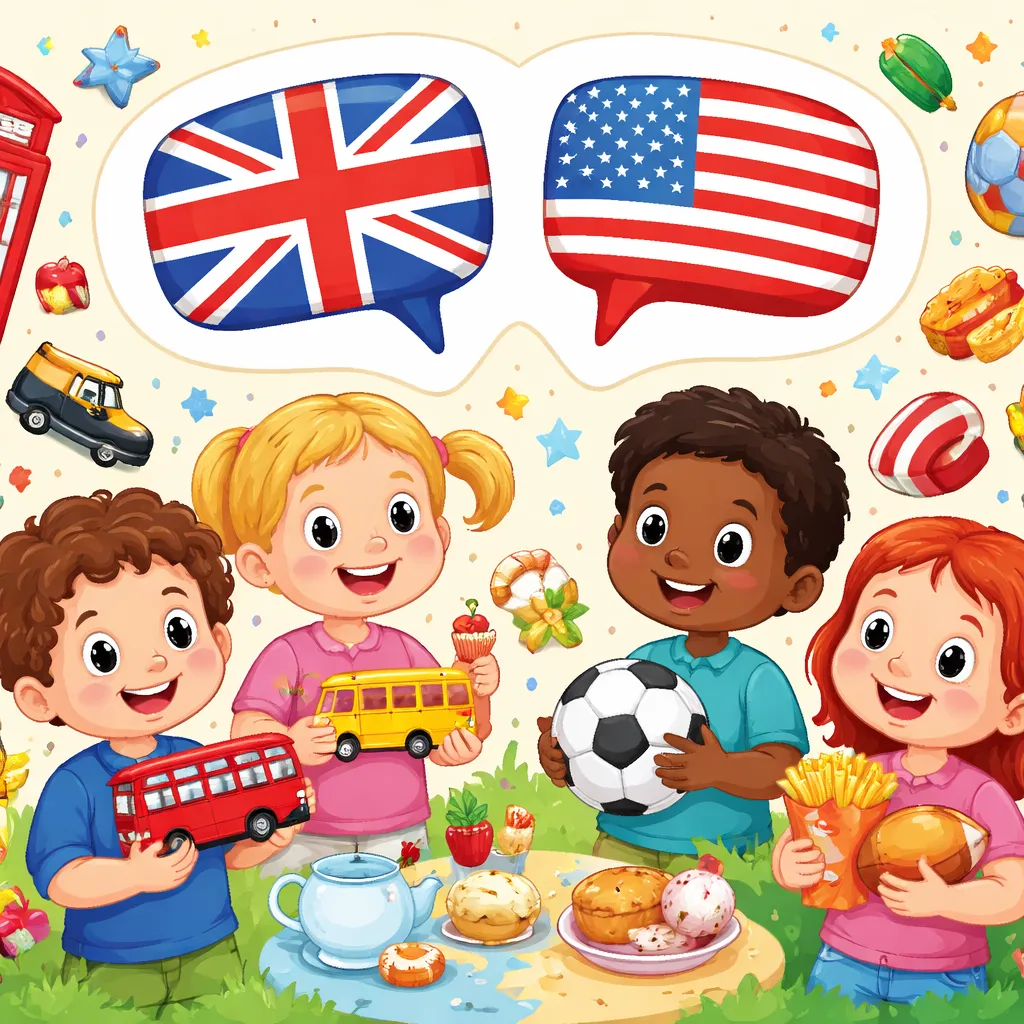

What Is This Situation?
English is a big language. People speak it in many countries. Two of the most common ways are British English and American English. They are like cousins. They are the same family but have their own little habits.
Your child may hear British English in a cartoon from the United Kingdom. They may hear American English in a movie from the United States. Sometimes the words sound different. Sometimes the words are completely different.
This situation happens when your child asks why a character said “lorry” instead of “truck.” It happens when they notice a friend says “biscuit” but they say “cookie.” These moments are not confusing. They are opportunities.
Understanding these differences helps children become flexible listeners. They learn that English has many flavors. They also learn that all of them are correct. This builds confidence and curiosity about language.
Key English Phrases for This Situation
Use phrases that celebrate variety. “In America, they say truck. In Britain, they say lorry. Both are right.” This phrase validates both versions. It teaches that language can be flexible.
Use phrases that invite comparison. “What do we call this?” lets your child name the item. Then you can say “In Britain, they call it a lift. In America, they call it an elevator.” This turns the difference into a fun fact.
Use phrases that acknowledge context. “If you talk to someone from London, you can say ‘lorry.’ If you talk to someone from New York, you can say ‘truck.’” This helps your child understand when to use each word.
Use phrases that show it is okay to mix. “Some people use both words. That is fine.” This reassures children who hear different versions at home or in media.
Use phrases that spark curiosity. “Let us see how they say it in Britain” before watching a show. This makes noticing differences an active game.
Simple Conversations for Kids
Dialogue 1: Watching a Cartoon
Child: “Why did he say ‘bin’? We say ‘trash can.’”
Parent: “That is British English. In Britain, they say ‘bin.’ In America, we often say ‘trash can.’”
Child: “Can I say ‘bin’?”
Parent: “Yes, you can. People will understand.”
This conversation answers a child’s observation. The parent explains clearly. The child feels empowered to try the new word.
Dialogue 2: Reading a Book
Child: “This book says ‘colour’ with a ‘u.’”
Parent: “Yes. That is British spelling. In America, we write ‘color’ without the ‘u.’”
Child: “Which is right?”
Parent: “Both are right. It just depends where the book was made.”
Here, the child notices a spelling difference. The parent explains without judgment. The child learns that different does not mean wrong.
Dialogue 3: Playing with a Friend
Friend: “I have a new jumper.”
Child looks confused.
Parent: “In Britain, they call a sweater a jumper. Isn’t that interesting?”
Child: “Oh! I have a sweater too.”
This dialogue happens in real time. The parent interprets for the child. The child learns a new word and sees that communication still works.
Vocabulary You Should Know
Truck and lorry both mean a large vehicle for carrying things. You can say “American English uses truck. British English uses lorry.” This is one of the most common differences.
Cookie and biscuit are different. In American English, a cookie is sweet and flat. In British English, a biscuit is what Americans call a cookie. In American English, a biscuit is a soft bread roll.
Apartment and flat both mean a home in a larger building. You can say “In America, people live in apartments. In Britain, people live in flats.”
Elevator and lift are the same thing. You can say “Push the button for the elevator. In Britain, they push the button for the lift.”
French fries and chips are both fried potato sticks. In American English, chips are thin slices in a bag. In British English, chips are what Americans call French fries.
Fall and autumn are the same season. You can say “In America, we say fall. In Britain, they say autumn.” Both are beautiful words.
How to Use These Phrases Naturally
Use a light and curious tone. Treat differences like discovering a fun secret. Say “Guess what they call this in Britain?” with a smile. Your child will share your curiosity.
Introduce differences when they come up naturally. Do not make a list and teach it. Wait until you see a truck in a book. Then mention “lorry.” Timing makes the learning stick.
Let your child hear both versions. It is fine if you use American English and a show uses British English. Your child will learn to understand both. This is a gift, not a problem.
When your child uses a British word, do not correct it. Just say “Yes, that is the British word. In America, we also say...” This validates their attempt and adds information.
Match your language to your context. If you live in America, use American words mostly. But let your child know other words exist. They will enjoy being “in the know.”
Common Mistakes to Avoid
One mistake is treating one version as “correct” and the other as “wrong.” Both are valid. If you say “That is not how we say it,” your child may feel confused or critical. Instead, say “That is how they say it in Britain.”
Another mistake is overwhelming your child with too many differences. Introduce them slowly. Let your child notice one difference at a time. Too many at once can feel like a lesson.
Some parents worry their child will mix the two. Mixing is normal. Children absorb language from many places. Over time, they learn to adjust. It is not a problem.
Avoid making fun of the other version. If you laugh at “lorry” or “lift,” your child learns to judge. Keep your tone respectful. All versions of English are valuable.
Tips for Parents and Practice Ideas
Watch shows from both the UK and the US. Choose age-appropriate cartoons. When a difference appears, pause and talk about it. Make it a game to spot differences.
Read books from different English-speaking countries. Compare the spellings. Notice the words for common objects. This builds awareness naturally.
When you travel or video call family in another country, point out the language differences. Say “Grandma in London says ‘petrol.’ We say ‘gas.’” This connects language to real people.
Do not force your child to choose one version. Let them use the words they hear and like. They will develop their own style over time.
Celebrate the variety. Tell your child “You know two ways to say it! That is special.” This builds pride in their flexible language skills.
Fun Practice Activities
Play a matching game. Make cards with pairs like “truck/lorry” and “elevator/lift.” Your child matches the American word with the British word. This turns vocabulary into a puzzle.
Create a two-column chart. Label one side “American” and one side “British.” Add pictures as you discover new pairs. Your child adds to it over time. It becomes a growing collection.
Act out a travel scenario. Pretend you are in London. Use British words. Then pretend you are in New York. Use American words. This role-play makes the differences active and fun.
Sing songs from both cultures. Listen to British nursery rhymes and American children’s songs. Notice the words. Enjoy the rhythms. Music makes language feel natural.
Read a book about the differences. There are children’s books that compare British and American words. Read them together. Let your child point out the pictures and say both words.
The difference between British and American English is not a problem to solve. It is a window into a wider world. When your child notices that people say the same thing in different ways, they learn something important. Language is alive. It changes with people and places. By knowing both versions, your child becomes a more flexible speaker and a more curious listener. They learn that there is not just one way to say something. There are many. And all of them are English.