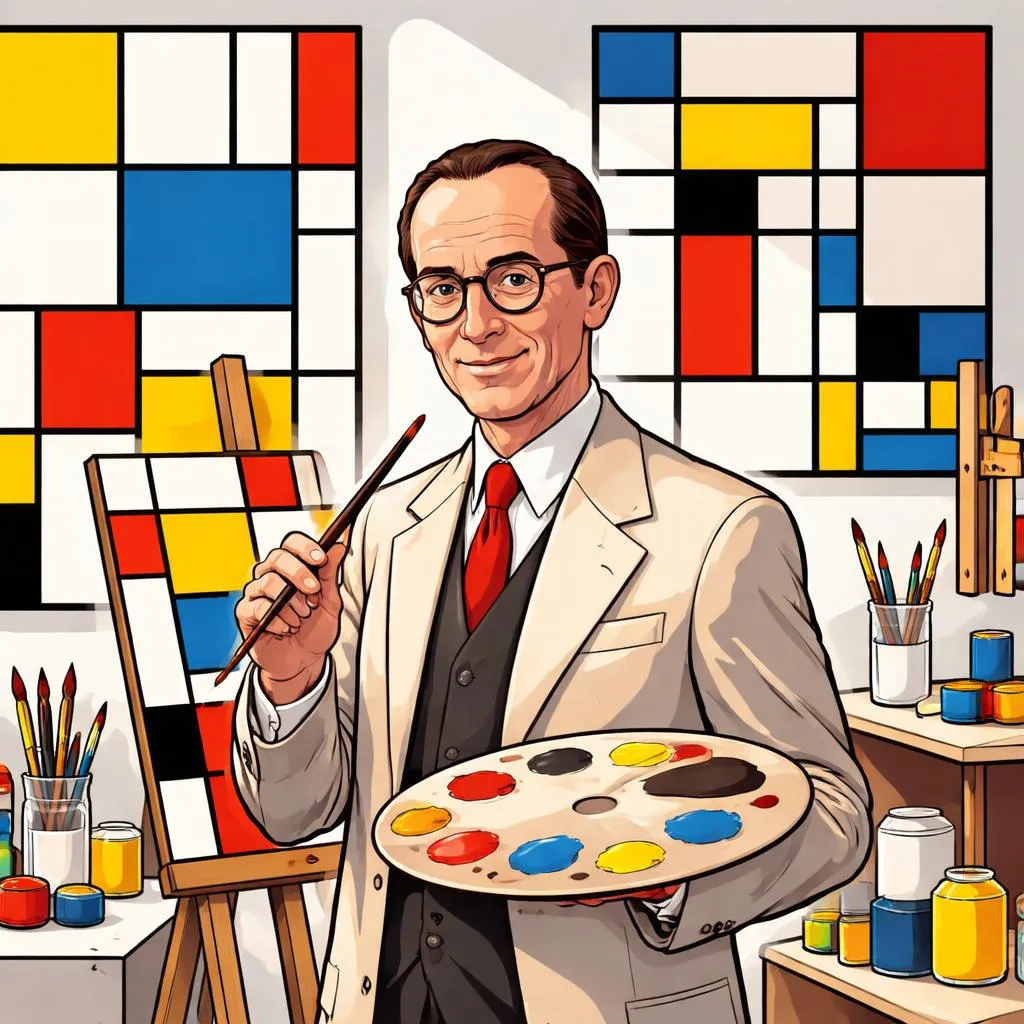

Have you ever seen a painting that looks like a grid? Black lines. White squares. Red, blue, and yellow rectangles. Nothing else. No trees. No people. No flowers. Just lines and blocks of color. That is a Piet Mondrian painting. His art looks simple. You might think you could paint it yourself. But try. It is harder than it looks. This Celebrity Story: Piet Mondrian will introduce you to an artist who spent his life simplifying. He started painting realistic landscapes. He painted trees and fields. Over time, he removed everything. He took away the leaves. He took away the curves. He took away the green. He ended with black lines and primary colors. He believed that art should be as basic as possible. He wanted to express the universal order of the universe.
Let us meet the man who painted rectangles. Piet Mondrian created a new visual language. You see it everywhere today.
Who Is This Celebrity?
Piet Mondrian was a Dutch painter. He lived from 1872 to 1944. He was one of the pioneers of abstract art. He co-founded an art movement called De Stijl. That means "The Style" in Dutch. De Stijl artists used only straight lines, right angles, and primary colors. That is red, blue, and yellow. Plus black, white, and gray.
Why is he famous? He created a style that is instantly recognizable. You have seen Mondrian's grids on t-shirts, coffee mugs, and buildings. His art influenced architecture, graphic design, and fashion. He believed in reducing art to its essence. No decoration. No curves. No emotion. Just balance and harmony. His paintings are calm. They feel orderly. They feel right.
Early Life and Childhood
Piet Mondrian was born in Amersfoort, Netherlands. His father was a schoolteacher. His uncle was a painter. They encouraged him to draw. He grew up in a strict Calvinist home. Calvinism is a form of Protestantism. It values simplicity and order.
Young Piet loved to draw. He drew flowers and animals. He also loved to paint landscapes. The Dutch countryside is flat. It has straight canals and straight roads. Those lines stayed in his mind.
He studied to become a drawing teacher. He taught for a while. But he wanted to be an artist.
In his 20s, he painted realistic scenes. He painted windmills. He painted fields. He painted trees. His early work looks like traditional Dutch painting. He was good. But he was not original.
He wanted to find something new. He moved to Paris in 1911. Paris was the center of the art world. He saw the work of Pablo Picasso and Georges Braque. They were inventing Cubism. Cubism broke objects into geometric shapes. Mondrian was inspired.
Education and Learning Journey
Piet Mondrian studied at the Rijksakademie in Amsterdam. That is the national art academy of the Netherlands. He learned traditional painting. He learned to draw the human figure. He learned perspective and shading.
But his real education happened in Paris. He saw Cubism. He started painting in a Cubist style. He painted trees that looked like cracked glass. He painted buildings that looked like broken rectangles.
He reduced his palette. He stopped using green and purple. He used only black, gray, and ocher. He was simplifying.
In 1914, he visited the Netherlands. World War I broke out. He could not return to Paris. He was stuck in his home country for the duration of the war.
During that time, he met other artists who wanted to simplify art. They formed a group called De Stijl. They published a magazine. Mondrian wrote articles explaining his ideas.
He said art should be reduced to basic elements. Straight lines. Right angles. Primary colors. He stopped painting landscapes entirely. He started painting only grids.
How Did They Become Successful?
Piet Mondrian became successful slowly. During World War I, only a few people knew his work. After the war, he returned to Paris. His new style was shocking. People did not understand it. He was poor. He lived in a small studio.
He painted the same painting over and over. A grid of black lines. White squares. A red square here. A blue square there. A yellow square. He adjusted the placement of colors. He wanted perfect balance.
In the 1920s, his fame grew. Other artists in the De Stijl group spread his ideas. Architects started designing buildings with Mondrian's grids. Designers made furniture in his style.
In the 1930s, he moved to London. Then he moved to New York City in 1940. World War II was happening in Europe. He wanted to be safe.
In New York, he discovered jazz music. He loved it. His paintings changed. He replaced black lines with colored lines. He painted "Broadway Boogie Woogie." That painting looks like a map of Manhattan. It is made of tiny colored squares. It feels like jazz.
He died in New York in 1944. He was 71 years old.
Big Ideas and Achievements
Piet Mondrian's biggest idea was that art should be universal. He believed that straight lines and primary colors could be understood by anyone. No language needed. No culture needed. Just basic visual truth.
His greatest achievement is his mature style. Those black grids with red, blue, and yellow rectangles are iconic. They are called "Compositions." He numbered them instead of naming them. "Composition in Red, Blue, and Yellow." "Composition with Large Red Plane." He wanted the viewer to see only the painting, not a story.
Another huge achievement is his influence on design. The Mondrian grid is everywhere. Modern architecture uses his principles. The Bauhaus school of design was influenced by him. Graphic designers use his colors. Yves Saint Laurent, a fashion designer, made a Mondrian dress in 1965. It became famous. It looks like a Mondrian painting.
He also influenced minimalism. Minimalist artists take away everything unnecessary. Mondrian was the first minimalist.
Challenges and Difficult Times
Piet Mondrian faced many challenges. First, he struggled to find his style. He was in his 40s when he developed his mature grid. He spent decades searching.
Second, he was poor. He lived in small studios. He ate simple food. He did not care about money. He cared about art.
Third, he was isolated. His art was so different that few people understood it. He had few friends. He spent most of his time alone in his studio.
Fourth, World War I trapped him in the Netherlands. He could not travel. He could not see the art world in Paris.
Fifth, World War II forced him to flee Europe. He left behind many paintings. Some were destroyed in the war. He had to start over in New York.
Through every challenge, he kept painting. He kept simplifying. He kept searching for balance.
Fun Facts About the Celebrity
Piet Mondrian was a dancer. He loved ballroom dancing. He went dancing every week in New York.
Another fun fact: He was a theosophist. Theosophy is a spiritual movement. He believed his paintings expressed spiritual truths.
He lived alone. He never married. He had no children. His art was his life.
He painted his studio walls white. He painted colored rectangles on them. He lived inside his own paintings.
One more fact: His painting "Composition II in Red, Blue, and Yellow" sold for 50 million dollars in 2009.
Why Is This Celebrity Important Today?
Piet Mondrian is important because he created a visual language that is still used. His grids are everywhere. Your notebook cover might have a Mondrian pattern. Your favorite brand's logo might use his colors.
He is also important because he showed that less is more. He took away everything unnecessary. What remained was pure balance. We can apply that idea to our own lives. Get rid of clutter. Keep only what matters.
His influence on design is immeasurable. Without Mondrian, modern buildings would look different. Your phone's interface might look different.
Parents can use his story to teach children about focus. Mondrian painted almost the same painting for 30 years. He was searching for perfection. He never stopped refining.
What Can Kids Learn from This Story?
Kids can learn beautiful lessons from Piet Mondrian. First, simplify. Mondrian took away everything unnecessary. Look at your room. What can you give away? Look at your art. What can you remove? Simple is powerful.
Second, balance matters. Mondrian moved colored squares around until the painting felt balanced. Balance makes you feel calm. Balance makes you feel safe.
Third, be patient. Mondrian painted grids for decades. He did not get bored. He kept refining. Good things take time.
Finally, trust your own vision. People thought Mondrian was crazy. He did not care. He painted what he believed. You should too.
Quick Quiz or Practice Time
Let us see what you learned from this Celebrity Story: Piet Mondrian. Answer these questions with a parent or by yourself.
What three primary colors did Mondrian use?
What art movement did Mondrian co-found?
What city did Mondrian move to in 1940?
What jazz-influenced painting did Mondrian make in New York?
What kind of dance did Mondrian love?
Here is a fun activity. Get a piece of white paper. Draw a grid of black lines. Use a ruler. Then color in some squares with red, blue, and yellow. Leave some squares white. Move the colors around until it feels balanced. You have made a Mondrian.
Another activity. Look around your house. Find three things that have a Mondrian pattern. A book cover? A rug? A toy? Mondrian is everywhere.
Piet Mondrian painted himself into a corner. He started with windmills and trees. He painted realistically. Then he simplified. He removed the leaves. He removed the curves. He removed the green. He removed everything until only black lines and primary colors remained. He painted grids for 30 years. He never got bored. He was searching for perfect balance. He never found it. But he got close. His paintings hang in museums. They are worth millions. They also appear on t-shirts and coffee mugs. Everyone knows his grids. His story teaches us to simplify. To seek balance. To be patient. To trust our vision. That is the real lesson of this celebrity story.