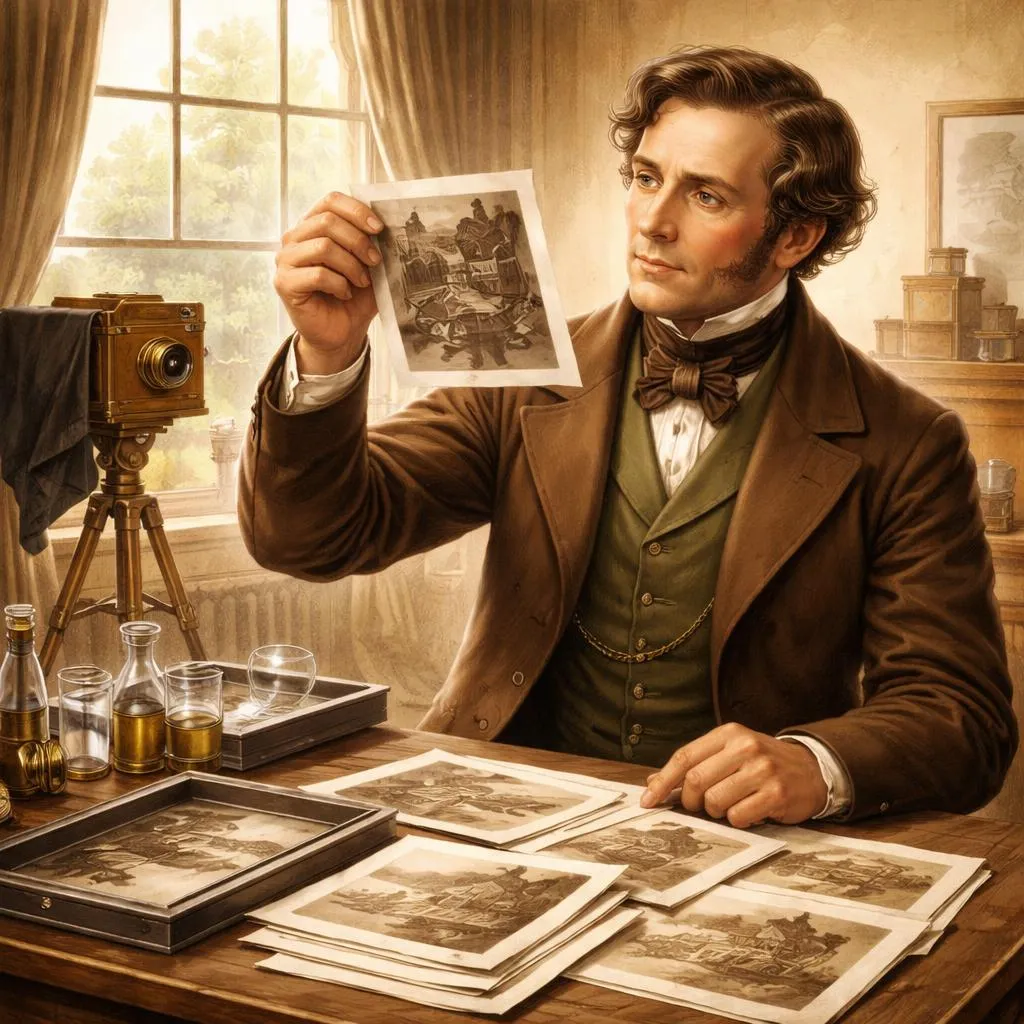

Have you ever tried to draw a picture with a pencil? It takes a long time. Now imagine capturing an image in seconds. That is what William Henry Fox Talbot did. He invented photography. Not the kind that makes a single picture. The kind that makes a negative. From that negative, you can make many positive prints. This Celebrity Story: William Henry Fox Talbot will introduce you to the man who made your family photos possible. He was born in England. He was a scientist, a mathematician, a linguist, and a botanist. He was frustrated by his poor drawing skills. He wished he could make images appear by magic. He figured out how. He called his invention "photogenic drawing." It changed the world.
Let us meet the father of modern photography. Talbot said, "The most transitory of things, a shadow, becomes a permanent record."
Who Is This Celebrity?
William Henry Fox Talbot was an English scientist, inventor, and photography pioneer. He lived from 1800 to 1877. He was a man of many talents. He studied mathematics and chemistry. He also studied astronomy, botany, and philology (the study of languages). He was a member of Parliament. He wrote books. He invented photography.
Why is he famous? He invented the negative-positive process. That is the basis of all modern photography. Before him, there was only the daguerreotype. That process made a single image on a metal plate. You could not copy it. Talbot's process made a negative on paper. From that negative, you could make many positive prints. He also wrote the first book illustrated with photographs. It was called "The Pencil of Nature."
Early Life and Childhood
William Henry Fox Talbot was born in Melbury, Dorset, England. His family was wealthy and aristocratic. His father died when he was only a few months old. His mother raised him. She encouraged his curiosity.
He was a sickly child. He had frequent headaches. He was not strong. He spent a lot of time indoors. He read books. He loved science. He also loved drawing. He was not very good at drawing. He wished he could capture images more easily.
He went to school at Harrow. He was a good student. He then went to Trinity College, Cambridge. He studied mathematics. He graduated with honors. He was a brilliant scholar.
After university, he bought an estate in Lacock, Wiltshire. The estate had a beautiful abbey. He lived there for the rest of his life. Today, Lacock Abbey is a museum dedicated to his work.
Education and Learning Journey
William Henry Fox Talbot studied at Harrow School and Trinity College, Cambridge. He studied mathematics, classics, and the sciences. He was a polymath. That means he knew a lot about many subjects.
He also studied chemistry. He was fascinated by light and chemicals. He conducted experiments in his home. He had a small laboratory at Lacock Abbey.
In 1833, he went on a honeymoon to Italy. He was newly married. He brought a camera lucida with him. That was a drawing aid. It projected an image onto paper. You traced the image. Talbot was not good at tracing. He was frustrated. He thought, "Why can't I make the image fix itself on the paper?"
He began experiments. He used paper coated with silver salts. Silver salts darken when exposed to light. He made contact prints of leaves and lace. He called them "photogenic drawings."
He worked for years. He improved his process. He discovered that a short exposure made an invisible "latent" image. It could be developed later. That was a huge breakthrough.
In 1839, the Frenchman Louis Daguerre announced his daguerreotype process. Talbot rushed to announce his own process. The two inventors competed.
How Did They Become Successful?
William Henry Fox Talbot became successful in the 1840s. His process was slower than Daguerre's. But it had one huge advantage: you could make multiple prints.
In 1841, he patented his process. He called it the "calotype." The word comes from the Greek "kalos," meaning beautiful. Calotypes were beautiful. They were soft and artistic. Daguerreotypes were sharp and detailed. Each had its fans.
He opened a studio in Reading, England. He made photographic prints for sale. He was not a great businessman. He did not make much money.
In 1844, he published "The Pencil of Nature." It was the first book illustrated with photographs. It had 24 calotypes. The photographs showed buildings, sculptures, and still lifes. The book is extremely rare today. A copy sold for over $2 million.
He continued to experiment. He improved his process. He developed a faster exposure time. He also developed a method for making photographic engravings.
He sued other photographers for using his patent. He was accused of holding back the art of photography. He eventually gave up his patent. He was generous. He said he wanted photography to be free.
He received many honors. He was elected a Fellow of the Royal Society, the most prestigious scientific organization in Britain.
Big Ideas and Achievements
William Henry Fox Talbot's biggest idea was the negative-positive process. That single invention changed the world. Every photograph you have ever seen on paper comes from his idea.
His greatest achievement is "The Pencil of Nature." That book is the first photographically illustrated book. It is a landmark in the history of publishing.
Another huge achievement is his botanical photography. He made photogenic drawings of plants. He placed a leaf on sensitized paper. He exposed it to light. The paper darkened everywhere except under the leaf. The result was a white silhouette of the leaf. It was simple. It was beautiful.
He also made the first photographs of the moon. He used his camera to capture the lunar surface.
He also made photographs of his family and friends. The earliest photograph of a person is a self-portrait by Robert Cornelius. But Talbot's photographs of his family are among the earliest human portraits.
He also made photographs of Lacock Abbey. You can still visit the abbey today. It looks much the same as in his photographs.
He also invented the photoglyphic engraving process. That was an early form of photogravure. It allowed photographs to be printed with ink, not chemicals.
Challenges and Difficult Times
William Henry Fox Talbot faced many challenges. First, he had to compete with Daguerre. The daguerreotype was more popular at first. People loved its sharpness.
Second, he was not a good businessman. His studio did not make much money.
Third, his patent was controversial. Many photographers hated him for it. He was accused of greed. He eventually gave it up.
Fourth, his process produced soft images. Critics said they were inferior. He believed they were artistic.
Fifth, he had to overcome his own shyness. He was not a good public speaker. He had to promote his invention.
Fun Facts About the Celebrity
William Henry Fox Talbot was a brilliant linguist. He translated ancient Assyrian cuneiform. He was one of the first people to decipher cuneiform writing.
Another fun fact: He was a member of Parliament. He served as a Whig from 1832 to 1835.
He loved to read. His library at Lacock Abbey had over 7,000 books.
He was a botany expert. He wrote a book about ferns.
One more fact: He invented a device called the "microscope camera." It was used to photograph tiny objects.
Why Is This Celebrity Important Today?
William Henry Fox Talbot is important because he invented the negative-positive process. Every time you take a picture with a film camera, you are using his invention. Even digital cameras use the concept of the negative. A digital file is like a negative. You can make many prints from it.
He is also important because he made the first photographically illustrated book. That book showed the world the power of photography.
His influence is everywhere. Every photographer owes him a debt.
Parents can use his story to teach children about perseverance. Talbot worked for years to perfect his process. He did not give up.
What Can Kids Learn from This Story?
Kids can learn wonderful lessons from William Henry Fox Talbot. First, do not give up. Talbot worked for years. He failed many times. He kept trying. If you fail, try again.
Second, combine art and science. Talbot was a scientist. He invented photography. He was also an artist. He used it to make beautiful images. Art and science are not opposites. They work together.
Third, be curious. Talbot was curious about everything. He studied math, chemistry, botany, and languages. Curious people change the world.
Finally, share your discoveries. Talbot eventually gave up his patent. He wanted photography to be free. Share what you learn. It will help others.
Quick Quiz or Practice Time
Let us see what you learned from this Celebrity Story: William Henry Fox Talbot. Answer these questions with a parent or by yourself.
What did Talbot invent that allowed multiple copies of a photograph?
What is the name of Talbot's first photographically illustrated book?
What process did Talbot call the "calotype"?
What French inventor announced his process in 1839?
What did Talbot use to make his first photogenic drawings?
Here is a fun activity. Place a leaf on a piece of paper. Take it outside in the sun. Leave it for a few hours. The paper will fade everywhere except under the leaf. You have made a photogenic drawing like William Henry Fox Talbot.
Another activity. Look up Talbot's photograph of Lacock Abbey online with your parent. Then draw your own house or school. Try to capture the light and shadows. You are photographing like Talbot.
William Henry Fox Talbot was born into wealth. He studied at Cambridge. He was a scientist and a scholar. He went on a honeymoon to Italy. He was frustrated by his bad drawing. He wished images could fix themselves. He experimented with silver salts. He invented the negative. He made photogenic drawings of leaves. He made calotypes of his family. He published "The Pencil of Nature." He gave up his patent. He shared his invention. He changed the world. His story teaches us to never give up. To combine art and science. To be curious. To share. That is the real lesson of this celebrity story.