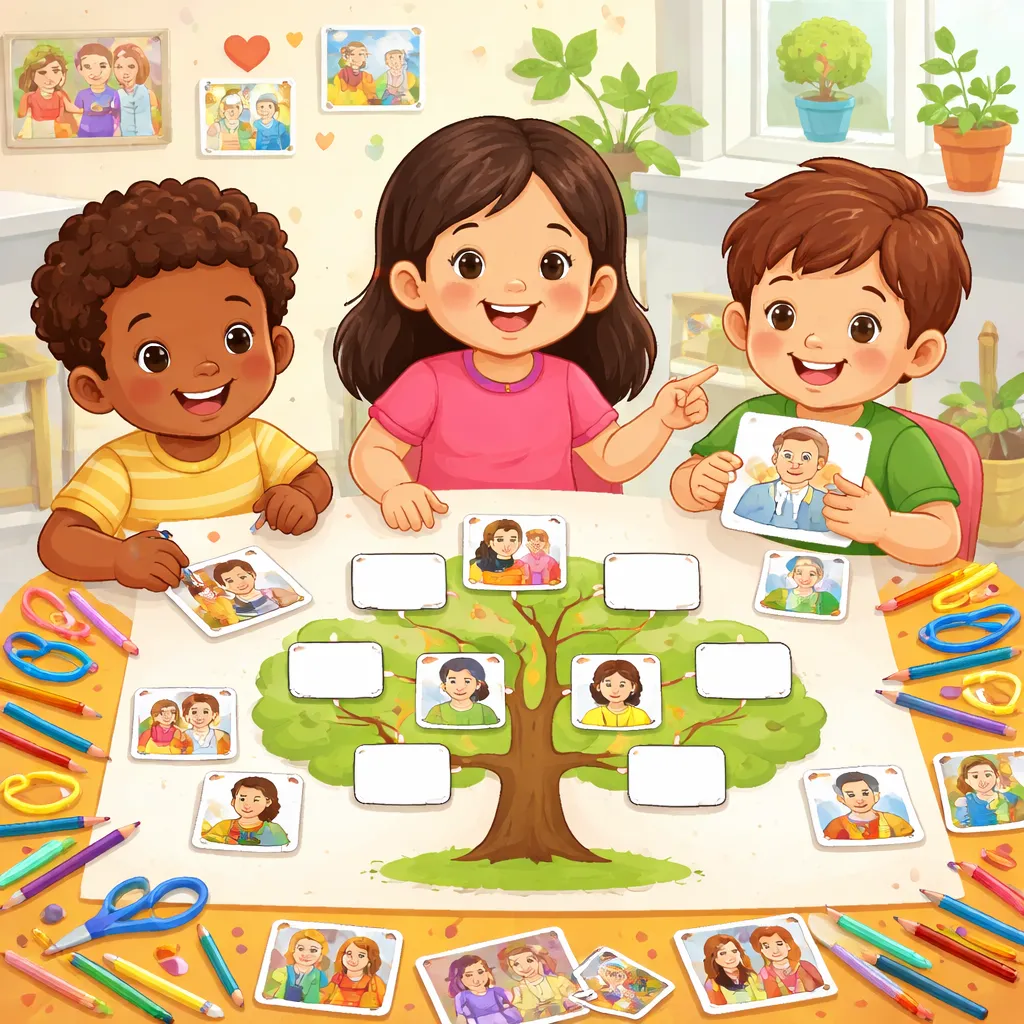

What Is This Situation? Family is the most important thing to a child. Mama, Papa, brother, sister, grandma, grandpa. Learning the words for family members helps children talk about the people they love. A family tree shows how everyone is connected.
A family tree worksheet for ESL students gives children a gentle way to learn family vocabulary. They draw pictures. They write names. They see how family members connect. The tree becomes a picture of their family.
This situation happens during quiet time, during art time, during moments when children learn about family. The worksheet is personal. It is about their own family. That makes the learning meaningful.
These worksheets are best used with conversation. Talk about each family member. Share stories. The learning happens while filling the tree.
Key English Phrases for This Situation Use phrases for introducing the family tree. "Let us make a family tree. A family tree shows your family. It starts with you." "At the bottom, draw yourself. Write your name."
Use phrases for family members. "Who is in your family? Mama, Papa, brother, sister?" "Grandma and Grandpa are your parents' parents."
Use phrases for drawing and writing. "Draw a picture of Mama. Write 'Mama' under her picture." "Draw a picture of Papa. Write 'Papa' under his picture."
Use phrases for talking about family. "What is your mama's name? Her name is Anna." "What does your papa like to do? He likes to play ball."
Use phrases for celebrating. "You made a family tree. It is beautiful." "You know all the family words. Good job."
Simple Conversations for Kids Dialogue 1: Starting the Tree Parent: "Let us make a family tree. First, draw yourself at the bottom." Child draws self. Parent: "Good. Write your name." Child writes name. Parent: "Now draw Mama above you." Child draws Mama. Parent: "Write Mama." Child writes Mama.
This conversation starts the family tree. The child draws. The parent guides. The learning begins.
Dialogue 2: Adding Family Members Parent: "Who else is in your family? Do you have a brother?" Child: "Yes. Leo." Parent: "Draw Leo next to you. Write 'brother Leo.'" Child draws and writes. Parent: "Now draw Papa above Mama." Child draws Papa. Parent: "Write Papa." Child writes Papa.
This conversation adds family members. The child draws and writes. The vocabulary grows.
Dialogue 3: Talking About Family Parent: "Your family tree is beautiful. Who is this?" Child: "Mama." Parent: "Yes. What is your mama's name?" Child: "Anna." Parent: "Good. And who is this?" Child: "Grandma." Parent: "Yes. Grandma is your mama's mama. You know all the family words."
This conversation reviews the family tree. The child names family members. The parent adds facts. The learning is complete.
Vocabulary You Should Know Mama is another word for mother. You can say "This is my mama." She is the parent.
Papa is another word for father. You can say "This is my papa." He is the parent.
Brother is a boy who has the same parents as you. You can say "My brother plays with me."
Sister is a girl who has the same parents as you. You can say "My sister shares her toys."
Grandma is your mother's mother or father's mother. You can say "My grandma gives me cookies."
Grandpa is your mother's father or father's father. You can say "My grandpa tells me stories."
How to Use These Phrases Naturally Use a warm and curious tone. Family is personal. Your voice should show interest. "Tell me about your family."
Say the phrases as your child draws. "Draw Mama. What does Mama look like?" The words guide the drawing.
Let your child share stories. "What does your brother like to do?" Sharing stories makes the tree come alive.
Use the family tree to teach relationships. "Grandma is your mama's mama." Understanding relationships builds language.
Celebrate the finished tree. "Your family tree is so special. Let us hang it up." Pride in the work builds confidence.
Common Mistakes to Avoid One mistake is focusing only on words. Share stories too. "Tell me about Grandma." Stories make the words meaningful.
Another mistake is making the tree too complex. Start with immediate family. Mama, Papa, child. Add more later.
Some children have non-traditional families. All families are beautiful. Adapt the tree to fit their family.
Avoid comparing. Every family is different. Your child's family tree is perfect for them.
Tips for Parents and Practice Ideas Use photos. Glue small photos on the tree. Photos make it personal.
Let your child decorate. Crayons, stickers, glitter. Decoration makes it fun.
Talk about family stories. "Remember when we went to the beach with Grandma?" Stories connect to the words.
Make a family book. After the tree, make a book about each family member. The book extends learning.
Share the tree with family. Show it to Grandma. She will love it. Your child will be proud.
Fun Practice Activities Play family charades. Act out a family member. Your child guesses. The game builds vocabulary.
Sing the family song. "Mama, Papa, brother, sister. Grandma, Grandpa, family." Music makes learning fun.
Make a family photo album. Put pictures in an album. Your child labels each one. "Mama. Papa. Brother."
Create a family story. "Once upon a time, there was a family. Mama, Papa, and child." Your child adds to the story.
Draw family portraits. Your child draws each family member. They label the drawings. The portraits build recognition.
A family tree worksheet for ESL students helps children learn family vocabulary and share their story. Mama, Papa, brother, sister, grandma, grandpa. Draw, write, talk. With playful practice and patient guidance, your child will learn family words. They will share their family story. They will be proud. That is the power of a family tree. One branch at a time, your child will learn. And you will be there to draw and share together.