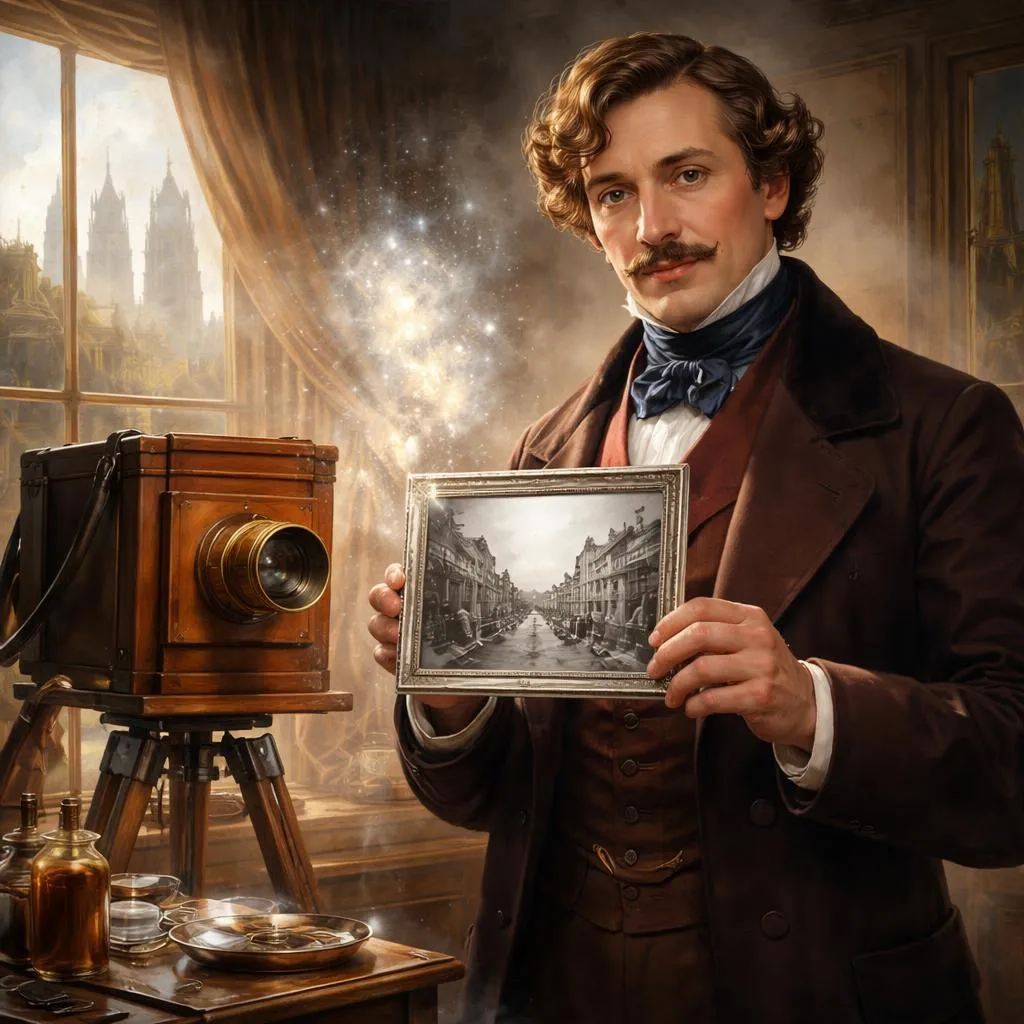

Have you ever looked at an old photograph in a silver frame? The image is sharp and silvery. It looks like a mirror with a ghost inside. That is a daguerreotype. Louis Daguerre invented it. This Celebrity Story: Louis Daguerre will introduce you to the man who made the first practical camera. He was a French artist. He painted huge backgrounds for plays. He was famous for his "dioramas," which were like 3D movies using painted backdrops and lighting effects. He wanted to capture reality directly. He experimented with chemicals and light. In 1839, he announced his invention. The world went crazy. Suddenly, you could capture a portrait in minutes. You could record a building. You could freeze time.
Let us meet the father of practical photography. Louis Daguerre said, "I have seized the light. I have arrested its flight."
Who Is This Celebrity?
Louis Daguerre was a French artist, inventor, and photographer. He lived from 1787 to 1851. He is best known for inventing the daguerreotype process. That was the first practical method of photography. He worked with Nicéphore Niépce for many years. After Niépce died, Daguerre continued their experiments. In 1839, he announced his process. The French government gave him a lifetime pension. In exchange, they gave the process free to the world.
Why is he famous? He invented the first camera that could capture a clear, permanent image. The daguerreotype was a silver-plated copper sheet. It was exposed in a camera. Then it was developed with mercury vapor. The image was incredibly sharp. It was also unique. You could not make copies. The daguerreotype created a sensation. It was the beginning of photography.
Early Life and Childhood
Louis Daguerre was born in Cormeilles-en-Parisis, France. It is a small town near Paris. His father was a clerk. His mother was a homemaker. He was not a wealthy child. He showed talent for drawing and painting.
He moved to Paris as a teenager. He apprenticed with a famous set designer. He learned to paint large theatrical backgrounds. He was good at it. He also loved science. He was fascinated by light and optics.
He became a master of illusion. He created dioramas. A diorama was a large painted scene. The lighting would change. Clouds would move. The scene would appear to change from day to night. People paid to see them. They were amazed.
He was successful. He became wealthy. He was also restless. He wanted to capture reality directly.
Education and Learning Journey
Louis Daguerre studied under the set designer Ignace Eugene Marie Degotti. He learned to paint large-scale scenes. He also studied optics and chemistry on his own. He was curious.
He opened his own diorama theater in Paris in 1822. The theater was a huge success. He also opened one in London. He traveled between the two cities.
In the 1820s, he learned about the work of Nicéphore Niépce. Niépce had made the first permanent photograph in 1826. It was called "View from the Window at Le Gras." The exposure took eight hours. It was very crude.
Daguerre wrote to Niépce. They began a partnership in 1829. They experimented together. They tried to improve the process. Niépce died in 1833. Daguerre continued alone.
He worked for years. He experimented with silver and mercury. He discovered that mercury vapor could develop a latent image. That was the breakthrough. Instead of exposing the plate for hours, he could expose it for minutes. Then he developed it with mercury.
In 1839, he announced his process. He named it the daguerreotype.
How Did They Become Successful?
Louis Daguerre became successful instantly. In January 1839, the French Academy of Sciences announced his invention. The world was amazed. People had never seen such clear images.
The French government gave Daguerre a lifetime pension of 6,000 francs a year. He also received a pension from Niépce's son. In exchange, the government gave the daguerreotype process free to the world. Anyone could use it.
Daguerre published a manual. It was translated into many languages. People all over the world started making daguerreotypes.
In the United States, people went crazy for daguerreotypes. Portrait studios opened in every city. For the first time, ordinary people could have their portraits made. It was cheap. It was fast. It was accurate.
Daguerre died in 1851. He was 63 years old. He died in a house on the outskirts of Paris. His name is inscribed on the Eiffel Tower. He is one of the 72 great French scientists and engineers honored there.
Big Ideas and Achievements
Louis Daguerre's biggest idea was that a latent image could be developed. Before him, you had to expose the plate until the image appeared. That took hours. He discovered that a short exposure could create an invisible image. Then you could use chemicals to make it visible. That is still how film photography works today.
His greatest achievement is the daguerreotype itself. The images are incredibly sharp. They have a silvery, mirror-like quality. They are beautiful. Many survive today, over 180 years later.
Another huge achievement is his dioramas. He was a master of illusion. His dioramas used painted backdrops, lighting, and moving parts to create realistic scenes. They were the precursors to motion pictures. They also funded his experiments.
He also trained other photographers. His manual taught thousands of people how to make daguerreotypes.
He also helped popularize photography. Before him, only a few scientists knew about the possibility. He made it a worldwide phenomenon.
He also influenced painting. Painters began to use photographs as references. The daguerreotype changed the way artists saw the world.
Challenges and Difficult Times
Louis Daguerre faced many challenges. First, his diorama theater burned down in 1839. He lost everything. He did not rebuild.
Second, he had to compete with other inventors. The English inventor William Henry Fox Talbot announced his calotype process in 1841. Talbot's process was inferior in quality. But it allowed multiple copies. Daguerre's process made only one.
Third, his partnership with Niépce was difficult. Niépce was secretive. He was also jealous. After Niépce died, his son demanded credit. Daguerre had to share the pension.
Fourth, he was accused of stealing Niépce's ideas. He was not. He had improved Niépce's process dramatically.
Fifth, he died before he saw the full impact of his invention. He never knew that photography would become a global art form.
Fun Facts About the Celebrity
Louis Daguerre painted panoramic murals. One of his murals was 70 feet wide.
Another fun fact: His diorama theater in Paris used rotating stages. The audience sat on a platform that rotated between scenes.
He was a perfectionist. He would work for weeks on a single image.
He never took a photograph of himself. There are no daguerreotypes of Daguerre. There is only a painting.
One more fact: A daguerreotype is very fragile. It is a silver surface. It tarnishes easily. It must be kept under glass.
Why Is This Celebrity Important Today?
Louis Daguerre is important because he made photography practical. Before him, it was a laboratory experiment. He turned it into a business.
He is also important because of the quality of his images. A well-made daguerreotype has more resolution than most digital cameras. They are stunning.
His influence is seen in every photograph taken. He proved that light could be captured. He proved that time could be frozen.
Parents can use his story to teach children about persistence. Daguerre worked for over a decade. He kept trying. He did not give up.
What Can Kids Learn from This Story?
Kids can learn wonderful lessons from Louis Daguerre. First, keep experimenting. Daguerre tried thousands of combinations of chemicals. He did not give up. When something does not work, try something else.
Second, combine art and science. Daguerre was an artist and a scientist. He used science to make art. You can too. Paint with light. Draw with a camera.
Third, share your discoveries. The French government gave Daguerre's invention to the world. He did not keep it secret. Share what you learn. It will help others.
Finally, look at old photographs. Daguerreotypes are over 180 years old. They still look new. They are windows into the past. Look at old photos of your family. They are your history.
Quick Quiz or Practice Time
Let us see what you learned from this Celebrity Story: Louis Daguerre. Answer these questions with a parent or by yourself.
What is the name of Daguerre's photographic process?
What did Daguerre use to develop the image?
What was the name of Daguerre's partner who died in 1833?
What theatrical attraction did Daguerre invent before photography?
Where is Daguerre's name inscribed in Paris?
Here is a fun activity. Find a shiny metal surface. A spoon. A pan. Look at your reflection. That silvery surface is like a daguerreotype. Now try to draw what you see. You are capturing a reflection like Louis Daguerre.
Another activity. Look up a daguerreotype online with your parent. Notice how sharp it is. The people in the photo lived over 150 years ago. They look real. Then take a photo of your family. Someday, that photo will be old too. You are making history.
Louis Daguerre was born near Paris. He was an artist. He painted huge dioramas. He wanted to capture reality. He experimented with silver and mercury. He invented the daguerreotype. The image was sharp. It was permanent. He announced his invention in 1839. The world went crazy. People lined up to have their portraits made. Daguerre died in 1851. His name is on the Eiffel Tower. His images still survive. They are silver ghosts. They show us the past. His story teaches us to experiment. To combine art and science. To share our discoveries. That is the real lesson of this celebrity story.