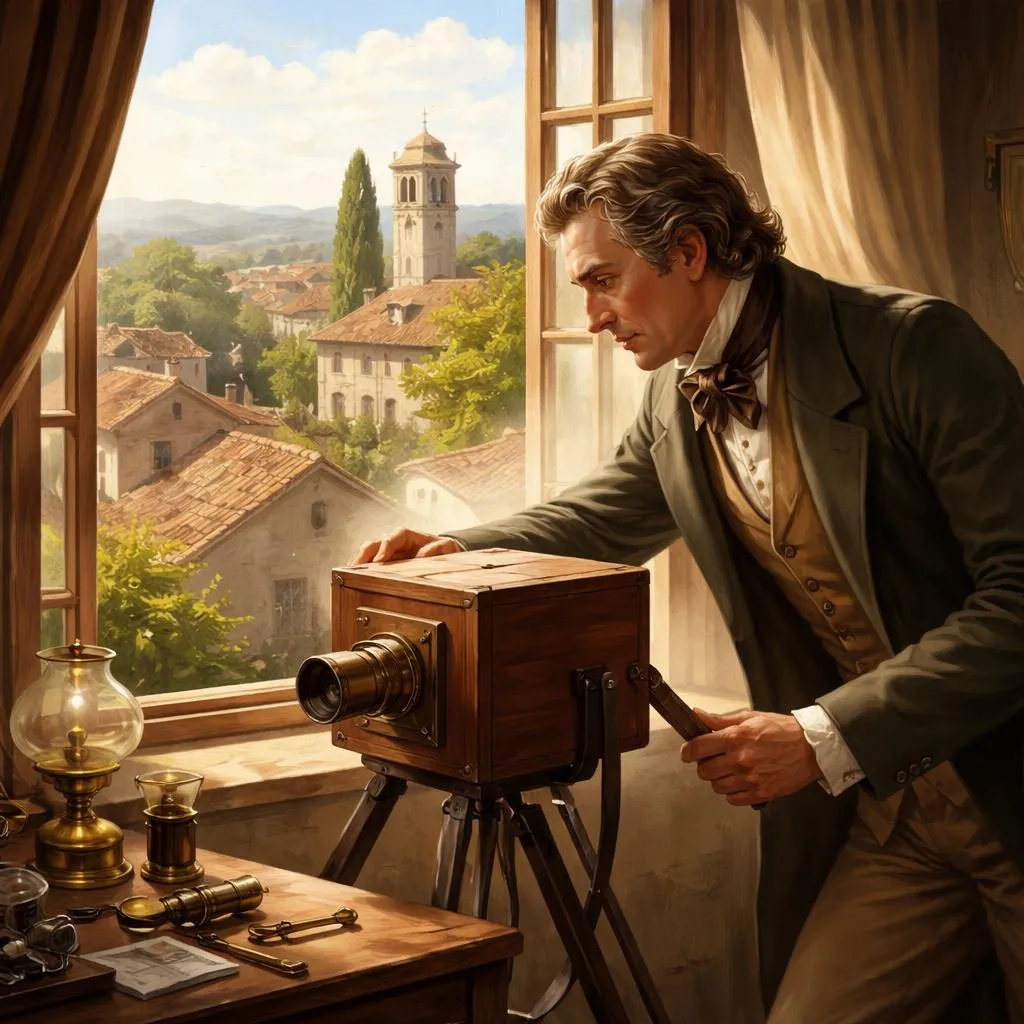

Have you ever taken a picture with your phone? It takes a second. Now imagine a camera that takes eight hours to capture a single image. That is what Nicéphore Niépce used. He took the first photograph in 1826. This Celebrity Story: Nicéphore Niépce will introduce you to the man who started it all. He was a French scientist and inventor. He was not an artist. He was not a showman. He was a quiet, determined man who wanted to capture light. He experimented for years. He used a material called bitumen of Judea, a kind of natural asphalt. He coated a metal plate. He put it in a camera. He exposed it for eight hours. The result was blurry and crude. But it was the first permanent photograph.
Let us meet the forgotten father of photography. Nicéphore Niépce did not become famous. Louis Daguerre took his work and made it practical. But Niépce was the first.
Who Is This Celebrity?
Nicéphore Niépce was a French inventor and scientist. He lived from 1765 to 1833. He is best known for taking the world's first permanent photograph. He called his process "heliography," which means "sun writing."
Why is he famous? He took the first photograph. It is called "View from the Window at Le Gras." It shows the view from his workroom window. You can see a barn, a tree, and a roof. The image is blurry. It is hard to see. But it is a photograph. Without Niépce, there would be no photography. He also developed the first internal combustion engine. He was a genius inventor. He is largely forgotten today.
Early Life and Childhood
Nicéphore Niépce was born in Chalon-sur-Sa?ne, France. His father was a wealthy lawyer. He was the third of five children. The family was comfortable. They had a large house and property.
He was a curious child. He loved science. He loved to experiment. He also loved to draw. He was not good at drawing. He wished he could capture images more accurately.
He attended school in the town of Angers. He studied to become a priest. He decided against it. He joined the French army. He served as a staff officer. He saw the French Revolution. He left the army in 1794.
He returned to Chalon. He became the administrator of the district. He married. He had a son. He also began to experiment. He wanted to invent.
Education and Learning Journey
Nicéphore Niépce studied at the Oratory school in Angers. He studied classics and science. He also studied at the university there. He was well educated.
His real education came from his own experiments. He was curious. He was methodical. He kept notes. He recorded his failures as well as his successes.
In 1801, he began working with his brother Claude. They invented a new kind of engine. It was called the Pyréolophore. It was an internal combustion engine. It ran on a fuel made from mushroom spores. They received a patent in 1807. That was 50 years before the modern internal combustion engine. They were ahead of their time.
He also experimented with lithography. Lithography was a way of printing images from a stone. He was not good at drawing. He wanted to find a way to make the images automatically.
He thought, "What if the light itself could make the image?" He began to experiment with light-sensitive chemicals.
How Did They Become Successful?
Nicéphore Niépce became successful after his death. He was not famous in his lifetime. He worked in obscurity. He did not seek fame. He wanted to solve the problem.
In 1816, he made his first "photograph." He used paper coated with silver chloride. The paper darkened where the light hit. He made a negative image. But he could not fix it. The image faded.
He kept experimenting. He tried many chemicals. In 1822, he discovered a new method. He used a type of asphalt called bitumen of Judea. This asphalt hardens when exposed to light. The unexposed areas can be washed away.
In 1826, he placed a polished pewter plate in a camera. He coated it with bitumen. He put the camera in his upstairs window. He opened the lens. He waited eight hours. The sun moved across the sky. It lit both sides of the courtyard. He closed the lens. He washed the plate with a solvent. The bitumen washed away where the light had not hit. The image remained. It was the first photograph.
He called it "View from the Window at Le Gras." It is now in the University of Texas at Austin.
He continued to improve his process. In 1829, he partnered with Louis Daguerre. Daguerre was a famous artist and showman. They signed a contract. They would work together. Niépce died in 1833. Daguerre continued. In 1839, Daguerre announced the daguerreotype. It was a much improved process. Niépce's name was almost forgotten.
Big Ideas and Achievements
Nicéphore Niépce's biggest idea was that light could create a permanent image. He proved it. He made the first photograph. That is his greatest achievement.
Another huge achievement is the Pyréolophore. He invented the internal combustion engine. That was decades ahead of its time.
He also invented the first photographic process. He called it heliography. It was slow. It was crude. But it worked.
He also inspired Louis Daguerre. Without Niépce, Daguerre might never have succeeded. He used Niépce's discoveries.
He also influenced William Henry Fox Talbot. Talbot invented the negative-positive process. He knew of Niépce's work.
His photograph "View from the Window at Le Gras" is a national treasure of France. It is in a museum in Texas. It looks like a blurry mess. But it is the beginning of everything.
Challenges and Difficult Times
Nicéphore Niépce faced many challenges. First, the French Revolution disrupted his life. He served in the army. He could have been killed.
Second, he worked alone for many years. His brother Claude helped him. Claude went insane and died. Niépce was alone.
Third, he lacked funding. He had to use his own money. He was not rich. He had to be frugal.
Fourth, his process was very slow. An eight-hour exposure was not practical. He could not photograph people. They would move. He could only photograph landscapes.
Fifth, he died before he saw his work succeed. He died in 1833. Daguerre announced the daguerreotype in 1839. Niépce's son Isidore received a pension from the French government. But Nicéphore never knew.
Fun Facts About the Celebrity
Nicéphore Niépce invented the word "photography." He used the Greek words for "light" and "drawing."
Another fun fact: He was a failed artist. He could not draw. That is why he invented photography.
He used bitumen of Judea. That is the same asphalt used to pave roads.
He lived in a house called "Le Gras." That is where he took the first photograph.
One more fact: His original pewter plate was lost for decades. It was rediscovered in 1952. It is now in Texas.
Why Is This Celebrity Important Today?
Nicéphore Niépce is important because he was the first. He took the first photograph. Every picture ever taken is his descendant.
He is also important because he was a true inventor. He did not seek fame. He sought knowledge. He experimented. He kept notes. He was a scientist.
His influence is seen in every camera. Every smartphone. Every family album.
Parents can use his story to teach children about persistence. Niépce worked for years. He failed many times. He never gave up.
What Can Kids Learn from This Story?
Kids can learn powerful lessons from Nicéphore Niépce. First, be persistent. Niépce failed for years. He kept trying. If you fail, try again. Do not give up.
Second, you can be first. Niépce was not a famous artist. He was not a wealthy man. He was a quiet inventor. He did something no one had done before. You can too.
Third, keep good notes. Niépce wrote down everything. He recorded his failures. He recorded his successes. That is how we know his story.
Finally, it is okay to be forgotten. Niépce is not a household name. But he changed the world. You do not need to be famous. You just need to do good work.
Quick Quiz or Practice Time
Let us see what you learned from this Celebrity Story: Nicéphore Niépce. Answer these questions with a parent or by yourself.
What is the name of the first photograph?
What material did Niépce use to make his first photograph?
How long did the exposure take?
What other important invention did Niépce create with his brother?
Who partnered with Niépce and later took credit for photography?
Here is a fun activity. Place a leaf or a key on a piece of paper. Put it in a sunny window for a week. The paper will fade around the object. The object will leave a shadow. You have made a photogram. You are photographing like Nicéphore Niépce.
Another activity. Look up "View from the Window at Le Gras" online with your parent. It is blurry. It is hard to see. But it is the first photograph. Then take a photo of the view from your own window. Compare. You are part of history.
Nicéphore Niépce was born in France. He was a scientist. He invented an engine. He wanted to capture light. He used bitumen of Judea. He waited eight hours. He took the first photograph. He called it heliography. He partnered with Daguerre. He died in 1833. Daguerre became famous. Niépce was forgotten. But he was the first. His photograph still exists. It is over 190 years old. It is a blur. It is a miracle. His story teaches us to be persistent. To be first. To keep notes. To do good work. That is the real lesson of this celebrity story.