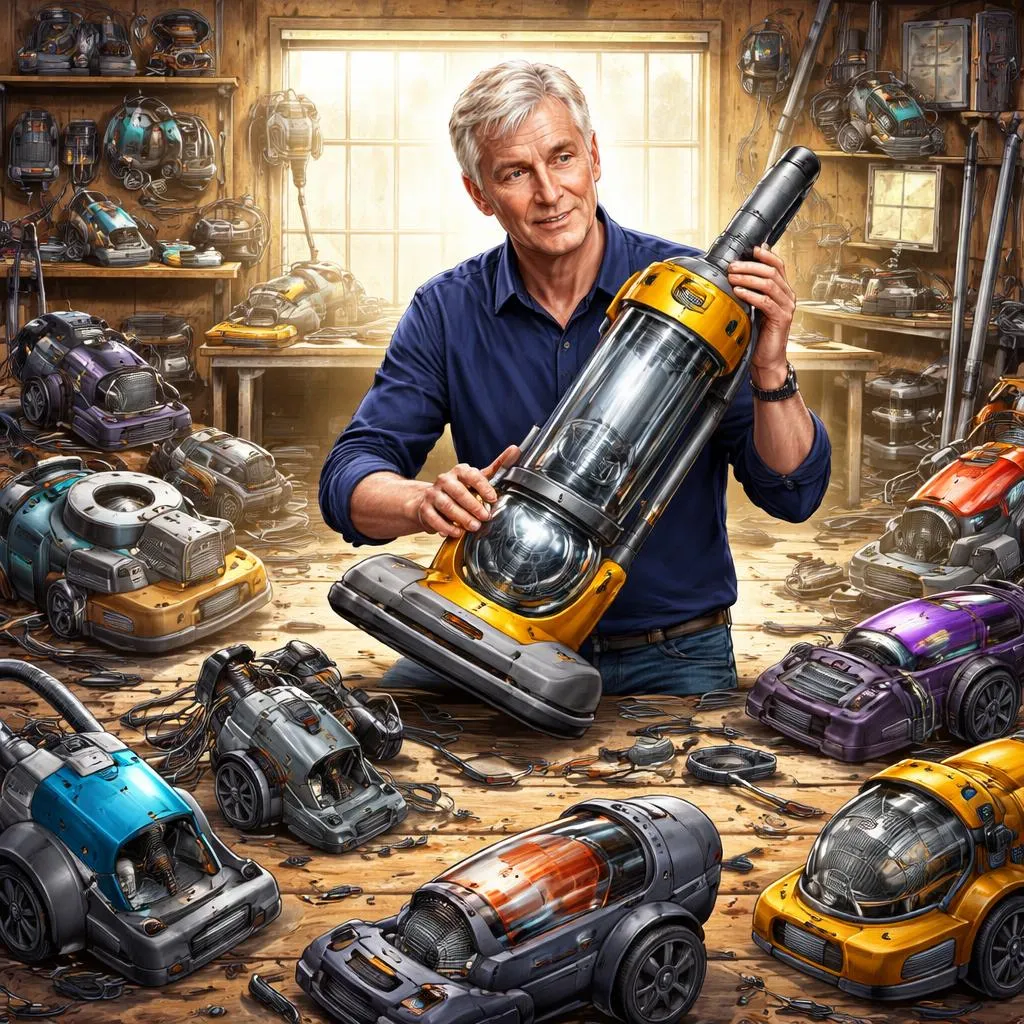

Have you ever used a vacuum cleaner that never lost suction? The dirt goes straight into the bin. The power never fades. That is a Dyson vacuum. James Dyson invented it. He made over 5,000 prototypes. Each one failed. He kept going. This Celebrity Story: James Dyson will introduce you to a man who believes that failure is the path to success. He was born in England. He studied art and engineering. He invented the ballbarrow, a wheelbarrow with a ball instead of a wheel. That was a success. Then he tackled the vacuum cleaner. The bagged vacuum lost suction as the bag filled. He wanted to solve that problem. He spent five years. He went bankrupt. He kept going. He finally succeeded. Now Dyson is a billionaire. His company makes fans, hair dryers, and electric cars.
Let us meet the man who loves failure. James Dyson says, "Fail your way to success."
Who Is This Celebrity?
James Dyson is a British inventor, industrial designer, and entrepreneur. He was born in 1947. He is still alive. He is best known for inventing the bagless vacuum cleaner. He founded the Dyson company.
Why is he famous? He invented a vacuum cleaner that uses cyclonic separation. Instead of a bag, the dirt spins around. The centrifugal force throws the dirt into the bin. The air stays clean. The suction never drops. He also invented the Dyson Airblade hand dryer. That is the fastest hand dryer in the world. He also invented the Dyson Supersonic hair dryer. That is a quiet, fast hair dryer. He also makes fans without blades. He is a serial inventor.
Early Life and Childhood
James Dyson was born in Cromer, Norfolk, England. His parents were teachers. He had an older brother. His father died of cancer when James was nine. He was devastated.
He went to boarding school. He was a good student. He was also mischievous. He loved to build things. He took apart radios. He built model airplanes.
He went to art school. He studied at the Byam Shaw School of Art in London. Then he studied at the Royal College of Art. He studied furniture design and industrial design.
He was not a great student. He was more interested in making things than in studying. He graduated in 1970.
He got a job as an industrial designer. He worked for a company that made furniture and kitchen equipment. He was bored. He wanted to invent.
Education and Learning Journey
James Dyson studied at the Royal College of Art in London. He learned design, engineering, and business. He also learned to think creatively.
His real education came from his own projects. In 1974, he invented the ballbarrow. It was a wheelbarrow with a ball instead of a wheel. The ball did not get stuck in mud. It was a success. He started a company to sell it. He made money.
He also invented a watercraft called the Sea Truck. It was a flat-bottomed boat that could be driven onto a beach. It was also successful.
He used the money from his inventions to fund his next project: the vacuum cleaner.
He was frustrated by his own vacuum cleaner. It lost suction. He took it apart. He saw the problem: the bag clogged with dust. He thought, "What if there was no bag?"
He remembered cyclones. A cyclone uses spinning air to separate particles. He had seen them in sawmills. He built a small cyclone into a vacuum cleaner.
How Did They Become Successful?
James Dyson became successful after 15 years of struggle. He made 5,127 prototypes. Each one failed. He was broke. He mortgaged his house. His wife supported him. He kept going.
In 1983, he made a prototype that worked. He called it the G-Force. He tried to sell it to vacuum companies. They were not interested. They made money selling bags. His machine did not need bags. They rejected him.
He took the G-Force to Japan. The Japanese loved it. It sold for $2,000. It became a status symbol.
In 1993, he opened his own factory in England. He built a new model called the DC01. It was a bright pinkish color. It sold out. People loved it. They loved that it did not lose suction.
His company grew. He moved into other products. The Airblade hand dryer. The Supersonic hair dryer. The bladeless fan. The electric car (which he later canceled).
He became a billionaire. He was knighted by the Queen. He is now Sir James Dyson.
He also started the Dyson Institute of Engineering and Technology. It is a university that trains engineers. Students do not pay tuition. They work at Dyson while they study.
Big Ideas and Achievements
James Dyson's biggest idea is that failure is necessary. He says, "Fail your way to success." He made 5,127 failures. Each one taught him something.
His greatest achievement is the bagless vacuum cleaner. It changed the industry. Now almost every vacuum cleaner uses cyclonic separation or a similar technology.
Another huge achievement is the Dyson Airblade. It dries hands in 10 seconds. It uses a blade of air to scrape the water off. It is much faster and more efficient than traditional dryers.
He also invented the Dyson Supersonic hair dryer. It is quiet. It is fast. It uses a small motor in the handle. The motor spins at 110,000 rpm. That is five times faster than a normal hair dryer.
He also invented the bladeless fan. It uses a loop amplifier. The air is sucked in at the base and blown out through a slit in the loop. It is safe for children. It is also easier to clean.
He also supports engineering education. The Dyson Institute is training the next generation of inventors.
He holds over 5,000 patents. He is a fellow of the Royal Society.
Challenges and Difficult Times
James Dyson faced many challenges. First, his father died when he was young. He had to grow up fast.
Second, he went bankrupt. He spent all his money on prototypes. He had to mortgage his house. He was in debt.
Third, no one believed in him. Vacuum companies rejected him. They laughed at him. He did not listen.
Fourth, he was sued. Other companies tried to copy his design. He had to defend his patents.
Fifth, he failed to make an electric car. He spent $500 million. He realized the car would not be profitable. He canceled the project. He lost the money. He moved on.
Fun Facts About the Celebrity
James Dyson was a competitive swimmer in his youth. He swam for his school.
Another fun fact: He loves to play the clarinet. He plays in a band.
He owns a farm in England. He grows crops.
He is a fan of the poet John Keats. He quotes him in speeches.
One more fact: His son, Jake Dyson, is also an inventor. He invented a LED light bulb that lasts 40 years.
Why Is This Celebrity Important Today?
James Dyson is important because he showed that failure is not the end. It is the beginning. He failed 5,127 times. He kept going. He succeeded.
He is also important because he made products that work better. His vacuum cleaners do not lose suction. His hand dryers are fast. His hair dryers are quiet. He improved everyday objects.
His influence is seen in engineering and design. The Dyson Institute is training the next generation. His company continues to innovate.
Parents can use his story to teach children about persistence. Dyson did not give up. Neither should you.
What Can Kids Learn from This Story?
Kids can learn powerful lessons from James Dyson. First, do not fear failure. Dyson failed 5,127 times. He kept going. Failure is not the opposite of success. It is part of success.
Second, solve problems. Dyson was frustrated by his vacuum cleaner. He solved the problem. Look around you. What frustrates you? Can you fix it?
Third, be patient. Dyson worked for five years on the vacuum cleaner. He was patient. Great things take time.
Finally, learn from mistakes. Dyson kept notes on each prototype. He learned what did not work. He used that knowledge to make the next one better.
Quick Quiz or Practice Time
Let us see what you learned from this Celebrity Story: James Dyson. Answer these questions with a parent or by yourself.
How many prototypes did Dyson make before he succeeded?
What technology does a Dyson vacuum use instead of a bag?
What was Dyson's first successful invention before the vacuum?
What does Dyson's hand dryer, the Airblade, use to dry hands?
What is the name of the university Dyson started?
Here is a fun activity. Take apart an old pen or an old toy. Look at how it works. Then try to improve it. Draw your improvement. You are inventing like James Dyson.
Another activity. Make a list of things that frustrate you. A sticky drawer. A noisy fan. A tangled cord. Pick one problem. Think of a solution. Draw it. You are a problem-solver.
James Dyson was born in England. His father died. He went to art school. He invented the ballbarrow. He was frustrated by his vacuum cleaner. He made 5,127 prototypes. He went bankrupt. He kept going. He succeeded. He started Dyson. He made bagless vacuums. He made fast hand dryers. He made quiet hair dryers. He failed at an electric car. He lost $500 million. He moved on. He started a university. He is a billionaire. He is a knight. His story teaches us to fail. To persist. To solve problems. To learn from mistakes. That is the real lesson of this celebrity story.