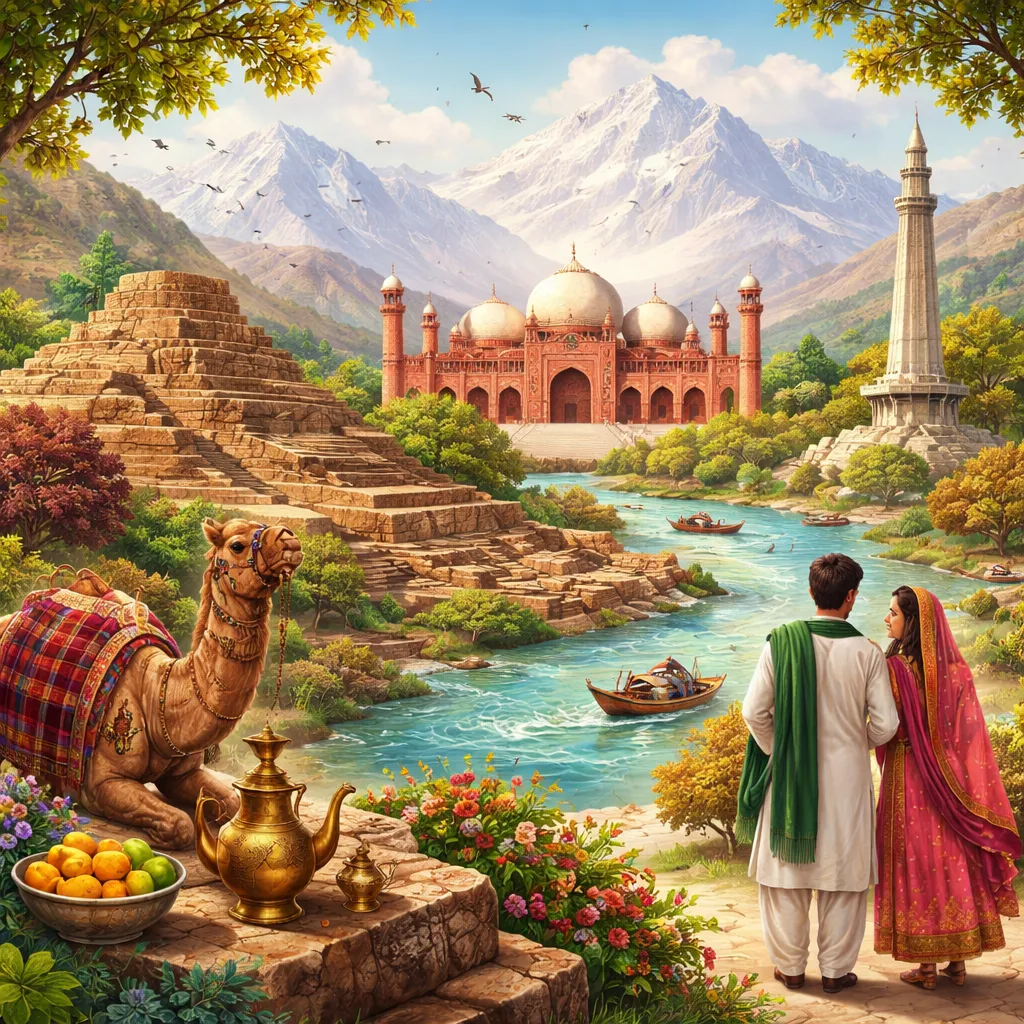

Introduction to Pakistan
Language learning transports us to a land where ancient civilizations once flourished. Today we explore a South Asian country with towering mountains and fertile river valleys. This nation holds the ruins of one of the world's earliest cities. Children will discover the mighty Indus River that gave the country its name. They will learn about mountain peaks that rank among the highest on Earth. Exploring Pakistan builds reading skills while revealing a land of deep history and dramatic landscapes. Every fact uncovers a new layer. Every word invites young readers to imagine this diverse nation.
Where Is Pakistan?
Pakistan lies in South Asia, bordering the Arabian Sea to the south. It shares borders with India to the east, China to the northeast, Afghanistan to the west and northwest, and Iran to the southwest. The capital city is Islamabad. Islamabad sits at the foothills of the Margalla Hills in the north. The country covers over three hundred forty thousand square miles. It ranks as the thirty-third largest country in the world. The Indus River flows from the Himalayas through the entire length of Pakistan. It empties into the Arabian Sea. Finding Pakistan on a map shows a country bridging South Asia, Central Asia, and the Middle East. Its location made it a crossroads for cultures and trade routes.
Interesting Facts About Pakistan
Pakistan offers countless remarkable facts for young learners. It is home to one of the world's oldest civilizations. The Indus Valley Civilization flourished over four thousand five hundred years ago. Mohenjo-Daro, a major city of this civilization, had advanced drainage systems and brick buildings. Another interesting fact involves mountains. Pakistan holds five of the world's fourteen highest peaks. K2, the second highest mountain on Earth, rises over twenty-eight thousand feet in the Karakoram Range.
Pakistan also has the world's largest deep-sea port. Gwadar sits on the Arabian Sea coast. Another fun fact involves the national game. Field hockey ranks as the national sport. Pakistan has won the Hockey World Cup four times. The country also has a unique truck art tradition. Truck drivers decorate their vehicles with colorful paintings, poetry, and intricate patterns. These decorated trucks have become a cultural symbol.
Pakistan also holds the world's highest paved road. The Karakoram Highway connects Pakistan with China. It winds through mountains at elevations over fifteen thousand feet. Another interesting fact involves the country's name. "Pakistan" means "land of the pure" in Urdu and Persian. It also serves as an acronym for the regions that make up the country. These facts show children a country of ancient history, natural grandeur, and vibrant culture.
Key Vocabulary About Pakistan
Let us build vocabulary for this South Asian nation. These words help children describe what they learn.
Civilization: a complex society with cities, government, and culture.
Indus: the great river flowing through Pakistan.
Peak: the highest point of a mountain.
Karakoram: a mountain range in northern Pakistan.
Mughal: an empire that ruled much of South Asia.
Mosque: a building where Muslims gather for prayer.
Cricket: a popular bat-and-ball sport. Introduce these words with pictures and stories. Show the ruins of Mohenjo-Daro. Show K2 rising above the clouds. Let children say each word aloud. These vocabulary words give children the language to explore Pakistan's history and landscapes.
Simple Sentences for Reading Practice
Short sentences help new readers build confidence. Use these sentences about Pakistan for practice.
Pakistan is a country in South Asia.
The capital city is Islamabad.
The Indus River flows through the country.
The Indus Valley Civilization was one of the world's oldest.
K2 is the second highest mountain on Earth.
The Karakoram Highway is the world's highest paved road.
People celebrate many festivals throughout the year. Read each sentence together. Let children point to the words. Encourage them to repeat after you. Use pictures to show each fact. These simple sentences prepare young readers for longer passages.
Short Reading Passage About Pakistan
Here is a short passage for children to read together.
“Pakistan stretches from the Arabian Sea to the world's highest mountains. The Indus River flows from the Himalayas down to the sea. Long ago, the Indus Valley Civilization built cities along this river. Mohenjo-Daro had streets laid out in grids and houses with indoor plumbing. In the north, the Karakoram Range holds K2, the second highest mountain on Earth. Climbers from around the world come to test themselves on these peaks. The Karakoram Highway winds through gorges and over passes. It connects Pakistan to China. In the cities, Mughal architecture fills the landscape. The Badshahi Mosque in Lahore ranks among the largest mosques in the world. Its red sandstone walls and marble domes draw visitors. Pakistani culture shines in its traditions. Truck drivers paint their vehicles with flowers, birds, and calligraphy. Families gather for cricket matches in parks and streets. Pakistan blends ancient history with natural beauty.”
Read this passage slowly together. Pause to talk about each idea. Ask children to find vocabulary words in the text. This activity builds reading fluency and deepens understanding.
Fun Questions About Pakistan
Questions make reading interactive and engaging. Use these to start conversations with young learners.
What is the capital city of Pakistan?
What river flows through the entire country?
What ancient civilization flourished in Pakistan?
What is the second highest mountain on Earth?
What is the highest paved road in the world?
What sport is very popular in Pakistan? Let children answer in complete sentences. Encourage them to use new vocabulary. Ask them to imagine visiting Mohenjo-Daro. What would they see in this ancient city? Creative questions make the topic personal and exciting.
Tips for Learning English with This Topic
Use Pakistan to create rich English learning experiences. Start with a map activity. Let children find Pakistan in South Asia. Point out its borders with India, China, Afghanistan, and Iran. Discuss how its location connected different regions throughout history.
Next, introduce the vocabulary through a hands-on activity. Create a simple model of an Indus Valley city using blocks or clay. Lay out streets in a grid pattern. For the mountains, build a model of K2 using paper or clay. Talk about why climbers come to these peaks. Use the words "civilization," "peak," and "Karakoram" during the activity.
Read the passage aloud with awe for the ancient history and mountains. Let your voice reflect the grandeur of the peaks and the richness of the culture. After reading, let children draw a scene from Pakistan. One child might draw the ruins of Mohenjo-Daro. Another might draw K2 with climbers on its slopes. Let them label their drawings with vocabulary words. Add blue for the Indus River and white for the mountain peaks.
Incorporate a history and geography connection. Talk about the Indus Valley Civilization and its advanced cities. Discuss how mountains shaped travel and trade in the region. This shows children that language learning reading connects to understanding ancient history and geography.
Use music and movement to enhance the experience. Listen to traditional Pakistani music with tabla drums and sitar strings. Let children move like climbers ascending a mountain. Pretend to paint a truck with colorful patterns. Physical activity reinforces learning in joyful ways.
Encourage children to share their knowledge. Let them tell a family member about Mohenjo-Daro and its ancient streets. They can explain why K2 is famous. Teaching others builds confidence and deepens understanding.
Connect Pakistan to your child's world. Ask, “What ancient places have we visited?” Compare them to Mohenjo-Daro. Ask about mountains or hills near you. Compare them to K2. These connections help children see that language learning reading is about understanding different histories and landscapes. By exploring Pakistan together, you give children a rich experience. They learn new words, discover a land of ancient cities and high peaks, and grow their love for reading. This South Asian nation becomes a meaningful part of their learning journey.