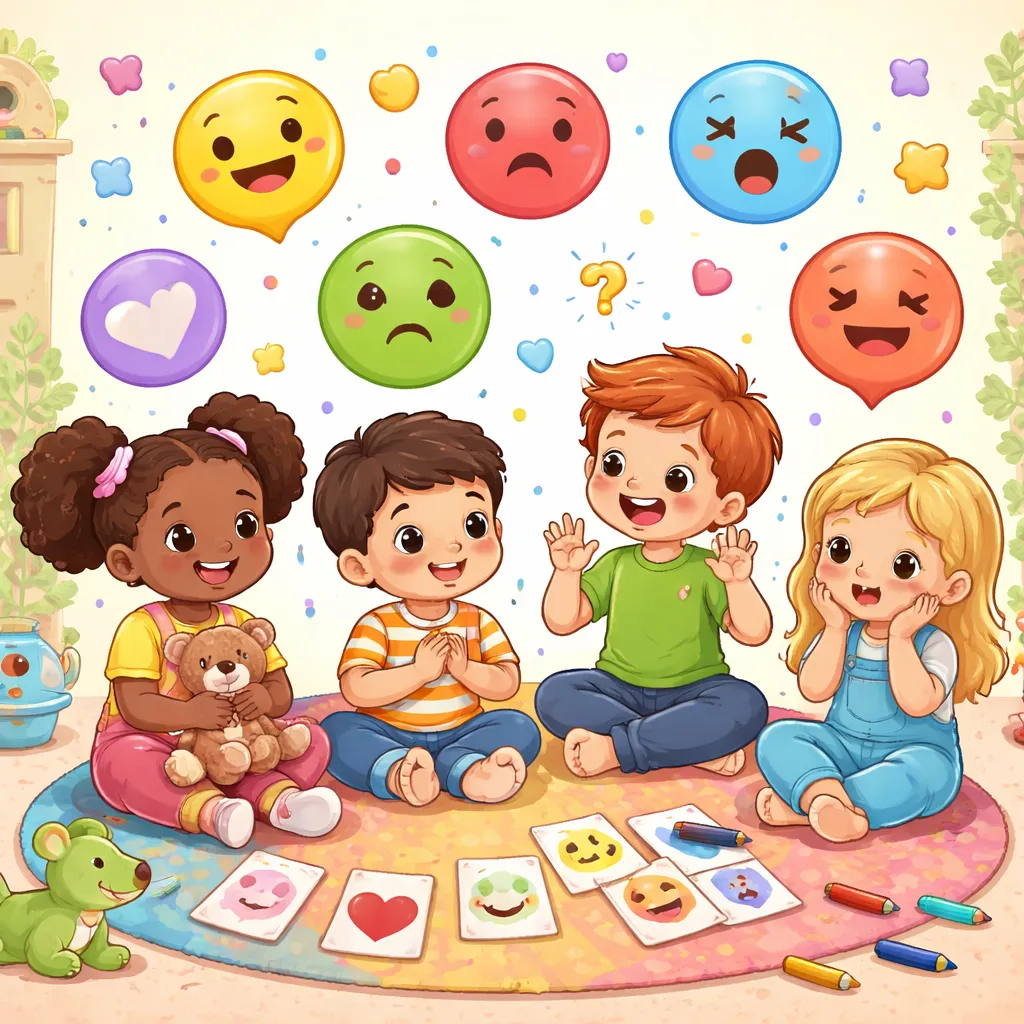

What Is This Situation? Emotions are part of every child's day. They feel happy when they play. They feel sad when a toy breaks. They feel angry when someone takes their turn. These feelings come and go. They are big and real.
Learning the names of emotions in English for children gives them words for these feelings. A child who can say "I am angry" instead of hitting has power. A child who can say "I am scared" instead of crying alone has connection. Words help children understand themselves.
This learning happens during everyday moments. When your child cries, you can say "You are feeling sad." When they laugh, you can say "You are feeling happy." The emotion word matches the moment. The child learns that feelings have names.
These words are tools. They help children communicate needs. They help parents understand what is happening inside. They build emotional intelligence alongside language skills.
Key English Phrases for This Situation Use phrases that name the emotion. "You look happy" notices the feeling. "Are you feeling sad?" asks gently. "I see that you are angry" validates without judgment.
Use phrases that invite sharing. "Can you tell me how you feel?" opens conversation. "What is making you feel scared?" helps identify cause. "Show me your feeling" uses face and body.
Use phrases that normalize emotions. "It is okay to feel sad sometimes" gives permission. "Everyone feels angry sometimes" reduces shame. "Feelings come and go" teaches that emotions are temporary.
Use phrases that offer support. "I am here with you" provides safety. "Let us take a deep breath together" offers a coping tool. "Do you want a hug?" gives comfort.
Use phrases that celebrate emotional language. "You told me you were angry. That was good communication." "Thank you for telling me how you feel." These phrases reinforce the value of emotional words.
Simple Conversations for Kids Dialogue 1: Naming a Feeling Child frowns and crosses arms. Parent: "You look upset. Are you feeling angry?" Child: "Yes. I want the red cup." Parent: "You are angry because you wanted the red cup. I understand."
This conversation starts with observation. The parent names the emotion. The child agrees. The parent validates the feeling and the reason. The child feels understood.
Dialogue 2: A Child Uses an Emotion Word Child: "I am sad." Parent: "Oh, you are feeling sad. Why are you sad?" Child: "My friend went home." Parent: "It is sad when friends leave. Do you want to draw a picture for your friend?"
Here, the child uses an emotion word independently. The parent accepts it and asks a gentle question. The parent validates the feeling and offers a coping activity.
Dialogue 3: Working Through Big Feelings Child yells: "I am so mad!" Parent: "I hear that you are mad. It is okay to be mad. Let us find a way to calm down together." Child: "I want to stomp." Parent: "Okay. Let us stomp three times. Then we can talk." Child stomps. Parent: "Are you feeling a little calmer now?" Child: "Yes."
This conversation accepts the strong emotion. The parent does not dismiss it. They offer a safe way to express it. They help the child move toward calm.
Vocabulary You Should Know Happy is the feeling when things are good. You can say "I am happy when we play together." This is often the first emotion word children learn.
Sad is the feeling when something is hard or lost. You can say "It is okay to feel sad." This word helps children express grief or disappointment.
Angry is the feeling when something is unfair or frustrating. You can say "I feel angry when someone takes my toy." This word gives children an alternative to acting out.
Scared is the feeling when something seems dangerous or unknown. You can say "I am scared of the dark." This word helps children ask for comfort.
Excited is the feeling when something good is coming. You can say "I am excited for the party." This word helps children express positive anticipation.
Calm is the feeling when your body is quiet and peaceful. You can say "Let us take deep breaths to feel calm." This word teaches children about emotional regulation.
How to Use These Phrases Naturally Use a gentle and accepting tone. Emotions can be intense. Your voice should be steady. Do not match your child's volume if they are loud. Your calm presence helps them calm down.
Say the phrases when you notice an emotion. Do not wait. Name it in the moment. "I see you are excited" when your child jumps up and down. Timing makes the word connect to the feeling.
Use emotion words for yourself too. "I am feeling frustrated because I cannot find my keys." Your child sees that adults have feelings. They see you name them. This models emotional language.
Match your phrase to the intensity. For small upset, a quiet "Are you feeling sad?" works. For big upset, a simple "I am here" may be all that fits. Trust your knowledge of your child.
Use emotion words during calm moments too. Look at books. Point to faces. "This character looks scared." Practice emotion words when no one is upset. Then the words are ready when needed.
Common Mistakes to Avoid One mistake is dismissing feelings. "Do not be sad" teaches children that sadness is bad. Instead, say "I see you are sad. I am here." Accept the feeling first.
Another mistake is using only one word for many feelings. "Mad" can cover frustration, disappointment, and tiredness. Help your child find the right word. "Are you frustrated because it is hard?" builds precision.
Some parents label emotions for their child but do not let the child disagree. If you say "You are angry" and your child says "No," listen. They may have a different word. Let them correct you.
Avoid shaming big emotions. "Stop crying" or "You are too old for tantrums" creates shame. Emotions are not shameful. They are human. Accept them so your child can learn to manage them.
Tips for Parents and Practice Ideas Use picture books about feelings. Many children's books show characters experiencing different emotions. Read them together. Point to the faces. Ask "How does she feel?"
Create a feelings chart with faces. Draw simple faces showing happy, sad, angry, scared, and excited. Hang it where your child can see it. When your child has a feeling, they can point.
Model emotional language daily. Say "I feel happy when you hug me." Say "I feel tired after work." Your child learns that talking about feelings is normal.
Validate all feelings. Even difficult feelings like anger and jealousy are valid. When your child says "I hate my brother," do not scold. Say "You are angry with your brother. Tell me what happened." Validate first. Solve later.
Read books about emotional vocabulary. There are books specifically about feelings words. Read them together. Let your child point to the faces and say the words.
Fun Practice Activities Play emotion charades. You act out a feeling without words. Your child guesses "Are you happy? Are you scared?" Then switch. Your child acts, and you guess. This builds recognition and vocabulary.
Make an emotion jar. Write emotion words on slips of paper. Put them in a jar. Each day, pick one. Talk about a time you felt that way. This builds conversation and vocabulary.
Draw feelings faces. Give your child paper and crayons. Say "Draw a happy face. Draw a sad face." As they draw, use the words. "That is a happy face. I see a smile."
Use mirrors. Stand in front of a mirror. Make happy faces. Make sad faces. Make surprised faces. Your child sees their own expressions. You name the emotion.
Sing about feelings. Make up simple songs. "I am happy, happy, happy. I am happy today." Use different emotions. Music makes words stick.
The names of emotions in English for children are more than vocabulary words. They are keys to understanding. A child who knows the word "frustrated" can ask for help instead of melting down. A child who knows the word "proud" can share their success. These words build bridges between what children feel inside and what they can express to the world. With your gentle guidance, your child learns that all feelings are welcome. All feelings have names. And every feeling is a chance to connect.