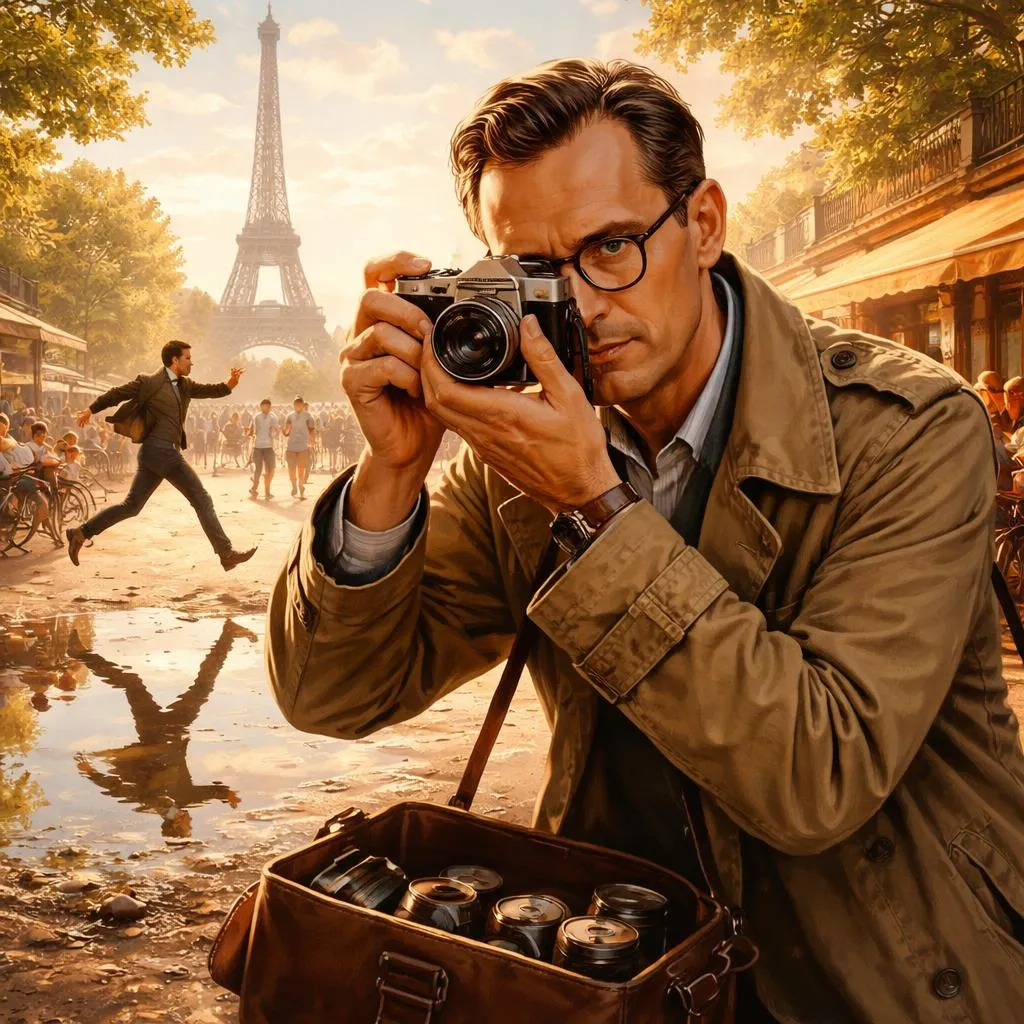

Have you ever seen a black and white photo of a man jumping over a puddle? He is reflected in the water. The moment is frozen forever. The photo feels like a poem. That is a Henri Cartier-Bresson photograph. This Celebrity Story: Henri Cartier-Bresson will introduce you to the father of modern photojournalism. He was born in France. He loved to draw as a child. Then he discovered the camera. He became the greatest street photographer of all time. He traveled the world. He photographed Gandhi just before he was assassinated. He photographed China, Mexico, and Russia. He never used a flash. He never cropped his photos. He captured "the decisive moment." That is the exact split second when everything comes together.
Let us meet the man who turned photography into art. Henri Cartier-Bresson believed that a camera is like a sketchbook.
Who Is This Celebrity?
Henri Cartier-Bresson was a French photographer. He lived from 1908 to 2004. He is considered the father of modern photojournalism. He was also a co-founder of Magnum Photos. That is a famous photo agency. Magnum allowed photographers to own their own work. Before Magnum, magazines owned the photos.
Why is he famous? He created the concept of "the decisive moment." That is the exact moment when the subject of a photograph reveals its essence. A man jumping over a puddle. A child running through a market. A couple kissing on a bench. He captured these moments with a small, handheld camera. He never used a flash. He never staged a scene. He waited. He watched. He clicked. His photos are not just documents. They are art.
Early Life and Childhood
Henri Cartier-Bresson was born in Chanteloup, France. His family was wealthy. They made thread and textiles. He was the oldest of five children.
His father wanted him to join the family business. Henri was not interested. He wanted to be an artist.
He loved to draw. He loved to paint. He was especially interested in the Surrealist movement. Surrealists explored dreams and the unconscious. They wanted to shock people out of their normal ways of seeing.
He studied painting with a famous artist. But he was restless. He wanted to travel. He wanted to see the world.
He went to Africa. He hunted. He fished. He got sick. He almost died. He was sent back to France to recover.
During his recovery, he discovered photography. He saw a photograph by a Hungarian photographer. The photograph showed three African boys running into the sea. He was captivated. He bought a small camera. He never looked back.
Education and Learning Journey
Henri Cartier-Bresson studied painting with André Lhote. Lhote taught him about composition and form. He learned how to arrange shapes in a rectangle. That skill would serve him well in photography.
He also was influenced by the Surrealists. He learned to look for the unexpected. He learned to see poetry in ordinary life.
He bought a Leica camera in 1932. The Leica was small and portable. He could carry it anywhere. He could be invisible. He painted the shiny parts with black paint so no one would see him.
He traveled through Europe. He took photos of Spain, Italy, and France. He captured the decisive moment. A man jumping over a puddle. A woman looking out a window. A child playing in the street.
His first exhibition was in New York in 1933. He was 25 years old. Critics praised his work.
How Did They Become Successful?
Henri Cartier-Bresson became successful in the 1930s. His work was published in magazines. He was recognized as a master.
During World War II, he served in the French army. He was captured by the Germans. He spent three years in a prison camp. He escaped on his third attempt. He returned to France and joined the Resistance. He made a film about the liberation of Paris.
After the war, he co-founded Magnum Photos. The agency allowed photographers to own their own work. They could choose their own assignments. They could keep their copyrights. Magnum became the most famous photo agency in the world.
He traveled extensively. He went to India to photograph Gandhi. He arrived just hours before Gandhi was assassinated. He photographed the funeral. The images are historic.
He also photographed China, the Soviet Union, Cuba, and Mexico. He captured everyday life. He did not photograph politicians posing. He photographed people in markets, on trains, and in the streets.
In the 1970s, he stopped taking photographs. He returned to drawing. He said he had said everything he needed to say with the camera. He spent his last 30 years as a painter.
Big Ideas and Achievements
Henri Cartier-Bresson's biggest idea was "the decisive moment." He defined it as the instant when the meaning of an event is captured in a photograph. You cannot plan it. You cannot stage it. You must be ready. You must be invisible. You must feel the moment.
His greatest achievement is his book "The Decisive Moment." It was published in 1952. It contains 126 of his photographs. The cover was designed by Henri Matisse, a famous painter. The book influenced generations of photographers.
Another huge achievement is the founding of Magnum Photos. Magnum allowed photographers to tell their own stories. It changed photojournalism. Today, Magnum is still one of the most important photo agencies.
He also photographed many historic events. The death of Gandhi. The liberation of Paris. The Cultural Revolution in China. His photos are in museums and archives around the world.
He also made films. He made a documentary about the liberation of Paris. He also made films about Spain and other countries.
He influenced every street photographer who came after him. His concept of the decisive moment is still taught in photography schools.
Challenges and Difficult Times
Henri Cartier-Bresson faced many challenges. First, his family wanted him to join the textile business. He refused. He followed his own path.
Second, he was a prisoner of war for three years. He was in a camp. He was hungry. He was cold. He almost died. He escaped.
Third, he struggled with his reputation. He was so famous that people recognized him. He wanted to be invisible. He wanted to blend in. Fame made that hard.
Fourth, he had to balance art and journalism. He was an artist. He was also a journalist. He had to meet deadlines. He had to satisfy editors. He managed both.
Fifth, he stopped taking photos. He felt he had done enough. Some people were disappointed. He did not care. He did what he wanted.
Fun Facts About the Celebrity
Henri Cartier-Bresson hated to be photographed. He would hide his face. He would turn away. There are very few good photos of him.
Another fun fact: He painted the shiny parts of his camera black. He wanted to be invisible. The chrome Leica was too noticeable.
He was a terrible businessman. He did not care about money. He let others handle the finances.
He loved to draw. He drew every day. He said photography was his work. Drawing was his pleasure.
One more fact: He never used a flash. He never cropped his photos. What you see is what he saw.
Why Is This Celebrity Important Today?
Henri Cartier-Bresson is important because he raised photography to the level of art. Before him, photography was seen as a craft. He showed that a photograph could be as expressive as a painting.
He is also important because he taught us to see. He taught us to look for the decisive moment. In our own lives, there are moments that tell a story. A hug. A smile. A tear. He taught us to notice.
His influence is everywhere. Every photographer who takes candid street photos is following in his footsteps.
Parents can use his story to teach children about patience. Cartier-Bresson waited hours for the right moment. He did not rush. He waited.
What Can Kids Learn from This Story?
Kids can learn beautiful lessons from Henri Cartier-Bresson. First, be patient. Cartier-Bresson waited for the perfect moment. He did not click randomly. He watched. He waited. If you want to take a great photo, wait for the moment.
Second, be invisible. Cartier-Bresson painted his camera black so no one would see him. Do not interrupt the moment. Let people be themselves. Your art should not disturb the world.
Third, geometry matters. Cartier-Bresson studied painting. He learned composition. When you take a photo, think about lines and shapes. Place your subject off-center. Look for patterns.
Finally, tell a story. Cartier-Bresson's photos are not just pretty. They tell a story. A man jumping a puddle tells a story about joy. A child crying tells a story about sadness. What story does your photo tell?
Quick Quiz or Practice Time
Let us see what you learned from this Celebrity Story: Henri Cartier-Bresson. Answer these questions with a parent or by yourself.
What is Henri Cartier-Bresson's most famous concept called?
What kind of camera did Cartier-Bresson use?
What famous photo agency did Cartier-Bresson co-found?
What did Cartier-Bresson do after he stopped taking photographs?
Which famous leader did Cartier-Bresson photograph just before his death?
Here is a fun activity. Take a camera or a phone. Go to a public place. A park. A street. A market. Sit quietly. Do not take a photo for five minutes. Just watch. Look for a moment when something happens. A child running. A couple laughing. A bird landing. Then take one photo. That is your decisive moment.
Another activity. Look up Henri Cartier-Bresson's photo of a man jumping over a puddle. It is famous. Notice the reflection. Notice the geometry. Then try to take a photo of a reflection. A puddle. A window. A mirror. Wait for someone to walk by. Click.
Henri Cartier-Bresson grew up in a wealthy family. He wanted to be an artist. He studied painting. He discovered photography. He bought a Leica. He painted it black. He traveled the world. He captured the decisive moment. He photographed Gandhi. He co-founded Magnum. He was a prisoner of war. He escaped. He stopped taking photos at 60. He returned to drawing. He died at 95. His photos are timeless. They tell stories without words. His story teaches us to be patient. To be invisible. To wait for the moment. That is the real lesson of this celebrity story.