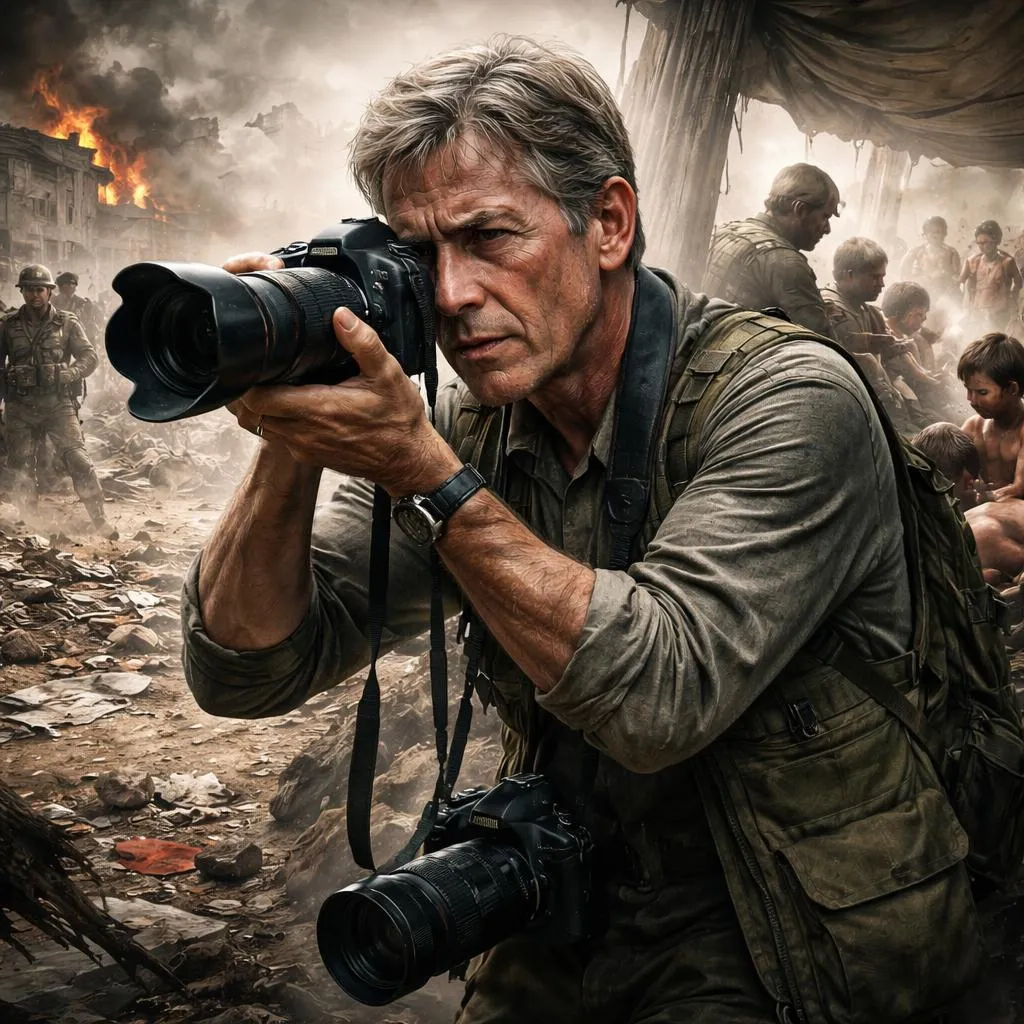

Have you ever seen a photograph that made you feel like you had to do something? A face. A child. A moment of pain or courage. That image stays with you. You cannot forget it. James Nachtwey takes those photographs. This Celebrity Story: James Nachtwey will introduce you to a man who has spent his entire career documenting war, famine, and disease. He does not want to shock you. He wants to wake you up. He believes that photographs can change the world. He has been shot at. He has been wounded. He has nearly died many times. He keeps going.
Let us meet the most important war photographer of our time. James Nachtwey says, "I have been a witness, and these pictures are my testimony."
Who Is This Celebrity?
James Nachtwey is an American war photographer and photojournalist. He was born in 1948. He is still alive. He has covered conflicts all over the world. He has been to El Salvador, Nicaragua, Guatemala, Lebanon, the West Bank, Gaza, Israel, Indonesia, Thailand, India, Sri Lanka, Afghanistan, the Philippines, South Korea, Somalia, Sudan, Rwanda, Bosnia, Kosovo, Chechnya, Romania, Brazil, and the United States after 9/11.
Why is he famous? He is considered one of the greatest war photographers of all time. He has won numerous awards. He won the Robert Capa Gold Medal five times. That is the highest award for war photography. He also won the World Press Photo award several times. He was nominated for an Academy Award for the documentary "War Photographer." The film follows him as he works. You see him cry after photographing a dying child. You see his compassion. That is what makes him special. He cares.
Early Life and Childhood
James Nachtwey was born in Syracuse, New York. His mother was a nurse. His father was a historian. They moved to Massachusetts when he was young. He grew up in a small town. He was a quiet boy.
He loved history. He loved reading. He was fascinated by photographs of war. He saw images from World War II and the Holocaust. He was horrified. He also was drawn to them. He wanted to understand how humans could be so cruel.
He went to Dartmouth College. He studied art history and political science. He was not a photographer yet. He graduated in 1970. He worked as a truck driver. He worked as a merchant seaman. He was searching.
He discovered photography in his late 20s. He taught himself. He learned by reading magazines. He learned by studying the work of Robert Capa and other war photographers.
In 1981, he quit his job. He decided to become a freelance photographer. He was 33 years old. It was a huge risk.
Education and Learning Journey
James Nachtwey did not go to photography school. He was self-taught. He learned by looking at the work of others. He learned by doing.
His first assignment was covering the 1981 hunger strike in Northern Ireland. He went to Belfast. He photographed the protests. He was scared. He did not know what he was doing. But he kept shooting.
His big break came in 1984. He went to El Salvador. There was a civil war. He documented the conflict. His photos were published in Time magazine. He was 36 years old. He was finally a professional.
He learned as he went. He learned how to stay safe. He learned how to get close. He learned how to photograph people in pain without exploiting them. He learned to be respectful. He learned to be compassionate.
He also learned that photography could make a difference. His photos of the famine in Somalia in 1992 helped prompt an international response. Aid was sent. Lives were saved. He saw proof that his work mattered.
How Did They Become Successful?
James Nachtwey became successful through dedication and courage. He went to places no one else wanted to go. He stayed when others left. He got close when others stayed back.
In the 1990s, he covered the civil war in Bosnia. He photographed the siege of Sarajevo. He photographed the massacre in Srebrenica. His photos were published around the world. They helped document war crimes. The perpetrators were later prosecuted.
In 1994, he went to Rwanda. The genocide had just happened. The country was covered in bodies. He photographed the aftermath. He said it was the most difficult thing he had ever done. He still has nightmares.
He also covered the terrorist attacks of September 11, 2001. He was in New York. He ran toward the towers when others ran away. He photographed the rescue workers. He photographed the dust and the rubble. His photos are part of the historical record.
He was featured in the documentary "War Photographer" in 2001. The film shows him working. He is quiet. He is focused. He is kind. The camera follows him. You see him take a photo of a dying child. Then you see him cry. The film was nominated for an Academy Award. It made him famous around the world.
He continues to work. He is in his 70s. He still goes to conflict zones. He says he cannot stop. Too much needs to be documented.
Big Ideas and Achievements
James Nachtwey's biggest idea is that photography can be a form of witness. He does not just take pictures. He testifies. He says, "I have been a witness, and these pictures are my testimony."
His greatest achievement is the body of work he has created over four decades. His photos of Rwanda, Bosnia, Somalia, and 9/11 are some of the most important images of our time.
Another huge achievement is his influence on other photographers. He has inspired a generation of photojournalists to be brave and compassionate. Many of them cite him as their hero.
He also co-founded the VII Photo Agency in 2001. VII is a cooperative of photojournalists. They own their own work. They control their own destinies.
He has also published several books. The most famous is "Inferno." It is a collection of his best work. The book is heavy. The images are heavy. It is not easy to look at. But it is important.
He has also given many TED Talks. He speaks about the power of photography. He speaks about the need to witness suffering. He speaks about hope.
Challenges and Difficult Times
James Nachtwey has faced incredible challenges. First, he has been shot at thousands of times. He has been wounded. He survived.
Second, he has seen terrible things. He has seen children die. He has seen mass graves. He has nightmares. He suffers from PTSD. He keeps working.
Third, he has struggled financially. War photography does not pay well. He has often been broke. He keeps going.
Fourth, he has been rejected. Magazines have turned down his work. He keeps submitting.
Fifth, he has been criticized. Some people say war photography is exploitative. He says it is necessary. He says we cannot look away.
Through every challenge, he has kept his camera in his hand.
Fun Facts About the Celebrity
James Nachtwey is very private. He does not give many interviews. He does not like to talk about himself.
Another fun fact: He has a master's degree in art history. He studied the old masters. Their compositions influence his photography.
He carries his camera in his hands. He never puts it in a bag. He says he needs to be ready.
He is a minimalist. He travels light. He carries only one camera and two lenses.
One more fact: He once had a bullet pass through his hand. He kept shooting. He bandaged his hand later.
Why Is This Celebrity Important Today?
James Nachtwey is important because he refuses to look away. The world is full of suffering. Most of us turn away. He runs toward it. He documents it. He shows us.
He is also important because he believes in the power of images. A photograph can change a mind. A photograph can change a policy. A photograph can change a life.
His influence is immense. Young photographers look up to him. They want to be like him. They want to have his courage.
Parents should be cautious with Nachtwey. His images are intense. They deal with death, disease, and destruction. They are for older children. But his story of compassion and courage is for everyone.
What Can Kids Learn from This Story?
Kids can learn profound lessons from James Nachtwey. First, do not look away. Nachtwey looked at suffering. He did not turn his head. When you see someone being bullied, do not look away. When you see someone sad, do not look away. Look. Then help.
Second, use your skills for good. Nachtwey uses photography. You might use drawing, writing, or music. Use your talent to help others.
Third, be brave. Nachtwey is scared. He admits it. He goes anyway. You can be scared and still do the right thing.
Finally, care. Nachtwey cares deeply. He cries for the people he photographs. Caring is not weakness. It is strength.
Quick Quiz or Practice Time
Let us see what you learned from this Celebrity Story: James Nachtwey. Answer these questions with a parent or by yourself.
What documentary film follows James Nachtwey as he works?
Which country did Nachtwey photograph after the genocide in 1994?
What award has Nachtwey won five times?
What did Nachtwey study in college?
What does Nachtwey call his photos?
Here is a fun activity for older children with parental guidance. Look up one of James Nachtwey's photographs online with your parent. Choose one that is not too graphic. Look at it for one minute. Then close your eyes. What do you remember? What does it make you feel? Talk about it.
Another activity. Think of a problem in your community. Litter. Pollution. Loneliness. Take a photo that shows that problem. Do not hurt anyone. Do not invade anyone's privacy. Just document. You are being a witness like James Nachtwey.
James Nachtwey was born in New York. He studied art history. He worked on a truck. He discovered photography late. He went to Northern Ireland. He went to El Salvador. He went to Bosnia. He went to Rwanda. He saw death. He saw suffering. He did not look away. He took photos. His photos helped send aid to Somalia. His photos helped prosecute war criminals in Bosnia. He was shot at. He was wounded. He kept working. He made a film. He wrote a book. He won every award. He is still working. He is in his 70s. He cannot stop. His story teaches us not to look away. To care. To be brave. To use our skills for good. That is the real lesson of this celebrity story. Note: James Nachtwey's photographs are very intense. Please preview before sharing with children. Focus on his mission of compassion and his courage for younger audiences.