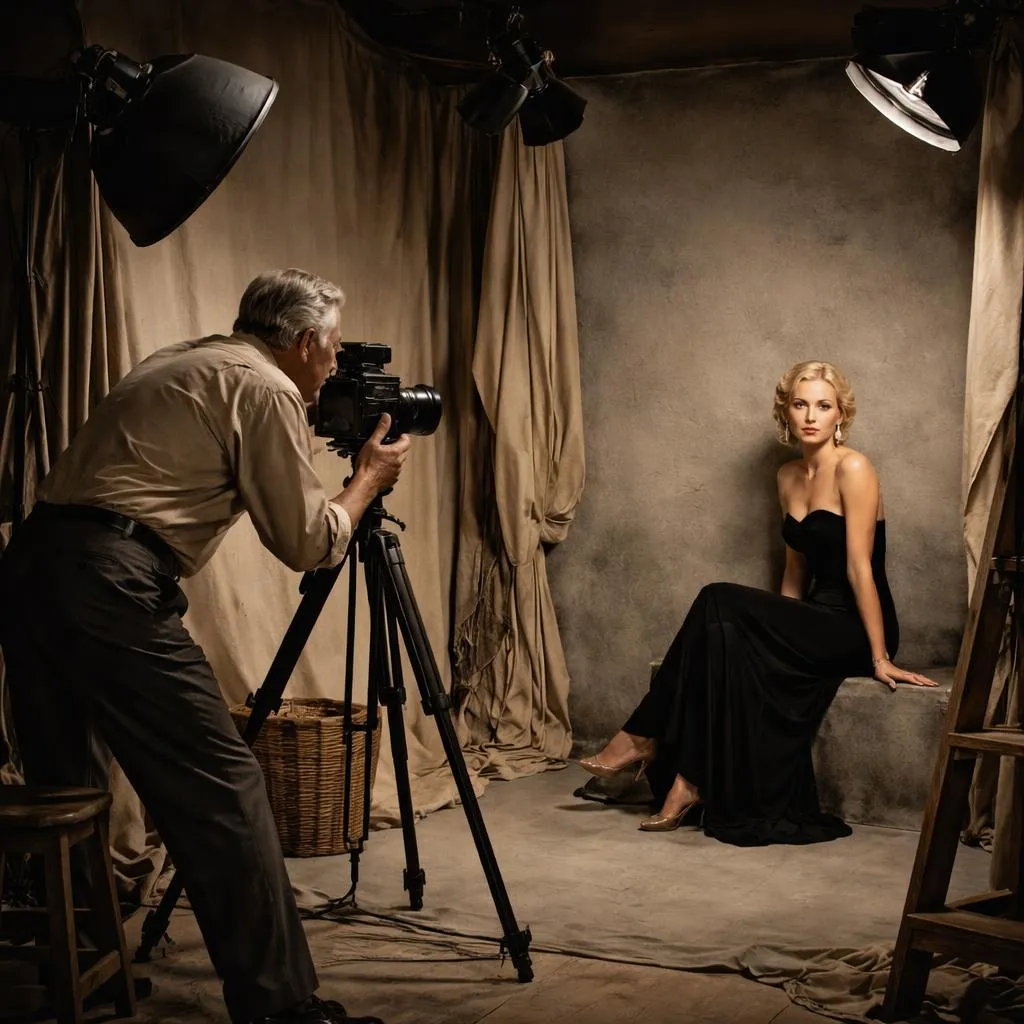

Have you ever seen a photo of a famous person standing in a corner? The walls meet at an angle. The background is gray. There is nowhere to hide. That is an Irving Penn portrait. He built that corner. He put his subjects inside it. Then he photographed them. This Celebrity Story: Irving Penn will introduce you to a photographer who found beauty in simple things. He was born in New Jersey. He wanted to be a painter. He became a photographer for Vogue magazine. He worked there for over 60 years. He photographed fashion models, celebrities, and ordinary people. He also photographed cigarette butts, food, and trash. He made everything look elegant. He was a master of light and composition.
Let us meet the quiet perfectionist. Irving Penn said, "A good photograph is one that communicates a fact, touches the heart, and leaves the viewer a changed person."
Who Is This Celebrity?
Irving Penn was an American photographer. He lived from 1917 to 2009. He worked for Vogue magazine for over six decades. He is considered one of the greatest photographers of the 20th century. He photographed fashion, portraits, still lifes, and nudes.
Why is he famous? He created a unique style of portraiture. He placed his subjects in a corner made of two gray walls. There was no furniture. No props. Just the person. He also created stunning fashion photographs. He used simple backgrounds and dramatic light. He also photographed unusual still lifes. He photographed trash. He photographed cigarette butts. He made garbage look beautiful. He was a perfectionist. He worked slowly. He paid attention to every detail.
Early Life and Childhood
Irving Penn was born in Plainfield, New Jersey. His father was a watchmaker. His mother was a nurse. He had a younger brother, Arthur, who also became a famous photographer.
He loved to draw. He loved to paint. He wanted to be an artist. He attended the Philadelphia Museum School of Industrial Art. He studied drawing and design. He graduated in 1938.
He then moved to New York. He worked as a freelance designer. He also took photographs. He was not yet a photographer. He was a designer who used a camera.
He met the art director of Vogue magazine, Alexander Liberman. Liberman saw his work. He offered him a job. Penn started working at Vogue in 1943. He was 26 years old. He stayed for 66 years.
Education and Learning Journey
Irving Penn studied at the Philadelphia Museum School of Industrial Art. He learned about design, color, and composition. He also studied under the artist Alexey Brodovitch. Brodovitch was the art director of Harper's Bazaar. He was a tough teacher. He pushed his students to be creative.
Penn also learned by doing. He worked as a designer. He learned how to lay out a page. He learned how to choose images. That knowledge helped him as a photographer.
He began taking photographs for Vogue. His early work was not traditional fashion photography. He placed models against simple gray backdrops. He used natural light. The photos were stark and modern. They were unlike anything before.
In 1948, he opened his own studio in New York. He built a corner in the studio. Two walls meeting at an angle. The floor was slanted. He would ask his subjects to stand in the corner. They could not lean. They could not relax. They had to stand. The corner became his trademark.
He also began to travel. He went to Peru, Nepal, and Cameroon. He photographed indigenous people. He set up his corner in the jungle. He asked local people to stand in the corner. The portraits are stunning.
How Did They Become Successful?
Irving Penn became successful quickly. His first cover for Vogue was in 1943. He was 26 years old. He became the lead photographer for the magazine. He was known for his elegant, simple style.
In the 1950s, he began photographing celebrities. He photographed Marlene Dietrich, Pablo Picasso, and Igor Stravinsky. His portraits are iconic.
He also began photographing still lifes. He photographed food. He photographed flowers. He photographed trash. He found beauty everywhere.
In 1974, he published a book called "Worlds in a Small Room." It featured his portraits from his travels. The book was a success.
He continued to work for Vogue for decades. He was not a fast worker. He was meticulous. He would spend hours arranging a single flower petal. He would wait for the perfect light. He was a perfectionist.
He worked until his 90s. He died in 2009. He was 92 years old.
Big Ideas and Achievements
Irving Penn's biggest idea was that simplicity is the ultimate sophistication. He stripped away everything unnecessary. No props. No fancy backgrounds. Just the subject and the light.
His greatest achievement is his corner portraits. He photographed artists, writers, dancers, and actors in that corner. The series is a chronicle of 20th-century culture.
Another huge achievement is his fashion photography. He made clothes look like sculpture. His photos are in the collections of the Metropolitan Museum of Art, the Museum of Modern Art, and the Art Institute of Chicago.
He also made a series called "Small Trades." He photographed workers in their uniforms. A baker. A chimney sweep. A butcher. The photos are simple and dignified.
He also photographed cigarette butts. He found beauty in garbage. He said, "I find the ordinary things beautiful."
He influenced countless photographers. His minimalist style is still studied.
Challenges and Difficult Times
Irving Penn faced many challenges. First, he was a perfectionist. He was never satisfied. He would reshoot endlessly. That caused stress.
Second, he struggled with the fashion industry. He wanted to make art. The industry wanted to sell clothes. He found a balance.
Third, he traveled to dangerous places. He went to the jungles of Peru and Nepal. He got sick. He kept working.
Fourth, he lost his brother Arthur to suicide in 1962. Arthur was also a famous photographer. Irving was devastated.
Fifth, he had to adapt to digital photography. He preferred film. He eventually used digital. He did not like it. He kept working.
Fun Facts About the Celebrity
Irving Penn was a terrible driver. He never got a driver's license.
Another fun fact: He built his famous corner in his studio. The floor was tilted. He wanted his subjects to lean forward slightly.
He loved to cook. He made elaborate French meals.
He was very tall. He was over six feet tall.
One more fact: He married a famous model, Lisa Fonssagrives. She was his favorite subject. He photographed her thousands of times.
Why Is This Celebrity Important Today?
Irving Penn is important because he showed that less is more. A gray corner. A single flower. A cigarette butt. He found elegance in simplicity.
He is also important because of his portraits. He captured the essence of his subjects. When you look at his portrait of Picasso, you see Picasso's genius. You see his arrogance. You see his playfulness. All in one image.
His influence is everywhere. Photographers today still use simple backdrops. They still study his compositions.
Parents can use his story to teach children about paying attention to details. Penn noticed everything.
What Can Kids Learn from This Story?
Kids can learn wonderful lessons from Irving Penn. First, pay attention to detail. Penn moved a flower petal one millimeter. He noticed everything. Pay attention to the small things. They matter.
Second, simplify. Penn stripped away everything unnecessary. When you draw or take a photo, ask yourself: what can I remove? Simple is often more powerful.
Third, find beauty everywhere. Penn photographed trash. He made it beautiful. Look around you. A crack in the sidewalk. A fallen leaf. A shadow. There is beauty everywhere.
Finally, work slowly. Penn was not fast. He was careful. Take your time. Do not rush. Good work takes time.
Quick Quiz or Practice Time
Let us see what you learned from this Celebrity Story: Irving Penn. Answer these questions with a parent or by yourself.
What did Irving Penn build in his studio to photograph people?
What magazine did Penn work for for over 60 years?
What unusual subjects did Penn photograph as still lifes?
What was the name of Penn's wife, who was also a famous model?
What did Penn study in school before becoming a photographer?
Here is a fun activity. Find a corner in your home. Ask a family member to stand in the corner. Take their photo. Use natural light. No props. No smiles. Just them. You are photographing like Irving Penn.
Another activity. Find an ordinary object. A spoon. A shoe. A toy. Place it on a plain table. Take a photo. Move it one inch. Take another photo. Notice the difference. Small changes matter.
Irving Penn grew up in New Jersey. He wanted to be a painter. He became a photographer. He built a corner in his studio. He put his subjects in the corner. He photographed them against gray walls. He worked for Vogue for 66 years. He photographed fashion, celebrities, and trash. He made everything look elegant. He was a perfectionist. He worked slowly. He never stopped. He died at 92. His story teaches us to pay attention to detail. To simplify. To find beauty everywhere. To work slowly. That is the real lesson of this celebrity story.