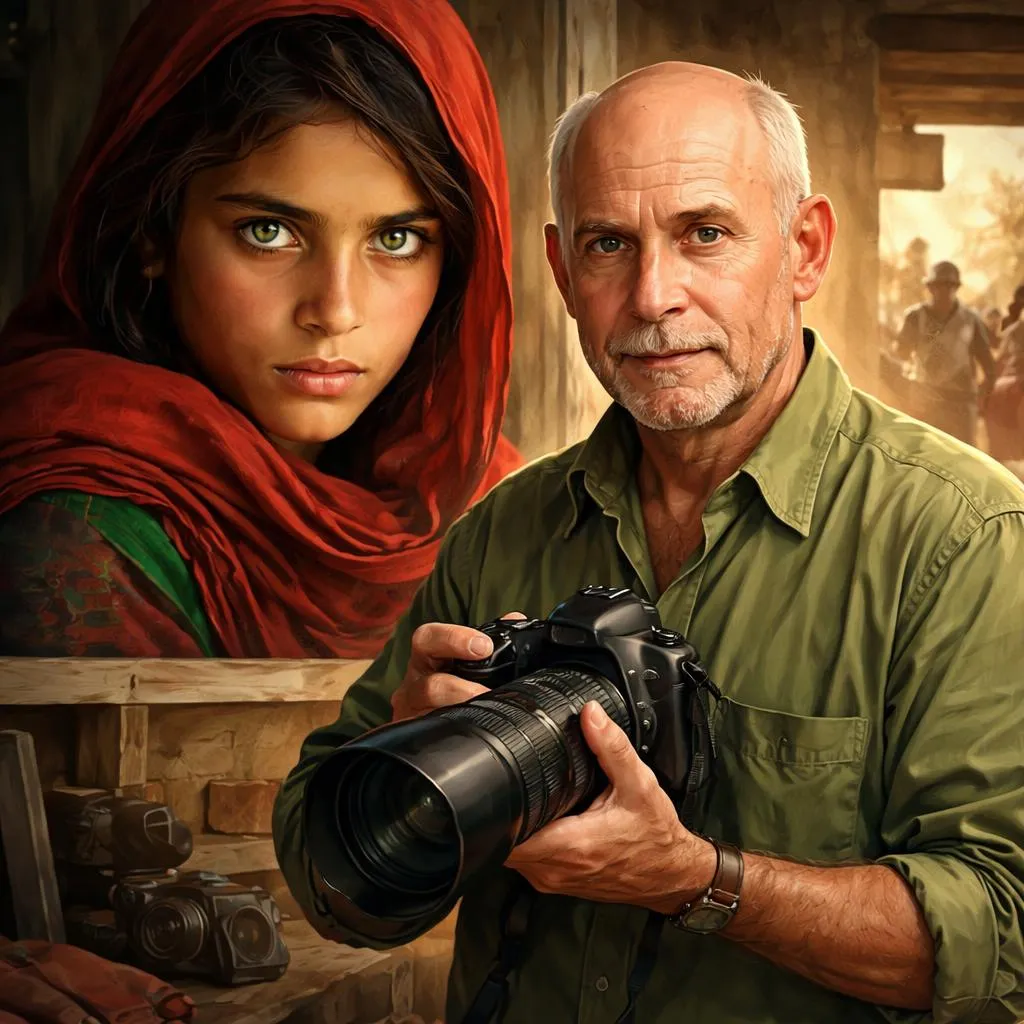

Have you ever seen a magazine cover of a young girl with green eyes that seem to look straight through you? Her face is framed by a torn red shawl. She looks scared and strong at the same time. That is the most famous photograph in National Geographic history. Steve McCurry took it. This Celebrity Story: Steve McCurry will introduce you to a photographer who travels to the far corners of the Earth. He photographs people in conflict zones and remote villages. He is a master of color and light. He captures the soul of his subjects. His photo "Afghan Girl" is one of the most recognized images in the world. He did not know the girl's name when he took the picture. He searched for her for 17 years. He finally found her. Her name is Sharbat Gula.
Let us meet the photographer of the human face. Steve McCurry believes that a portrait can change the world.
Who Is This Celebrity?
Steve McCurry is an American photographer. He was born in 1950. He is still alive and still working. He is best known for his color photography of human beings in war zones and remote cultures. He has been a member of Magnum Photos since 1986.
Why is he famous? He took the photograph "Afghan Girl" for National Geographic in 1984. The image of Sharbat Gula, a young refugee with piercing green eyes, became an icon. It is one of the most reproduced photographs in history. He has also documented conflicts in Afghanistan, Lebanon, Cambodia, the Philippines, and the Gulf War. His work is characterized by vibrant color, dramatic light, and a deep empathy for his subjects.
Early Life and Childhood
Steve McCurry was born in Philadelphia, Pennsylvania. He grew up in a suburb called Merion. His father was an engineer. His mother was a homemaker. He was a quiet boy. He loved to draw. He loved to paint. He loved to read.
He went to college at Penn State University. He studied film and theater. He graduated in 1974. He did not know what to do next. He worked at a local newspaper. He took photographs for them. He was not trained. He learned on the job.
He saved his money. He bought a one-way ticket to India. He was 28 years old. He wanted to travel. He took his camera. He crossed the border into Pakistan. He met Afghan refugees. The Soviet Union had invaded Afghanistan. The refugees were fleeing.
He was moved. He decided to document their story. He snuck into Afghanistan. He disguised himself in traditional clothing. He grew a beard. He looked like a local. He stayed for several weeks. He took hundreds of photos.
Education and Learning Journey
Steve McCurry did not go to photography school. He studied film at Penn State. He learned about storytelling. He learned about light. He learned about composition. But he taught himself photography.
He learned by doing. He traveled. He made mistakes. He learned from them. He read photography magazines. He studied the work of Henri Cartier-Bresson and Robert Capa.
His big break came from those first photos of Afghanistan. When he returned to Pakistan, he had rolls of film. He had hidden the film in his clothing. He sewed it into his turban. He gave the film to a photo agency. The agency sent the photos to magazines.
National Geographic published his photos in 1979. They were the first images of the conflict in Afghanistan. The issue was a huge success. He was 29 years old. He was a professional.
He continued to travel. He went to Lebanon during the civil war. He went to Cambodia. He went to the Philippines. He photographed the violence. He also photographed the beauty.
He joined Magnum Photos in 1986. Magnum is the most prestigious photo agency in the world. He learned from other great photographers.
How Did They Become Successful?
Steve McCurry became successful with his Afghan photos. But his true fame came in 1984. He was in a refugee camp in Pakistan. He saw a young girl. She was about 12 years old. Her eyes were incredible. He asked permission to photograph her. She agreed.
He took her picture. He did not ask her name. He did not know she would become famous. The photo was published on the cover of National Geographic in June 1985. The world was captivated. Letters poured in. People wanted to know who she was. No one knew.
For 17 years, he searched for her. He made several trips to Afghanistan. He showed the photo to villagers. No one recognized her. Finally, in 2002, a man told him he knew her. He took McCurry to her village. He showed her the photo. She remembered. Her name was Sharbat Gula. She was now in her 30s. She had three daughters.
He photographed her again. She looked older. Her eyes were still fierce. National Geographic published the story. It was a sensation. A foundation was created to help her. She received medical care and a home. The photograph changed her life.
McCurry continues to travel and photograph. He has published many books. His most famous is "The Iconic Photographs." He also gives workshops and lectures.
Big Ideas and Achievements
Steve McCurry's biggest idea is that the human face is the most powerful subject. A portrait can tell a thousand stories. A single pair of eyes can communicate fear, hope, and resilience.
His greatest achievement is "Afghan Girl." That photograph is more than an image. It is a symbol of the plight of refugees. It has raised awareness and funds for refugees around the world.
Another huge achievement is his body of work on India. He has photographed India for decades. His images of the Holi festival, the Taj Mahal, and everyday street life are iconic. They are full of color and energy.
He also documented the aftermath of the tsunami in Sri Lanka. He photographed the destruction and the survivors. He donated his photos to relief efforts.
He has won many awards. He has won the Robert Capa Gold Medal. He has won the National Press Photographers Award. He has also won the World Press Photo award several times.
He influences young photographers. His use of color is studied. His empathy is admired.
Challenges and Difficult Times
Steve McCurry faced many challenges. First, he snuck into Afghanistan illegally. He could have been killed. He was lucky.
Second, he was in many war zones. He was shot at. He was bombed. He survived.
Third, he searched for the Afghan girl for 17 years. He did not give up. He could have stopped. He did not.
Fourth, he has been criticized. Some people say his photos are too beautiful. They say he aestheticizes suffering. He says he wants to show the dignity of his subjects.
Fifth, he has been accused of manipulating his photos. Some of his images have been found to have digital editing. He has apologized. He says he made mistakes. He continues to work.
Fun Facts About the Celebrity
Steve McCurry had a near-death experience. He was on a plane that crashed in the mountains. He survived. He walked for hours to find help.
Another fun fact: He loves coffee. He drinks it constantly.
He carries his camera everywhere. He says you never know when a moment will happen.
He is colorblind. He cannot see certain shades of green and red. He relies on his assistants to help him.
One more fact: He once photographed the Dalai Lama. He said it was a very peaceful experience.
Why Is This Celebrity Important Today?
Steve McCurry is important because he shows us the world. Most of us will never go to Afghanistan or India or Sri Lanka. He brings those places to us. He shows us the beauty and the pain.
He is also important because of "Afghan Girl." That photograph is a reminder that refugees are not statistics. They are people. They have faces. They have names.
His influence is seen in travel photography. Young photographers try to capture the same vivid colors and human connection.
Parents can use his story to teach children about persistence. He searched for the Afghan girl for 17 years. He did not give up.
What Can Kids Learn from This Story?
Kids can learn wonderful lessons from Steve McCurry. First, look people in the eyes. McCurry's portraits are powerful because he captures the eyes. When you talk to someone, look at their eyes. You will learn a lot.
Second, travel if you can. McCurry traveled the world. He learned about different cultures. He became a better person. Travel opens your mind.
Third, do not give up. McCurry searched for 17 years. He found her. If something is important, keep trying.
Finally, use your skills for good. McCurry's photos helped refugees. Your skills can help people too. Draw a picture for a nursing home. Write a letter to a soldier. Use your talent.
Quick Quiz or Practice Time
Let us see what you learned from this Celebrity Story: Steve McCurry. Answer these questions with a parent or by yourself.
What is the name of the famous "Afghan Girl"?
What magazine published her photo?
How long did McCurry search for the girl?
What country is Steve McCurry from?
What color is the girl's shawl in the famous photo?
Here is a fun activity. Look at the "Afghan Girl" photo online with your parent. Look into her eyes. What do you think she is feeling? Write down three words. Then draw a portrait of someone you know. Try to capture their eyes. You are photographing like Steve McCurry.
Another activity. Take a photo of a family member. Use natural light. Put them near a window. Look for the catchlight in their eyes. That is the reflection of the window. A good portrait has light in the eyes. Practice.
Steve McCurry grew up outside Philadelphia. He studied film. He traveled to India. He snuck into Afghanistan. He photographed refugees. He took a photo of a girl with green eyes. He did not know her name. He searched for 17 years. He found her. Her name is Sharbat Gula. She had been a refugee her whole life. He helped her. She got a home. She got medical care. He still travels. He still photographs. He still looks into people's eyes. His story teaches us to look. To travel. To persist. To care. That is the real lesson of this celebrity story.