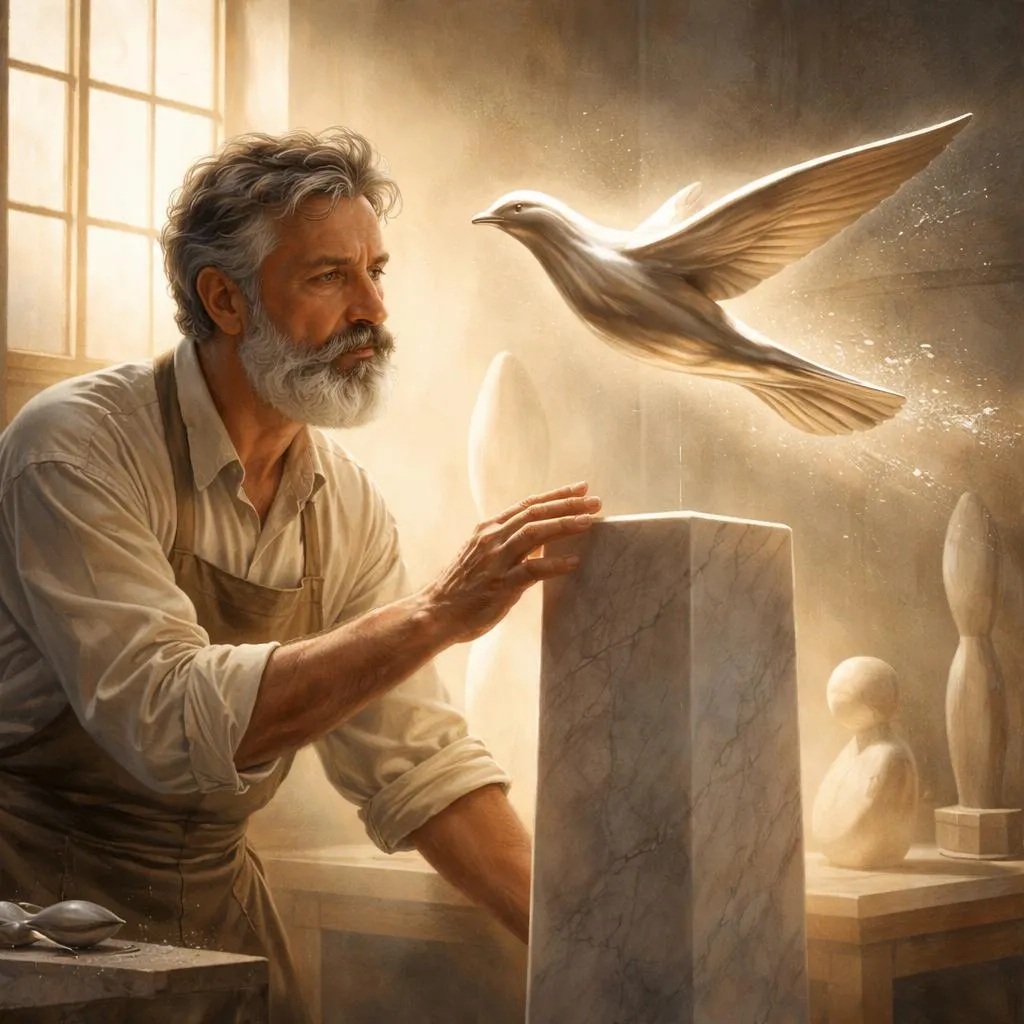

Have you ever seen a bird made of smooth, polished brass? No feathers. No beak. Just a sleek shape that looks like it is flying. That is a Constantin Brancu?i sculpture. He carved forms down to their simplest shape. A bird became a teardrop of metal. A kiss became a cube with two sides touching. This Celebrity Story: Constantin Brancu?i will introduce you to a sculptor who believed that less is more. He walked from Romania to Paris as a young man. He worked for Auguste Rodin. Then he left. He said, "Nothing grows well in the shade of a big tree." He carved his own path. His sculptures are smooth, simple, and beautiful. They look like they come from another world.
Let us meet the sculptor of essence. Brancu?i did not copy nature. He found the soul of nature.
Who Is This Celebrity?
Constantin Brancu?i was a Romanian sculptor. He lived from 1876 to 1957. He spent most of his career in Paris. He is considered a pioneer of modern sculpture. He took objects and simplified them to their purest forms.
Why is he famous? He created sculptures that look like nothing before. "Bird in Space" is a long, sleek, polished shape. It does not look like a real bird. It looks like the idea of a bird flying. "The Kiss" shows two people embracing. Their bodies are fused into one block. "Sleeping Muse" is an oval head with closed eyes. He carved directly into stone and wood. He did not make clay models first. He polished his bronze sculptures until they shined like mirrors. His work influenced every modern sculptor who came after him.
Early Life and Childhood
Constantin Brancu?i was born in Hobita, Romania. That is a small village in the Carpathian Mountains. His parents were poor farmers. His father was a shepherd. His mother worked in the fields.
He was the seventh of eight children. The family lived in a small house with a dirt floor. He grew up surrounded by wood, stone, and nature. He learned to carve wood from local craftsmen. He made tools and furniture.
He ran away from home when he was 11. He left to escape a difficult father. He worked odd jobs. He herded sheep. He washed dishes. He saved money.
He was determined to become a woodcarver. He walked to the nearest town. He enrolled in a school of crafts. He learned to carve furniture and architectural details.
He was talented. He was admitted to the Bucharest School of Fine Arts. He studied sculpture. He learned the traditional techniques. He was a good student. He won prizes.
But he wanted more. He wanted to go to Paris. Paris was the center of the art world.
Education and Learning Journey
Constantin Brancu?i walked from Romania to Paris. It took him 18 months. He worked along the way. He arrived in 1904. He was 28 years old.
He enrolled in the école des Beaux-Arts. That was the most famous art school in Paris. He studied under a famous sculptor. He learned to model in clay. He learned to carve in marble.
He also studied anatomy. He learned the structure of the human body. But he was bored. He did not want to copy nature. He wanted to simplify it.
He discovered the art of non-European cultures. He looked at African masks. He looked at Cycladic figures from ancient Greece. Those artists simplified the human figure into basic shapes. Brancu?i was inspired.
He left the école des Beaux-Arts. He wanted to find his own way.
How Did They Become Successful?
Constantin Brancu?i became successful after working for Auguste Rodin. Rodin was the most famous sculptor in the world. Brancu?i worked as his assistant. He learned from Rodin. But he left after two months.
He said, "Nothing grows well in the shadow of a big tree." He needed to be independent.
He started making simple, abstract sculptures. He carved a wooden figure called "The Prayer." It is a woman kneeling. Her body is reduced to simple planes. Critics noticed him.
He was friends with modern artists. He knew Pablo Picasso and Henri Matisse. They supported his work.
In 1913, his work was shown in the Armory Show in New York. That exhibition introduced modern art to America. Brancu?i became famous internationally.
He made "Mademoiselle Pogany" in 1913. It is a portrait of a woman. Her face is an oval. Her hands are crossed over her chest. Her eyes are huge. The sculpture is simple and strange.
His most famous work is "Bird in Space." He first made it in 1923. He made many versions. The bird is a long, sleek, polished shape. It stands on a narrow base. It looks like it is flying.
He continued to work until his death in 1957. He lived simply. He wore peasant clothes. He cooked his own meals. His studio in Paris is preserved exactly as he left it.
Big Ideas and Achievements
Constantin Brancu?i's biggest idea was that sculpture should not copy nature. It should capture the essence of nature. A bird is not feathers and beak. A bird is flight.
His greatest achievement is "Bird in Space." This sculpture is pure flight. It has no wings. It has no head. It is just a shape that rises. When it was first shipped to America, customs officials taxed it as a piece of metal, not as art. They said it did not look like a bird. Brancu?i won the lawsuit. The court ruled that "Bird in Space" was indeed art.
Another huge achievement is his series of "Endless Columns." These are tall towers of carved rhomboids. They seem to rise forever. One version stands in Romania. It is over 90 feet tall.
He also created "The Table of Silence," "The Gate of the Kiss," and "The Endless Column" as a memorial in Romania. It is an ensemble of sculptures in a park. It is one of the great works of 20th-century public art.
He also created furniture. He carved stools and benches from single blocks of wood. They are sculptures you can sit on.
He influenced every minimalist artist who came after him. You can see his influence in the work of artists like Donald Judd and Isamu Noguchi.
Challenges and Difficult Times
Constantin Brancu?i faced many challenges. First, he grew up in extreme poverty. He walked to Paris. He had almost nothing.
Second, he was a foreigner in Paris. He spoke French poorly. He was an outsider.
Third, he had to leave Rodin. Rodin was a great mentor. But Brancu?i knew he had to be independent. That took courage.
Fourth, he struggled with the law. His "Bird in Space" was almost denied entry to the United States. He had to fight for his art.
Fifth, World War I and World War II disrupted his life. He was trapped in Paris during the wars. He kept working.
Fun Facts About the Celebrity
Constantin Brancu?i dressed like a peasant. He wore a white shirt and wooden shoes. He looked like he came from his Romanian village.
Another fun fact: He was a barber. He cut the hair of his friends and assistants. He used his sculpture tools.
He loved to cook. He would make traditional Romanian meals for his friends. He ate simply.
He had a pet dog. He loved animals. He made a sculpture of a seal for his dog to play with.
One more fact: He made his own tools. He forged chisels and hammers in his studio. He did not trust store-bought tools.
Why Is This Celebrity Important Today?
Constantin Brancu?i is important because he changed what sculpture could be. Before him, sculpture was mostly about representing the human body. He showed that sculpture could be about pure form. A bird could be a polished shape. A kiss could be a cube.
He is also important because he carved directly into stone and wood. He did not make clay models first. That technique is called "direct carving." It gives the work a freshness and immediacy.
His influence is everywhere. You see his simple, elegant shapes in modern architecture and furniture design.
Parents can use his story to teach children about finding the essential. Brancu?i removed everything that was not necessary. What is the most important part of what you are drawing? Focus on that.
What Can Kids Learn from This Story?
Kids can learn beautiful lessons from Constantin Brancu?i. First, simplify. Brancu?i did not carve every feather. He carved the idea of flight. When you draw, do not draw every detail. Draw the most important part.
Second, be independent. Brancu?i left Rodin because he needed to find his own way. You do not need to follow the crowd. Find your own path.
Third, craft matters. Brancu?i polished his sculptures to a perfect shine. He made his own tools. Take care with your work. Make it beautiful.
Finally, use your hands. Brancu?i carved wood and stone with his hands. Draw. Build. Shape. Make things.
Quick Quiz or Practice Time
Let us see what you learned from this Celebrity Story: Constantin Brancu?i. Answer these questions with a parent or by yourself.
What is Brancu?i's most famous sculpture about a bird called?
Which famous sculptor did Brancu?i work for?
What country was Brancu?i from?
How did Brancu?i walk to Paris?
What court case did Brancu?i win about "Bird in Space"?
Here is a fun activity. Get a piece of clay or play-doh. Think of a bird. Do not sculpt a realistic bird. Do not add eyes, beak, or wings. Just sculpt the shape of flying. Make it smooth. Make it sleek. You are sculpting like Brancu?i.
Another activity. Look up "Bird in Space" by Constantin Brancu?i online with your parent. Notice how simple it is. Then look at a photograph of a real bird. Compare them. Which one captures flight better? Talk about it.
Constantin Brancu?i walked from Romania to Paris. He worked for Rodin. He left to find his own way. He carved "Bird in Space." He made it smooth and sleek. He captured flight without wings. He simplified everything to its essence. He polished his sculptures until they shined. He made his own tools. He wore peasant clothes. He lived simply. His work is in museums around the world. His studio is a museum in Paris. He changed sculpture forever. His story teaches us to find the essential. To remove the extra. To make things simple and beautiful. That is the real lesson of this celebrity story.