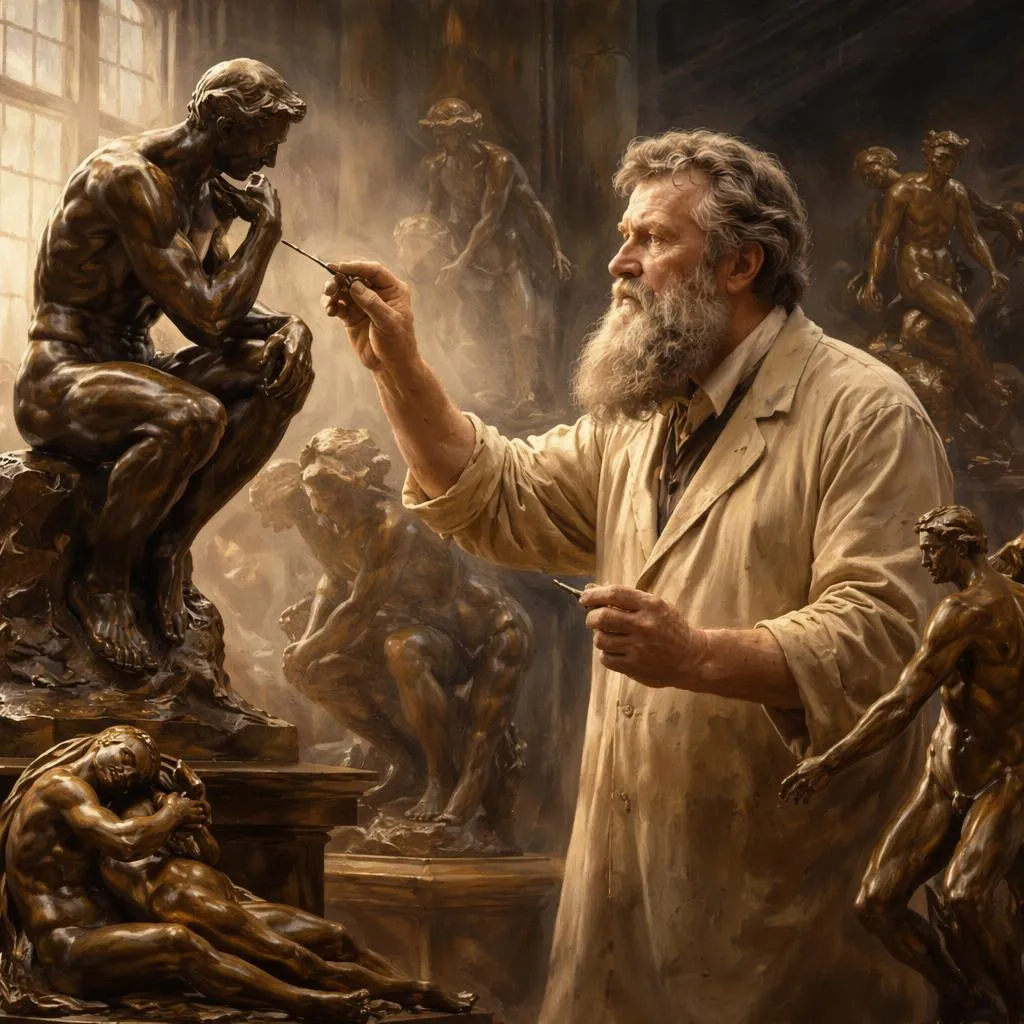

Have you ever seen a statue of a man sitting and thinking so deeply that his hand holds his chin? His muscles tense. You can almost feel his thoughts. That statue is "The Thinker." Auguste Rodin made him. This Celebrity Story: Auguste Rodin will introduce you to the father of modern sculpture. Before Rodin, statues were smooth, perfect, and heroic. They looked like Greek gods. Rodin made statues that looked like real people. They had rough surfaces. They had bent bodies. They showed pain, joy, and thought. He made bronze and marble come alive. His hands were his tools. He shaped clay with his fingers. He left his fingerprints in the clay. Those fingerprints became part of the art.
Let us meet the man who carved movement into stone. Auguste Rodin struggled for years. He was rejected by art schools. He was poor. He kept working.
Who Is This Celebrity?
Auguste Rodin was a French sculptor. He lived from 1840 to 1917. He is considered the father of modern sculpture. Before him, sculpture was about ideal beauty. Statues looked perfect. They did not look real. Rodin changed that. He made statues that showed real human emotion. His surfaces were rough. His poses were twisted. His people looked like they were moving.
Why is he famous? He made "The Thinker." That is one of the most famous sculptures in the world. He also made "The Kiss," which shows two lovers embracing. He made "The Burghers of Calais," which shows six men walking to their deaths. He made "The Gates of Hell," a huge door covered in figures. His work is in museums everywhere. His studio in Paris is now a museum. People visit from all over the world.
Early Life and Childhood
Auguste Rodin was born in Paris, France. His father was a police clerk. His mother was a former seamstress. The family was not rich. They lived in a small apartment.
Young Auguste was not a good student. He could not memorize things. He was bored in school. His uncle noticed he loved to draw. He drew constantly. He drew on his schoolbooks. He drew on the walls.
His father wanted him to have a practical career. He wanted Auguste to become a craftsman. But Auguste wanted art.
He applied to the école des Beaux-Arts. That was the most famous art school in France. He was rejected three times. The judges did not like his style. He was crushed.
He took odd jobs. He worked as a mason. He worked in a plaster shop. He carved decorative stones for buildings. He hated it. But he learned to handle stone and clay.
In his spare time, he sculpted. He worked in a small studio. He was poor. He could not afford models. He used his friends and neighbors.
Education and Learning Journey
Auguste Rodin did not go to a famous art school. He was rejected. He learned by doing. He studied at the Petite école. That was a school for decorative arts. He learned to draw. He learned to model in clay. He was good.
He also studied at the Louvre museum. The Louvre is the biggest museum in Paris. He looked at ancient Greek and Roman sculptures. He studied the work of Michelangelo. Michelangelo was a Renaissance sculptor. He made figures that looked powerful and alive. Rodin was inspired.
He worked as an assistant to other sculptors. He learned the craft. He learned how to cast bronze. He learned how to carve marble.
For years, he was unknown. He supported himself by making decorative work for buildings. He saved his personal work for nights and weekends.
In 1875, he traveled to Italy. He saw the work of Michelangelo in person. He was overwhelmed. He returned to Paris and started a new sculpture. It was called "The Age of Bronze." It showed a man waking up. The sculpture was so realistic that people accused Rodin of making a cast from a real person. They did not believe he could sculpt such realism by hand. That accusation was actually a compliment. It proved how real his work looked.
How Did They Become Successful?
Auguste Rodin became successful in his late 30s. "The Age of Bronze" was exhibited in 1877. It caused a scandal. People said it was too real. Rodin proved he had made it by hand. He showed his working drawings. He was cleared. The scandal made him famous.
He received his first government commission. He was asked to make a door for a new museum. The door was to be called "The Gates of Hell." It was inspired by Dante's "Inferno," a poem about hell. Rodin worked on the doors for 37 years. He never finished them. But the doors became a laboratory for his ideas. He created over 200 figures for the doors. Many became famous sculptures on their own. "The Thinker" sits on top of the gates. "The Kiss" was also part of the gates.
By the 1890s, Rodin was world-famous. He had exhibitions in Paris, Brussels, and London. He was invited to the United States. He was honored everywhere.
He also made portraits of famous people. He sculpted the writer Victor Hugo. He sculpted the composer Gustav Mahler. He sculpted the politician George Clemenceau. His portraits did not just look like the person. They captured their personality.
Big Ideas and Achievements
Auguste Rodin's biggest idea was that sculpture should express emotion, not just ideal beauty. He said, "There is nothing ugly in art except that which is without character."
His greatest achievement is "The Thinker." That figure has become a symbol of philosophy and deep thought. There are over 20 bronze casts around the world. You can see one in Paris, one in New York, one in Tokyo.
Another huge achievement is "The Burghers of Calais." This sculpture shows six men walking to their death. They volunteered to be executed to save their city. Rodin did not put them on a heroic pedestal. He put them on the ground, at the same level as the viewer. They look scared. They look sad. They look real.
He also revolutionized how sculpture was displayed. Before Rodin, statues were displayed on tall pedestals. You looked up at them. Rodin put his statues on low bases. You looked at them eye to eye. He also displayed fragments. He would display a hand, or a head, or a torso by itself. He said the fragment could be as powerful as the whole.
He also created a new way of working. He would sculpt a figure in clay. Then he would cut it into pieces. He would arrange the pieces in new ways. He would combine a hand from one figure with a torso from another. This technique influenced modern art.
Challenges and Difficult Times
Auguste Rodin faced many challenges. First, he was rejected from art school three times. He was told he was not good enough. He proved them wrong.
Second, he was poor for years. He worked as a craftsman to survive. He did his real work at night.
Third, his relationship with his wife, Rose Beuret, was difficult. They lived together for 53 years. They had a son. But Rodin had other lovers. He had a long affair with a younger sculptor named Camille Claudel. The relationship ended badly. Camille was institutionalized. Rodin felt guilty.
Fourth, he was accused of faking his work. He had to defend himself in public. It was humiliating.
Fifth, he had to deal with critics. Some people hated his work. They said it was ugly. He kept working anyway.
He died in 1917 at age 77. He had finally married Rose a few weeks earlier. She died two weeks after the wedding. Rodin died two weeks after her.
Fun Facts About the Celebrity
Auguste Rodin loved hands. He sculpted hundreds of hands. He said the hand expresses as much as the face.
Another fun fact: He used his own fingerprints as a textural element in his clay. You can see his thumbprints on the surfaces of his sculptures.
He was a terrible businessman. He often gave away his sculptures. He did not like to talk about money.
He had a photographic memory. He could look at a person once and then sculpt their portrait from memory.
One more fact: His studio in Paris, the Musée Rodin, is in a beautiful old mansion. You can see "The Thinker" in the garden.
Why Is This Celebrity Important Today?
Auguste Rodin is important because he made sculpture modern. Before him, sculpture was about ideal forms. He made it about real feelings. Every sculptor since has been influenced by him.
He is also important because he showed that unfinished could be beautiful. His sculptures often look rough, like they are still emerging from the stone. That idea influenced painters like the Impressionists.
His influence is everywhere. Every time you see a sculpture that looks raw and emotional, you are seeing Rodin's influence.
Parents can use his story to teach children about persistence. Rodin was rejected from art school. He was poor. He kept working. He became the greatest sculptor of his age.
What Can Kids Learn from This Story?
Kids can learn powerful lessons from Auguste Rodin. First, do not listen to people who say you are not good enough. Rodin was rejected from art school. He ignored them. He became great.
Second, use your hands. Rodin sculpted with his fingers. He left his fingerprints in the clay. Your hands are your tools. Draw. Build. Sculpt. Make things with your hands.
Third, real is better than perfect. Rodin's sculptures are not perfectly smooth. They are rough. They look real. Do not try to be perfect. Try to be real.
Finally, keep working. Rodin worked every day. He never stopped. Great things take time.
Quick Quiz or Practice Time
Let us see what you learned from this Celebrity Story: Auguste Rodin. Answer these questions with a parent or by yourself.
What is Rodin's most famous sculpture called?
What art school rejected Rodin three times?
What huge door did Rodin work on for 37 years?
What city has a museum dedicated to Rodin?
What did people accuse Rodin of doing with "The Age of Bronze"?
Here is a fun activity. Get a piece of clay or play-doh. Close your eyes. Think of a feeling. Happiness. Sadness. Anger. Then sculpt that feeling. Do not try to make a person. Just make a shape. Squeeze. Push. Pull. Use your fingers. Your fingerprints are now part of the art. You are sculpting like Rodin.
Another activity. Look up "The Thinker" by Auguste Rodin online with your parent. Sit like him. Put your chin on your hand. Think a deep thought. Have someone take your picture. Compare your pose to the sculpture.
Auguste Rodin was a poor boy who loved to draw. He was rejected from art school. He worked as a craftsman. He sculpted at night. He made "The Thinker." He made "The Kiss." He made "The Gates of Hell." He left his fingerprints in the clay. He showed that real is more powerful than perfect. He showed that emotion is the subject of art. He became the father of modern sculpture. His story teaches us to keep working. To use our hands. To ignore the critics. That is the real lesson of this celebrity story.