
What Is This Situation?
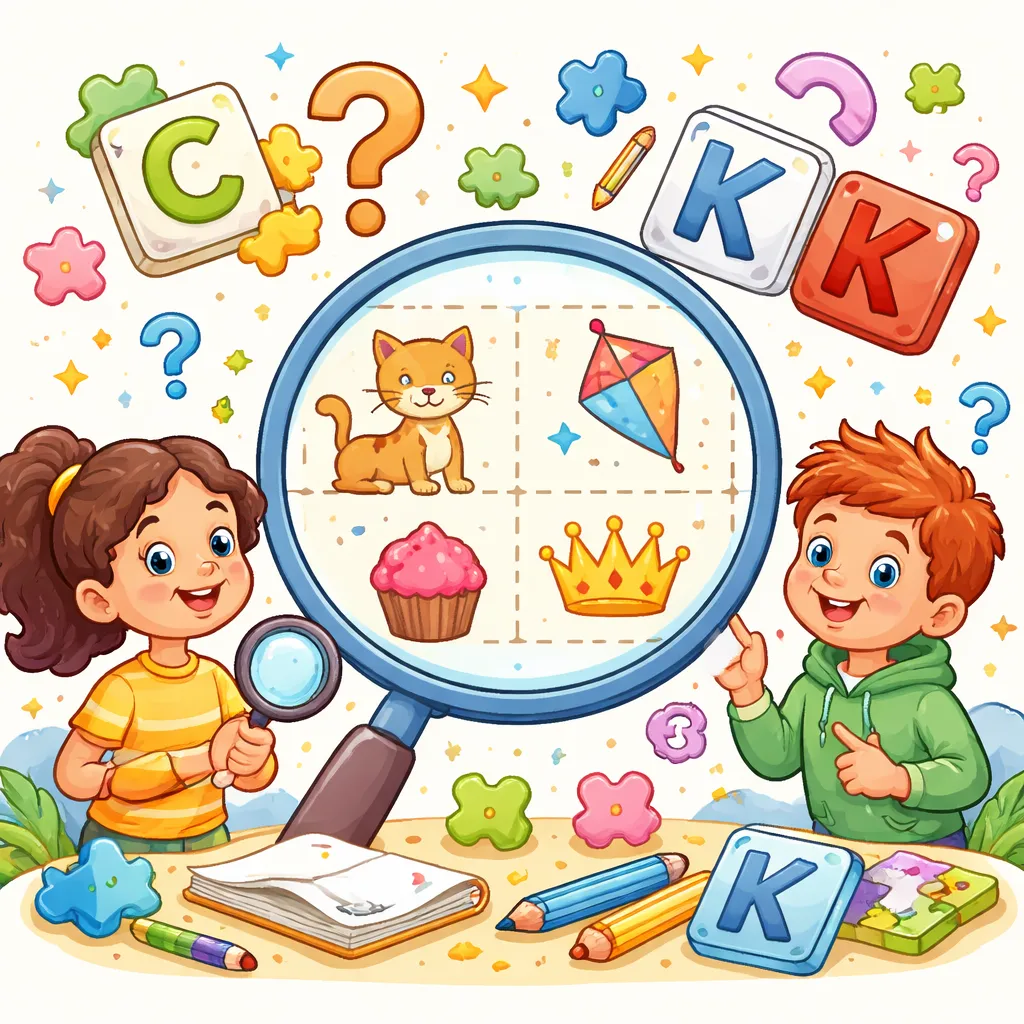
C and K can be confusing. They make the same sound. Cat starts with C. Kite starts with K. Both make the "k" sound. So how do you know which letter to use? There is a rule. And it is simple.
C vs K sound rules for kids give children the key to this spelling puzzle. When you hear the "k" sound at the beginning of a word, look at the next letter. If the next letter is E, I, or Y, use K. If the next letter is A, O, U, or a consonant, use C.
This situation happens when children are learning to spell. They know the sound. They do not know which letter to write. The rule gives them a clear answer. It works for most words.
These rules are best learned through playful practice. Word sorts, games, and rhymes make the rule stick. With the C vs K rule, your child will know which letter to choose.
Key English Phrases for This Situation
Use phrases for introducing the rule. "C and K make the same sound. But we use them at different times." "Here is the rule: If the next letter is E, I, or Y, use K. If the next letter is A, O, U, or a consonant, use C."
Use phrases for explaining. "Look at cat. The next letter is A. So we use C. C-a-t." "Look at kite. The next letter is I. So we use K. K-i-t-e."
Use phrases for practicing. "Let us sort these words. Cat goes with C. Kite goes with K." "What letter comes next in dog? D is a consonant. So we use C. C-dog? No, dog starts with D. This rule is for words that start with the K sound."
Use phrases for reading. "Read this word. C-a-t. Cat. Good. C before A." "Read this word. K-i-t-e. Kite. Good. K before I."
Use phrases for celebrating. "You used the rule. Good job." "You know when to use C and when to use K."
Simple Conversations for Kids
Dialogue 1: Learning the Rule
Parent: "C and K make the same sound. Listen: cat, kite. Both start with the k sound. But how do we know which letter to use?"
Child: "I do not know."
Parent: "Here is the rule. If the next letter is E, I, or Y, use K. If the next letter is A, O, U, or a consonant, use C."
Child: "So cat has A after C. So use C."
Parent: "Yes! And kite has I after K. So use K. Good."
This conversation introduces the rule. The parent explains. The child applies it. The learning is clear.
Dialogue 2: Sorting Words
Parent: "Let us sort these words. Cat, kite, cup, king. Which ones use C?"
Child: "Cat and cup. They have A and U."
Parent: "Yes. Which ones use K?"
Child: "Kite and king. They have I and I."
Parent: "Good. You used the rule."
This conversation practices sorting. The child applies the rule. The parent confirms. The rule becomes automatic.
Dialogue 3: Spelling Practice
Parent: "I will say a word. You tell me if it starts with C or K. Can."
Child: "C. A is next."
Parent: "Yes. Can. C-a-n. Now, key."
Child: "K. E is next."
Parent: "Yes. Key. K-e-y. Good job."
This conversation practices spelling. The child uses the rule. The parent praises. The skill builds.
Vocabulary You Should Know
Cat is an animal. It starts with C because A is next. You can say "C-a-t. Cat."
Cup is something you drink from. It starts with C because U is next. You can say "C-u-p. Cup."
Kite is something that flies in the wind. It starts with K because I is next. You can say "K-i-t-e. Kite."
Key is what opens a door. It starts with K because E is next. You can say "K-e-y. Key."
Kangaroo is an animal that jumps. It starts with K because A is next? Wait, kangaroo has A next, so it should be C? No, kangaroo is an exception. Some words break the rule. Kangaroo starts with K. Explain that sometimes there are exceptions.
How to Use These Phrases Naturally
Use a clear and patient tone. The rule is simple, but it takes practice. Your patience says "You can learn this."
Say the phrases with word sorts. Write C and K on paper. Give your child words to sort. The hands-on activity makes the rule concrete.
Practice with words your child knows. Cat, cup, kite, key. Familiar words make the rule make sense.
Remind your child of the rule often. "Cat starts with C because A is next." Repetition builds memory.
Celebrate when they use the rule. "You remembered the rule. Good job." Celebration reinforces learning.
Common Mistakes to Avoid
One mistake is teaching the rule before the child knows letter sounds. The rule builds on knowing that C and K make the same sound. Teach that first.
Another mistake is forgetting exceptions. Some words break the rule. Kangaroo starts with K. Explain that sometimes words are different. Most words follow the rule.
Some children confuse the rule with the sound. They think C and K make different sounds. Remind them they make the same sound. The rule tells you which letter to write.
Avoid using the rule for words that do not start with the K sound. This rule is only for words that start with the K sound. Like cat and kite. Not for words like sun.
Tips for Parents and Practice Ideas
Make a C and K chart. Write the rule at the top. "If next letter is E, I, Y: use K. If next letter is A, O, U, or consonant: use C." Add example words.
Use magnetic letters. Your child spells cat. They choose C because A is next. They spell kite. They choose K because I is next. Hands-on learning works.
Create word cards. Write words that follow the rule. Your child sorts them into C and K piles. The sort builds skill.
Play C and K bingo. Make bingo cards with C and K words. Call out a word. Your child finds it. Bingo makes practice fun.
Sing the C and K song. "C before A, O, U. K before E, I, Y. C and K sound the same. Now you know the game." Music makes the rule stick.
Fun Practice Activities
Make a C and K sorting game. Write C and K on two boxes. Your child puts word cards in the correct box. The game builds sorting skill.
Play C and K memory. Make pairs of word cards. Turn them over. Find the matching pair. The game builds word recognition.
Use a C and K spinner. Make a spinner with C and K. Spin. Your child says a word that starts with that letter following the rule. The game builds quick thinking.
Create a C and K book. Each page is a word. "Cat starts with C because A is next." Your child draws pictures. The book is a reference.
Go on a C and K hunt. Look in books. Find words that start with the K sound. Sort them into C and K. The hunt builds awareness.
C vs K sound rules for kids solve a common spelling puzzle. C and K make the same sound. But you choose C when the next letter is A, O, U, or a consonant. You choose K when the next letter is E, I, or Y. That is the rule. It is simple. It works for most words. With playful practice and patient guidance, your child will learn this rule. They will see "cat" and know C is right. They will see "kite" and know K is right. They will spell with confidence. And they will know that even when letters sound the same, there is a rule to help you choose. That is the power of phonics. One rule, many words. And your child will know it.