
What Is This Situation?
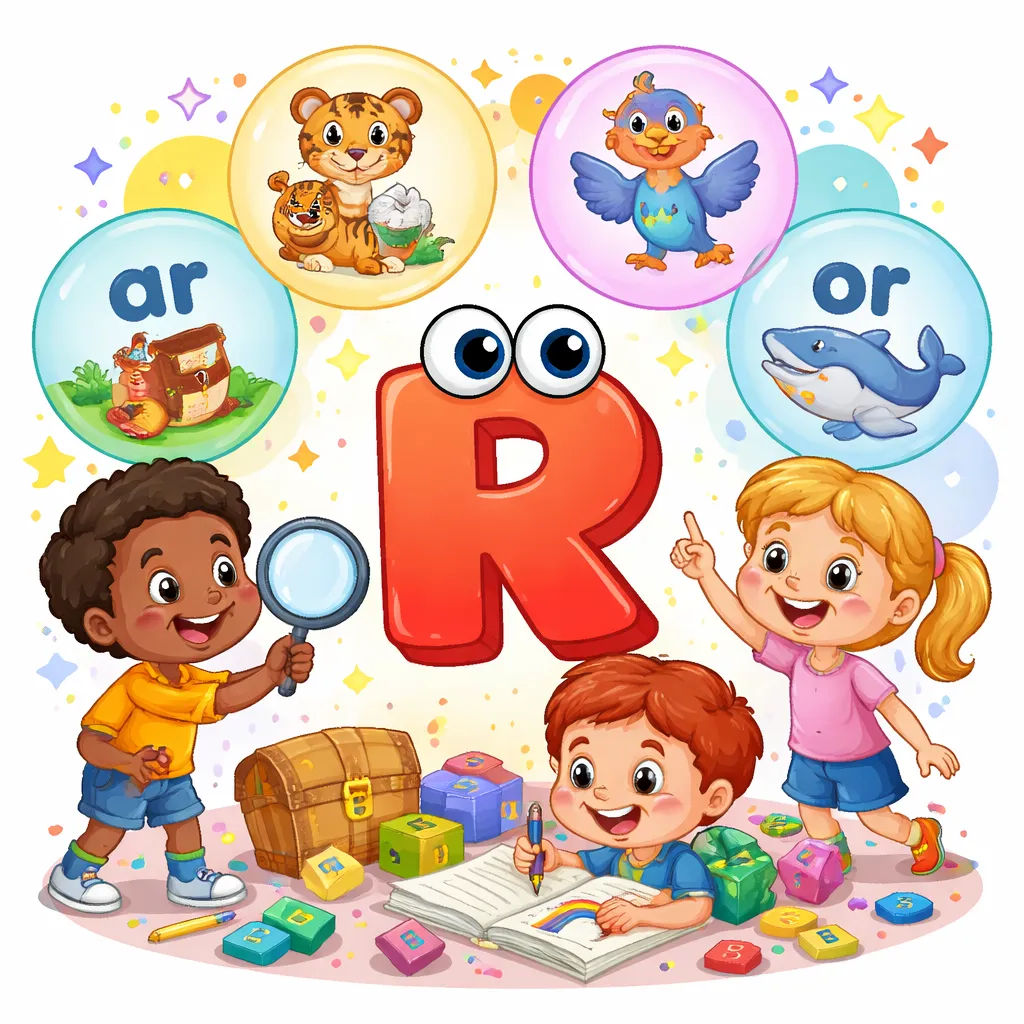
When a vowel is followed by the letter R, something changes. The vowel is not short. It is not long. It makes a new sound. R controls the vowel. R is the boss. That is why they are called R-controlled vowels.
R-controlled vowels explained simply gives children a clear way to understand this reading rule. When A is followed by R, it makes the "ar" sound like in car. When E is followed by R, it makes the "er" sound like in her. When I is followed by R, it makes the "ir" sound like in bird. When O is followed by R, it makes the "or" sound like in corn. When U is followed by R, it makes the "ur" sound like in turn.
This situation happens when children are reading words with R after a vowel. They see "car" and wonder why it is not "cah." They see "bird" and wonder why it is not "bih-rd." The R controls the vowel.
These rules are best learned through playful practice. Word families, games, and silly stories make the pattern stick. With R-controlled vowels, your child learns that R is a powerful letter.
Key English Phrases for This Situation
Use phrases for introducing the rule. "When R comes after a vowel, it controls the vowel. The vowel makes a new sound." "R is the boss. It tells the vowel what to say."
Use phrases for each sound. "AR says 'ar' like in car. Can you say ar?" "ER says 'er' like in her. IR says 'er' like in bird. UR says 'er' like in turn. They all sound the same." "OR says 'or' like in corn."
Use phrases for comparing. "Look at cat. A is short. Now look at car. R is after A. The sound changes. Ar."
Use phrases for reading. "Let us read these ar words. Car, star, far." "Now er words. Her, sister, flower." "Now ir words. Bird, girl, first." "Now or words. Corn, fork, morning." "Now ur words. Turn, burn, nurse."
Use phrases for celebrating. "You read an R-controlled vowel word. Good job." "You know the bossy R rule."
Simple Conversations for Kids
Dialogue 1: Introducing AR
Parent: "Look at this word. C-a-r. What is it?"
Child: "Car."
Parent: "Yes. The A has R after it. R is the boss. It tells A to say 'ar.' Car. Can you say ar?"
Child: "Ar."
Parent: "Good. Let us read some ar words. Star. Far."
This conversation introduces one R-controlled vowel. The parent models. The child reads. The rule becomes clear.
Dialogue 2: The ER Sound
Parent: "Now let us learn about ER, IR, and UR. They all make the same sound. Like 'er.' Listen: her, bird, turn."
Child: "Her, bird, turn."
Parent: "Yes. They all have the same 'er' sound. R controls the vowel. Say the sound."
Child: "Er."
Parent: "Good. Can you read these? Sister, girl, nurse."
Child: "Sister. Girl. Nurse."
This conversation teaches the three ways to spell the same sound. The parent shows the pattern. The child reads the words. The learning is gentle.
Dialogue 3: Reading OR Words
Parent: "Now let us learn OR. OR says 'or' like in corn. Can you say or?"
Child: "Or."
Parent: "Good. Let us read some or words. Corn, fork, morning."
Child: "Corn. Fork. Morning."
Parent: "You read all the R-controlled vowel words. Good job."
This conversation introduces the last R-controlled vowel. The child practices. The parent praises. The rule is mastered.
Vocabulary You Should Know
Car is a vehicle. It has AR. You can say "The car is red." This is a common word.
Star is in the sky at night. It has AR. You can say "Look at the star." This word is fun.
Her is a word for a girl or woman. It has ER. You can say "That is her toy." This word is common.
Bird is an animal that flies. It has IR. You can say "The bird sings." This word is in many stories.
Corn is a vegetable. It has OR. You can say "I eat corn." This word is common.
Turn means to rotate or change direction. It has UR. You can say "It is your turn." This word is used often.
How to Use These Phrases Naturally
Use a playful and curious tone. R is the boss. That is a fun idea. Your child will remember the bossy R.
Say the phrases with word families. Teach ar words together. Car, star, far. The pattern helps. Then teach er words. Her, sister, flower. The pattern repeats.
Practice one R-controlled vowel at a time. AR first. Then ER. Then IR. Then OR. Then UR. Master one before adding another.
Use real words your child knows. They know car. They know bird. They know turn. Familiar words make the rule make sense.
Read books with R-controlled vowels. Point them out. "There is an ar word. Car." Seeing the rule in real reading builds skill.
Common Mistakes to Avoid
One mistake is teaching all the R-controlled vowels at once. That is too much. Teach one at a time. Let your child master each sound.
Another mistake is confusing ER, IR, and UR. They sound the same. That is confusing. Teach them as one sound with different spellings. "Er, ir, and ur all say 'er.'"
Some children try to sound out each letter. They say "b-i-r-d" instead of "bird." Remind them "R controls the vowel. The i and r together say 'er.' Bird."
Avoid moving too fast. R-controlled vowels take time. Be patient. Practice a little each day.
Tips for Parents and Practice Ideas
Make a bossy R crown. Your child wears the crown. They are the bossy R. They change words. "What does car become with bossy R?" The crown makes the rule fun.
Use magnetic letters. Make cat. Add R to make cart. Show how the R changes the sound. Hands-on learning works.
Create word family cards. ar: car, star, far. er: her, sister, flower. ir: bird, girl, first. or: corn, fork, morning. ur: turn, burn, nurse. Flip through the cards.
Play bossy R bingo. Make bingo cards with R-controlled vowel words. Call out a word. Your child finds it. Bingo makes practice fun.
Sing bossy R songs. "Bossy R, bossy R, you change the vowel sound. AR says ar. ER says er. IR says er. OR says or. UR says er. Bossy R." Music makes the rule stick.
Fun Practice Activities
Make a bossy R book. Each page is one R-controlled vowel. "AR words: car, star, far." Your child draws pictures. The book is a reference.
Play bossy R memory. Make pairs of word cards. Turn them over. Find the matching pair. The game builds word recognition.
Use play dough. Roll play dough into letters. Make car. Add star. The hands-on activity reinforces the words.
Create a bossy R word hunt. Hide word cards around the room. Your child finds them and reads them. The hunt makes reading active.
Draw bossy R pictures. Your child draws a car, a star, a bird, a fork, a turn sign. They label each drawing. The pictures make the words real.
R-controlled vowels explained simply gives your child the key to reading many common words. Car, star, her, bird, corn, turn. These words are everywhere. When your child knows that R is the boss, they can read them all. AR says ar. ER, IR, UR say er. OR says or. That is the rule. With playful practice and patient guidance, your child will master the bossy R. They will see "car" and read it. They will see "bird" and read it. They will see "corn" and read it. And they will know that R is a powerful letter. One rule, many words. That is the power of phonics.