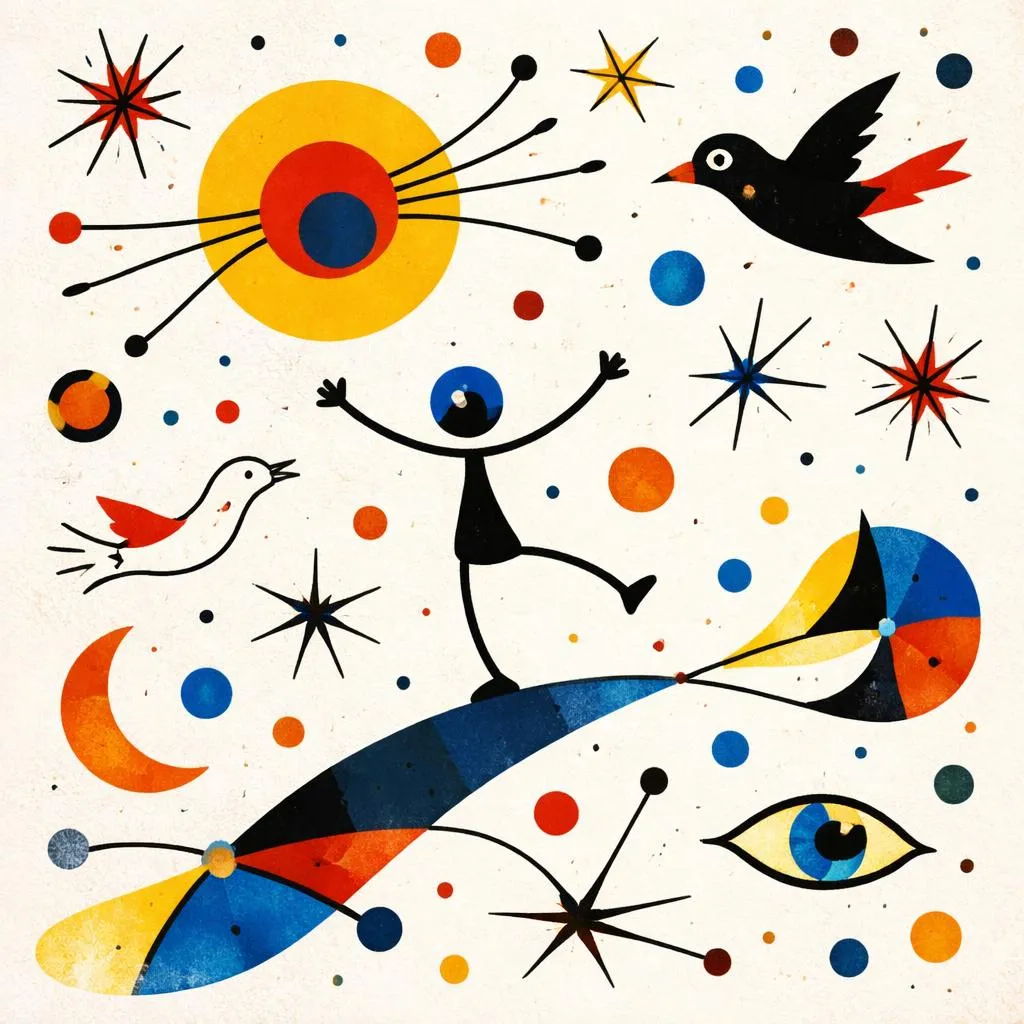

Have you ever seen a painting that looks like a child's drawing? There are stick figures. There are stars. There is a bird floating in a blue sky. But the painting is in a museum. It is worth millions. That is a Joan Miró painting. This Celebrity Story: Joan Miró will introduce you to an artist who painted like a child on purpose. He was born in Spain. He grew up on a farm. He saw stars, birds, and the moon. He painted those images over and over. But he made them simple. He made them playful. He believed that art should be free. It should not be serious. It should make you smile.
Let us meet the painter of stars and dreams. Joan Miró wanted to murder painting. By that, he meant he wanted to destroy the old rules. He wanted to make something new.
Who Is This Celebrity?
Joan Miró was a Spanish painter, sculptor, and ceramicist. He lived from 1893 to 1983. He was associated with the Surrealist movement. Surrealists explored dreams and the unconscious. But Miró was different. His art was not scary. It was joyful. He painted bright colors. He painted simple shapes. He painted stars, moons, birds, and women.
Why is he famous? He created a visual language of symbols. A black dot with a line was a bird. A star was a star. A circle was the sun. He repeated these symbols for 70 years. His art looks simple. But it is not childish. It is sophisticated simplicity. He influenced generations of artists, designers, and illustrators. His work is playful and deep at the same time.
Early Life and Childhood
Joan Miró was born in Barcelona, Spain. His father was a watchmaker. His mother was the daughter of a cabinetmaker. He grew up in a neighborhood near the city market. He saw colorful fruits and vegetables. He heard the calls of vendors. That market stayed in his memory.
His family also had a farm in the countryside. Miró spent summers there. He loved the land. He loved the sky. He loved the stars at night. Those stars would appear in his paintings forever.
He started drawing when he was very young. He was good at it. But his parents wanted him to have a practical career. They pushed him to go to business school. He hated it. He was bored. He got sick. He had a nervous breakdown.
His parents finally agreed to let him go to art school. He studied at the School of Fine Arts in Barcelona. He also studied at a private art academy. He learned traditional painting. He painted landscapes and portraits realistically.
He was not happy. He wanted to do something new.
Education and Learning Journey
Joan Miró studied at the School of Fine Arts in Barcelona. His teachers were traditional. They taught him how to draw the human figure. They taught him perspective and shading. He became a skilled realistic painter.
But he felt trapped. He looked at the art of his time. Picasso was painting strange, broken figures. The Surrealists were painting dreams. Miró wanted to join them.
He moved to Paris in 1920. Paris was the center of the art world. He met Picasso. He met other Surrealist artists. They encouraged him to be free.
He started simplifying his forms. A woman became a few lines. A bird became a dot. A star became a star. He painted with bright colors. He said he wanted to "assassinate painting." He meant he wanted to kill the old rules. He wanted to start fresh.
He also started to paint from his imagination. He did not look at models. He closed his eyes. He let his hand move. He painted what came out. That was his technique.
How Did They Become Successful?
Joan Miró became successful in the 1920s. He had his first solo exhibition in Paris in 1925. It was a success. Critics noticed his unique style. Collectors bought his work.
His most famous early painting is "The Farm." He painted it in 1921. It shows his family's farm in Spain. It is realistic but strange. Everything is painted in detail. The painting feels magical. The writer Ernest Hemingway bought it. Hemingway said it was his favorite painting.
In the 1930s, Miró started making prints and sculptures. He made mobiles. He made ceramics. He worked in many mediums. He never stopped experimenting.
During the Spanish Civil War, he painted a famous mural called "The Reaper." It was a protest against the war. The mural was destroyed during the war. But photos remain.
After World War II, he became internationally famous. Museums gave him retrospectives. He won prizes. He traveled to the United States and Japan. He was honored everywhere.
He kept working until he died at age 90. He was productive until the very end.
Big Ideas and Achievements
Joan Miró's biggest idea was that art should be free. It should not be constrained by rules. It should not be realistic. It should come from the imagination. He said, "I try to apply colors like words that shape poems, like notes that shape music."
His greatest achievement is his visual language. He created a set of symbols that anyone can understand. A star. A moon. A bird. A woman. A dog. These symbols appear in all his work. They feel universal.
Another huge achievement is his sculpture. He made whimsical sculptures of bronze and ceramic. They are in parks and museums around the world. In Chicago, there is a large Miró sculpture called "The Sun, the Moon, and One Star." Children climb on it.
He also created the Fundació Joan Miró in Barcelona. That is a museum dedicated to his work. It also supports contemporary artists. He wanted to help young artists find their way.
He influenced modern art, graphic design, and illustration. His playful style is seen in children's books, cartoons, and logos. You have seen his influence even if you do not know his name.
Challenges and Difficult Times
Joan Miró faced many challenges. First, his parents did not support his art career. He had to fight to become an artist. He had a nervous breakdown from the pressure.
Second, he was poor in Paris. He lived in a small studio. He was hungry often. He said he survived on figs and dry bread.
Third, the Spanish Civil War (1936-1939) was terrible. His home country was torn apart. He could not return. He felt exiled.
Fourth, World War II was also terrible. He lived in France under Nazi occupation. He had to flee to Spain. He was safe, but he was scared.
Fifth, he lost friends. Many artists died in the wars. Miró survived. But he carried sadness.
Through all these challenges, he kept painting. He kept making art. He said art was his reason for living.
Fun Facts About the Celebrity
Joan Miró was terrified of success. When he became famous, he felt pressure. He would hide in his studio and paint.
Another fun fact: He loved children. He said children understand his art better than adults.
He had a pet bird. The bird would sit on his shoulder while he painted.
He once said, "I want to assassinate painting." That does not mean he wanted to kill art. He wanted to kill the old, boring rules.
One more fact: He designed the logo for the Spanish tourism board. You have probably seen it. It is a drawing of a sun.
Why Is This Celebrity Important Today?
Joan Miró is important because he showed that art can be playful and serious at the same time. His paintings look like fun. But they are about deep things. The stars represent the infinite. The birds represent freedom. The women represent life.
He is also important because he inspired children. Many children look at his paintings and think, "I could do that." They are right. They could. And they should. Miró wanted everyone to make art.
His influence is everywhere. Graphic designers use his colors. Illustrators use his shapes. Cartoonists use his humor.
Parents can use his story to teach children about the value of play. Miró played with paint. He played with shapes. Play is not a waste of time. Play is how we create.
What Can Kids Learn from This Story?
Kids can learn wonderful lessons from Joan Miró. First, keep it simple. Miró did not paint complicated pictures. He painted simple shapes. A star. A dot. A line. Simple can be powerful. Do not overcomplicate your art.
Second, play. Miró played with paint. He played with shapes. He did not take himself too seriously. Art is fun. Let it be fun.
Third, develop your own symbols. Miró painted the same symbols for 70 years. A star meant star. A bird meant bird. Create your own symbols. Draw them over and over. They will become yours.
Finally, be persistent. Miró struggled for years. He was poor. He was unrecognized. He kept painting. He never gave up.
Quick Quiz or Practice Time
Let us see what you learned from this Celebrity Story: Joan Miró. Answer these questions with a parent or by yourself.
What country was Joan Miró from?
Name three symbols Miró often painted.
What writer bought Miró's painting "The Farm"?
What does Miró mean by wanting to "assassinate painting"?
How old was Miró when he died?
Here is a fun activity. Look up a Joan Miró painting online with your parent. "The Garden" is a good one. Look at the shapes. Then take a piece of paper. Draw a star. Draw a moon. Draw a bird as a simple line. Color them in bright reds, blues, and yellows. You have made a Miró.
Another activity. Close your eyes. Think of a star. Draw it without looking. Think of a bird. Draw it without looking. Do not worry about realism. Just let your hand move. That is how Miró painted.
Joan Miró lived a long, creative life. He grew up in Barcelona. He moved to Paris. He was poor. He was hungry. He painted stars and birds and women. He made them simple. He made them bright. He made them playful. He said, "I try to apply colors like words that shape poems." His poems are made of shapes. A red circle. A blue star. A black line. He painted for 70 years. He never stopped playing. His story teaches us that art does not need to be serious. It does not need to look real. It just needs to be free. That is the real lesson of this celebrity story.