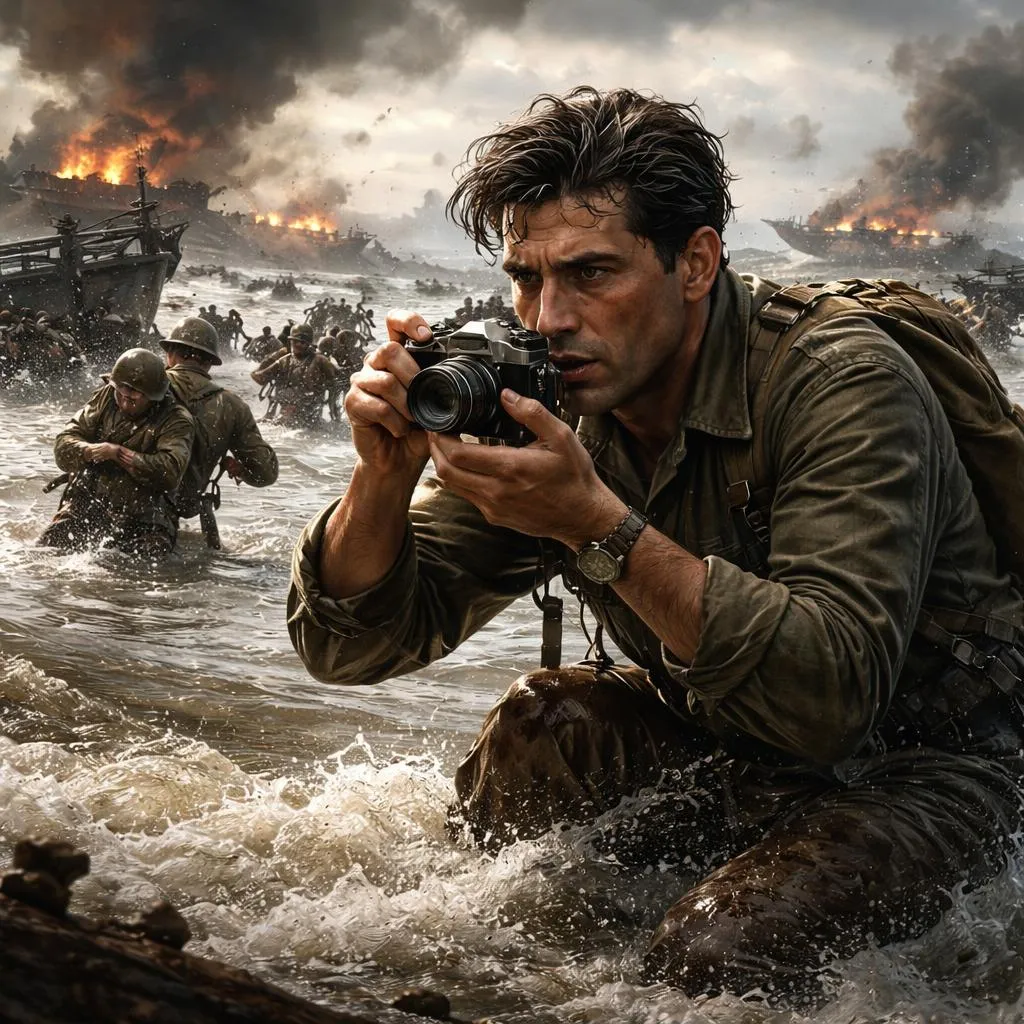

Have you ever seen a blurry black and white photo of soldiers wading through water toward a beach? The image is shaky. The men are barely visible. But you feel the fear. You feel the chaos. That is a Robert Capa photograph. This Celebrity Story: Robert Capa will introduce you to the greatest war photographer in history. He was born in Hungary. He fled the Nazis. He photographed five different wars. He landed on Omaha Beach on D-Day with the first wave of soldiers. His photos of that day are legendary. He said, "If your pictures aren't good enough, you're not close enough." He got very close. He died on the battlefield at age 40.
Let us meet the man who ran toward danger. Robert Capa believed that photographers must document the truth.
Who Is This Celebrity?
Robert Capa was a Hungarian-born war photographer. He lived from 1913 to 1954. He covered five wars: the Spanish Civil War, the Second Sino-Japanese War, World War II, the 1948 Arab-Israeli War, and the First Indochina War. He co-founded Magnum Photos, the famous photo agency.
Why is he famous? He took the most iconic photos of the Spanish Civil War. His photo "The Falling Soldier" shows a Republican soldier at the exact moment he is shot. The image is blurry and real. It made Capa famous. He also photographed the D-Day landings on Omaha Beach. He was the only photographer to go ashore with the first wave. He took 106 photos. A darkroom technician destroyed most of them by accident. Only 11 survived. They are called "The Magnificent Eleven." They are among the most famous war photos ever taken.
Early Life and Childhood
Robert Capa was born in Budapest, Hungary. His real name was Endre Friedmann. His family was Jewish. They were not rich, but they were comfortable. His father was a tailor.
He was a rebellious boy. He got into trouble. He was arrested for protesting. He was arrested for handing out leaflets. The political situation in Hungary was tense.
He wanted to be a writer. He studied at university. But he left Hungary in 1931. He was 18 years old. He moved to Berlin. He studied journalism. He got a job in a darkroom. He learned to develop film. He also learned to take photos.
He saw the rise of the Nazis. He knew he was in danger. He was a Jew. He was a leftist. He fled to Paris in 1933. He had no money. He had no job. He spoke little French.
In Paris, he met a German photographer named Gerda Taro. She became his lover and his partner. They invented a new name together. They called him "Robert Capa." It sounded American. It sounded glamorous. They thought it would sell better.
Education and Learning Journey
Robert Capa learned photography in a darkroom in Berlin. He learned the technical skills. He learned to develop film and make prints. He also learned to use a Leica camera. The Leica was small and portable. He could carry it anywhere.
He learned by doing. He started taking photos of political events. He photographed a rally. He photographed a protest. He began to sell his photos to magazines.
His big break came in 1936. The Spanish Civil War broke out. He and Gerda Taro traveled to Spain. They photographed the war.
He took "The Falling Soldier" in September 1936. The photo shows a soldier just as he is hit by a bullet. The man falls backward. His arms are outstretched. The photo is blurred. It is real. It is devastating.
The photo was published around the world. It became a symbol of the war. Robert Capa became famous.
Gerda Taro was killed in 1937. She was run over by a tank. She was 26 years old. Capa was devastated. He never got over her death. He kept her photo in his wallet for the rest of his life.
How Did They Become Successful?
Robert Capa became successful through courage and luck. He went where the fighting was. He got close. Very close.
In 1938, he went to China to photograph the Japanese invasion. He took powerful images of civilians suffering.
When World War II broke out, he was in New York. He had fled Europe. He became a photographer for Life magazine. Life was the most important photo magazine in America.
He photographed the war in North Africa and Italy. He landed on Omaha Beach on D-Day, June 6, 1944. He was with the first wave of American soldiers. He waded through the water. Bullets flew past him. He took 106 photos. He shipped the film to London.
A darkroom technician was too eager. He dried the film too quickly. The emulsion melted. The images were destroyed. Only 11 frames survived. They are blurry. They are shaky. They are perfect. They capture the chaos and terror of D-Day.
After the war, he co-founded Magnum Photos in 1947. The agency allowed photographers to own their own work. It became the most famous photo agency in the world.
In 1954, he went to cover the First Indochina War. He was in Vietnam. He went with a French regiment. He walked ahead of the soldiers. He stepped on a landmine. He was killed instantly. He was 40 years old.
Big Ideas and Achievements
Robert Capa's biggest idea was "Get closer." He said, "If your pictures aren't good enough, you're not close enough." He lived by that rule. He got as close as possible to the action.
His greatest achievement is "The Magnificent Eleven." Those 11 photos of D-Day are some of the most important images of the 20th century. They are blurry. They are shaky. They are real. You can almost smell the smoke and hear the gunfire.
Another huge achievement is "The Falling Soldier." That photo has been debated for years. Is it real? Or is it staged? Most experts believe it is real. It captures the exact moment of death. No one had done that before.
He also co-founded Magnum Photos. Magnum allowed photographers to tell their own stories. It changed photojournalism. Today, Magnum is still the gold standard.
He also mentored young photographers. He was generous. He helped others.
Challenges and Difficult Times
Robert Capa faced terrible challenges. First, he was a Jew in Nazi Europe. He had to flee for his life.
Second, his partner Gerda Taro was killed. He blamed himself. He never recovered.
Third, most of his D-Day photos were destroyed. That was a disaster. He could have been angry. He was not. He moved on.
Fourth, he was constantly in danger. He was shot at. He was bombed. He survived. Until he did not.
Fifth, he had a gambling problem. He lost money. He borrowed money. He always managed to pay it back.
Fun Facts About the Celebrity
Robert Capa hated being called a war photographer. He said he was a photographer. War was just his subject.
Another fun fact: He was friends with Ernest Hemingway. Hemingway was a famous writer. They drank together.
He loved to play poker. He gambled constantly.
He wore expensive suits. He looked like a movie star.
One more fact: His brother, Cornell Capa, was also a famous photographer. Cornell founded the International Center of Photography in New York.
Why Is This Celebrity Important Today?
Robert Capa is important because he showed the reality of war. Before him, war photography was often staged. He showed the chaos. He showed the fear. He showed the death.
He is also important because he inspired generations of photographers. His motto "Get closer" is still taught. Magnum Photos is still operating.
His photos are in museums. They are in books. They are in our memories.
Parents can use his story to teach children about courage. Capa was afraid. He went anyway.
What Can Kids Learn from This Story?
Kids can learn powerful lessons from Robert Capa. First, get close. Capa got close to the action. In your own life, get close to what matters. Get close to your friends. Get close to your work. Do not stand back.
Second, be brave. Capa was terrified. He went anyway. Courage is not the absence of fear. It is acting despite fear.
Third, tell the truth. Capa did not stage his photos. He told the truth about war. Tell the truth in your art. Do not pretend.
Finally, live fully. Capa died at 40. He lived more in those 40 years than most people do in 80. Make every day count.
Quick Quiz or Practice Time
Let us see what you learned from this Celebrity Story: Robert Capa. Answer these questions with a parent or by yourself.
What is Robert Capa's most famous motto?
What famous battle did Capa photograph on June 6, 1944?
How many of Capa's D-Day photos survived?
What photo agency did Capa co-found?
How did Capa die?
Here is a fun activity for older children with parental guidance. Look up Robert Capa's "The Magnificent Eleven" online with your parent. Look at the blurry images. Imagine you were there. Write a short paragraph about what you think the soldiers felt.
Another activity. Practice getting closer. Take a photo of a friend from across the room. Then take a photo from three feet away. Which is better? Capa would say the closer one. Try it.
Robert Capa was born in Hungary. He fled the Nazis. He fell in love with Gerda Taro. She died. He kept her photo in his wallet. He photographed the Spanish Civil War. He captured a soldier falling. He landed on Omaha Beach. He took 106 photos. Only 11 survived. They are blurry. They are perfect. He co-founded Magnum. He said "Get closer." He stepped on a landmine in Vietnam. He died at 40. He lived a thousand lives. His story teaches us to be brave. To get close. To tell the truth. That is the real lesson of this celebrity story. Note: Capa's photos of war and death are intense. Please preview before sharing with younger children. Focus on his bravery and his motto "Get closer" for younger audiences.